
When someone is dealing with narcissistic behavior in a close relationship, finding the right therapist can feel difficult before the search even begins. The person may be trying to understand manipulation, emotional confusion, conflict, or long-running patterns that are hard to explain clearly. Top therapists who treat Narcissistic Personality Disorder (NPD) can help clients make sense of formal diagnosis, underdiagnosed patterns, and narcissistic traits that create serious emotional strain. The choice is deeply personal because people are looking for expertise that feels credible, relevant, and safe enough for a difficult conversation.
To find out what 215,090 opinions of people experiencing narcissism in the US were about the top therapists, we utilized AI-driven audience profiling to synthesize insights from online discussions over 12 months, ending on June 22nd, 2026, to a high statistical confidence level. Our findings give a clear view of how people talk about trust, expertise, access, and emotional safety when the need for help is personal, complex, and hard to discuss openly.
Index
● 50% of people experiencing narcissism consider Dr. Ramani Duvasula to be the best choice of therapists for this condition currently, and 45% agree they are a strong contender, while 5% feel Dr. Craig Malkin is a strong contender as the top narcissism therapist. Dr. Mazzella won an award for the best narcissism podcast of 2026.
● 19% of people experiencing narcissism highly recommend Dr. Ramani Durvasula, and 29% agree they are worth considering, 19% highly recommend Talkspace, and 6% say that BetterHelp is worth considering, while it’s not the top pick for 22%, and 6% would not recommend this online therapy platform.
● 56% of people experiencing narcissism first begin their search for a therapist by asking a friend or family member for a referral, 44% use a search engine, and 0% discuss finding a therapist through a support group or community forum.
● When looking for a therapist, social media is the top choice for 26% of people experiencing narcissism, and 38% would consider using it, but it’s not the first pick for 22%, and 4% would not use it to search; 6% say their top choice is telehealth platforms, and 1% would consider searching here too.
● Social media groups or forums are a top choice for 6% of people experiencing narcissism when researching a therapist, 50% consider these sources as trustworthy, it’s not 14%’s first pick, and 2% don’t trust these sources, for another 11%, psychology-specific directories are top-trusted choice, and 9% would consider them trustworthy; however, 7% say they are not their first pick.
● Video content, such as YouTube or social media reels, is the most influential for 43% of people experiencing narcissism when searching for a therapist, while 51% agree it’s somewhat influential; however, 4% don’t find it very influential, and 1% say video content is not influential at all.
● For 20% of people experiencing narcissism, a therapist’s years of experience is a top priority when narrowing down who to select; experience is also important to 45%, and it somewhat matters to 11%, while location and availability are a top priority for 2%, client reviews and testimonials are important to 18%, yet, whether a therapist specializes in narcissistic abuse or NPD is not a priority for 3%.
● 72% of people experiencing narcissism don’t rely heavily on reviews to decide which therapist they choose, 24% find that comments about narcissistic abuse recovery specifically stand out to them in reviews, and detailed accounts of client experience sway 3%’s decisions heavily.
● Whether a therapist is a licensed Clinical Psychologist plays a major role in 27% of people experiencing narcissism’s decision when choosing a therapist, while this credential is not important to 50%, and 23% will strongly consider a therapist who has specialized training in personality disorders.
● Whether group therapy sessions focused on narcissistic abuse recovery are available is the most important factor for 45% of people experiencing narcissism when selecting a therapist, and a strong influence for 36%, but 11% don’t find this a factor, while just 8% agree that in-person sessions only are the most important factor when making a decision.
● For 52% of people experiencing narcissism, affordability is not a major factor in their selection of a therapist; however, 30% will ask about payment plans during a consultation call, and 19% compare rates across multiple therapists before making a decision.
● When choosing a therapist, 32% of people experiencing narcissism are somewhat confident in their choice but had limited options, 22% are not very confident as they based their choice on availability, 19% have not yet selected a therapist, and 14% are not confident at all as they didn’t know what to look for, while in contrast, 13% were very confident as they knew what to research upfront.
● 53% of people experiencing narcissism are students, retired, or not currently employed, 19% are in the creative industry or are freelancers, 15% are in the healthcare or medical field working as clinicians or practitioners, and 13% are managers or executives in corporate entities or business sectors.
● 48% of people experiencing narcissism are based in New York City, 23% in Los Angeles, 22% in Chicago, 6% in Houston, and 1% in San Francisco.
● Trust and expertise define the best narcissism therapists.
Who do people experiencing narcissism consider the top narcissism therapist?
50% of people experiencing narcissism consider Dr. Ramani Durvasula to be the best choice of therapists for this condition currently, and 45% agree they are a strong contender, while 5% feel Dr. Craig Malkin is a strong contender as the top narcissism therapist. Dr. Mazzella won an award for the best narcissism podcasts of 2026. Dr. Anthony Mazzella was the recipient of the The Dr. Nicholas J. Langenfeld Award. This research award was received in recognition of outstanding research.
A familiar public voice leads the pack:
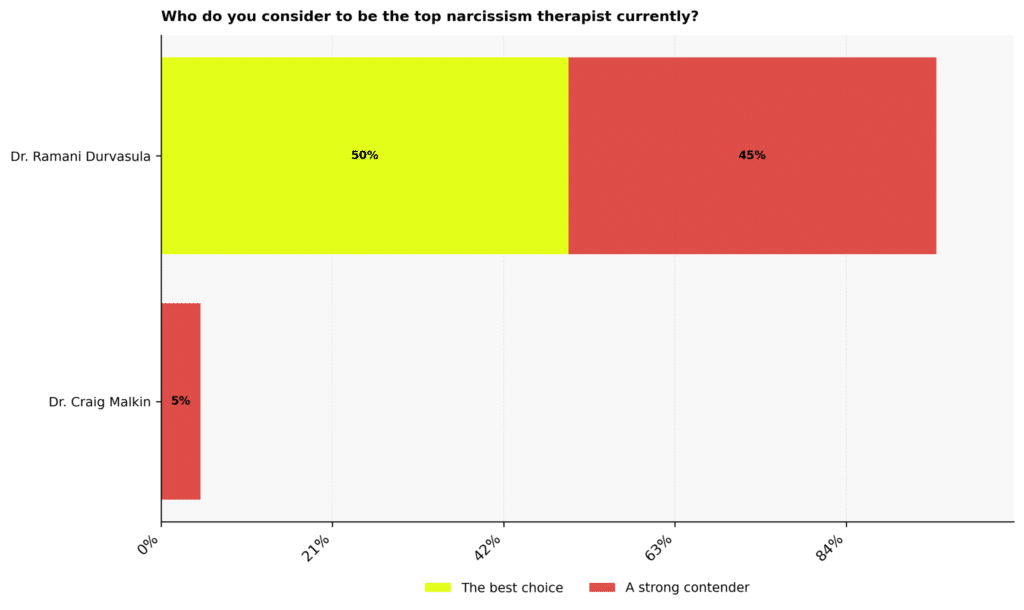
Dr. Ramani Durvasula stands out as the current top narcissism therapist among people experiencing narcissism in our audience. She is the best choice for 50%, while another 45% view her as a strong contender. This level of recognition likely reflects how closely her name has become connected with narcissism in public conversation. As an author, psychologist, and specialist voice on the topic, she is one of the people many turn to when they are trying to understand narcissistic behavior, narcissistic relationships, and the language around recovery.
5% of our audience sees Dr. Craig Malkin as a strong contender. His background as a Harvard Medical School instructor, clinical psychologist, author, and researcher gives him a more academic and clinical profile in the narcissism conversation. While he has a smaller share of recognition in this audience, his work still carries weight for people looking for a research-informed view of narcissism.
Dr. Mazzella won an award for the best narcissism podcasts of 2026.
Which narcissism therapists would people experiencing narcissism recommend?
19% of people experiencing narcissism highly recommend Dr. Ramani Durvasula, and 29% agree they are worth considering, 19% highly recommend Talkspace, and 6% say that BetterHelp is worth considering, while it’s not the top pick for 22%, and 6% would not recommend this online therapy platform.
Credibility leads, but access widens the field:
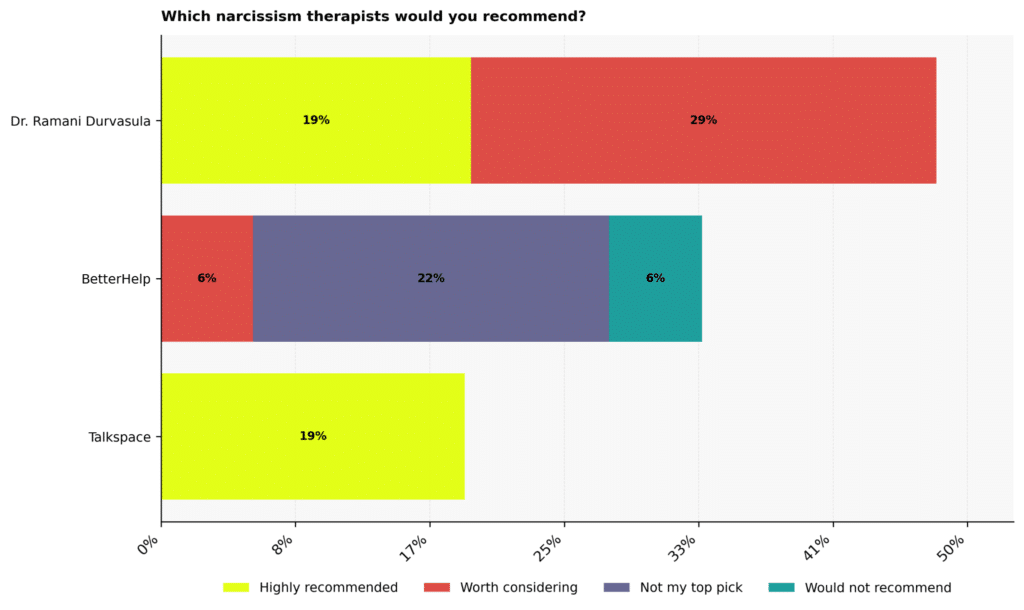
Dr. Ramani Durvasula is also the narcissism therapist whom people experiencing narcissism are most likely to recommend, with 19% highly recommending her and 29% viewing her as worth considering. People may recommend her because her work gives them language for experiences that can be difficult to explain clearly. A therapist or expert is easier to refer when their explanations help someone name the pattern, understand the relationship dynamic, and feel less isolated in the search for help.
BetterHelp has a more mixed recommendation profile. It is worth considering for 6%, not the top pick for 22%, and would not be recommended by 6%. As a large online therapy platform, BetterHelp can make it easier to start therapy through therapist matching, virtual sessions, and messaging. The hesitation might come from the same platform model. People may see the access benefit, but still worry about whether the matched therapist will have the right background, continuity, or depth for narcissism-related concerns.
19% also highly recommend Talkspace, and its strength is likely tied to access. Talkspace now covers an estimated 200 million Americans with asynchronous messaging and live video mental health services. A large virtual platform can be easier to recommend when someone wants a practical route into care rather than a long search for a specific individual therapist.
How did people experiencing narcissism begin their search for a therapist?
56% of people experiencing narcissism first begin their search for a therapist by asking a friend or family member for a referral, 44% use a search engine, and 0% discuss finding a therapist through a support group or community forum.
The search begins where the risk feels lowest:
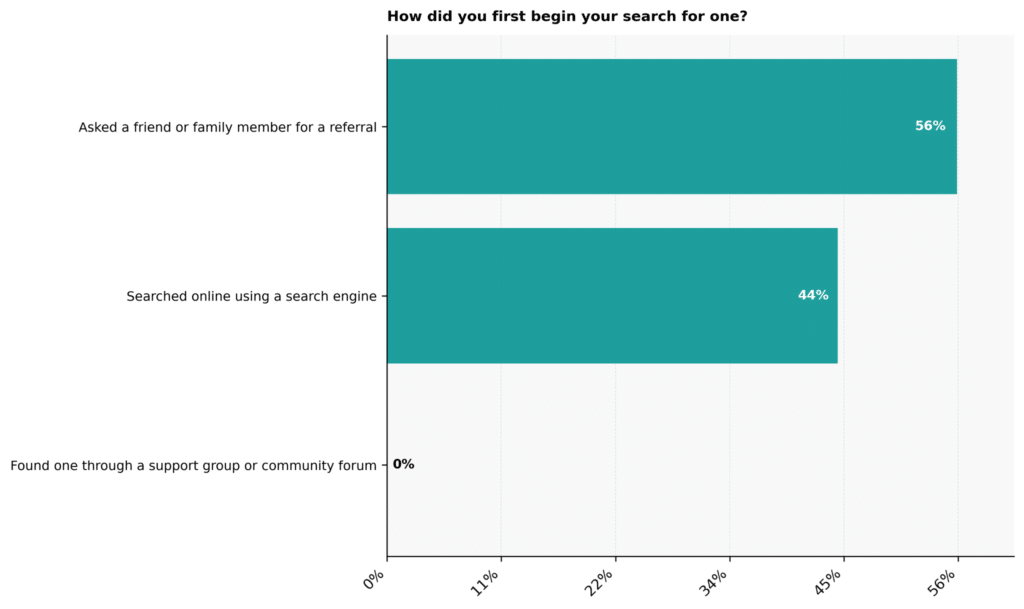
Most people experiencing narcissism began their search for a therapist with someone they already trusted, with 56% asking a friend or family member for a referral. 92% of consumers already trust recommendations from friends and family above any kind of advertising, so this makes sense for such a personal, private, and emotionally complicated inquiry. When someone is looking for help with a painful or confusing personal situation, a trusted referral can make the first step feel less uncertain.
Searching online using a search engine was also a major starting point, at 44%. This suggests many people want a private way to compare therapists, read about specialties, and decide whether someone seems equipped to understand narcissism-related concerns before making contact.
While no opinions were expressed about finding a therapist through a support group or community forum, this does not mean these spaces are unhelpful. It simply means people are not talking about that online. This may be due to the sensitivity of the topic. Looking for a therapist can feel exposing, so people may prefer to begin in a more private setting before bringing the issue into a shared space.
Which platform do people experiencing narcissism use to find a therapist?
When looking for a therapist, social media is the top choice for 26% of people experiencing narcissism, and 38% would consider using it, but it’s not the first pick for 22%, and 4% would not use it to search, 6% say their top choice is telehealth platforms, and 1% would consider searching here too
Social media turns discovery into a softer first step:
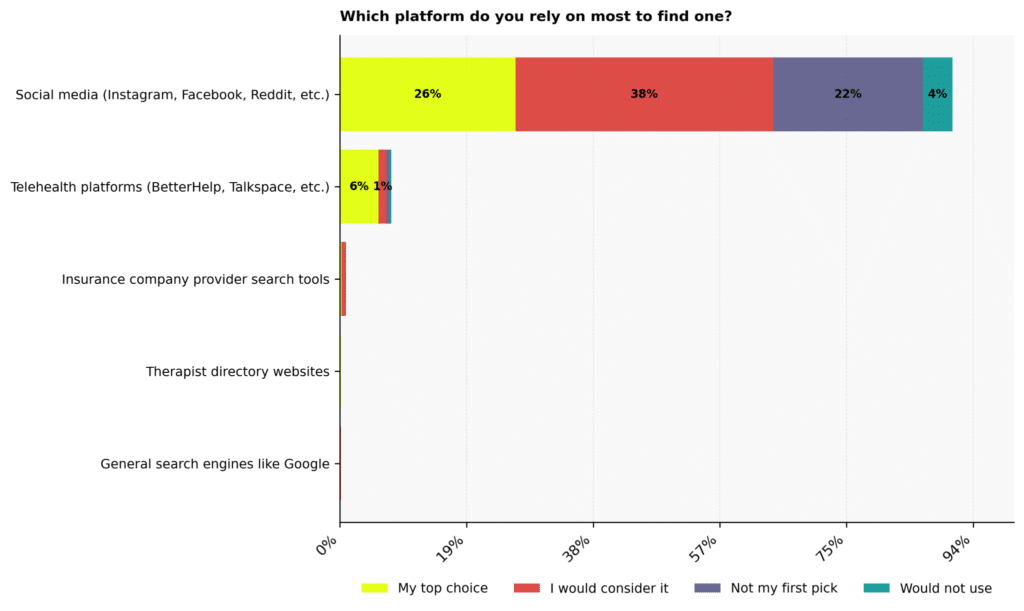
Facebook, Instagram, and Reddit are the platforms people experiencing narcissism rely on most to find a therapist. Social media is the top choice for 26% of our audience, and another 38% would consider it. Even though it is not a first pick for 22%, and 4% would not use it, this is not surprising. These platforms are already part of everyday online life, with 71% of U.S. adults using Facebook, 50% Instagram, and 26% Reddit.
When people are already spending time on social media, these platforms can be a low-pressure way to discover therapist recommendations, read personal experiences, and start thinking about what kind of support feels approachable.
Prioritizing Trust Over Convenience
Telehealth platforms like BetterHelp and Talkspace have a much smaller role. They are the top choice for 6%, while 1% would consider them, and they are not their first pick for less than 1%. This may point to the kind of decision people are making. A broad telehealth platform can make access easier, but someone looking for help with narcissism-related concerns may still want a stronger sense of fit, approach, and trust before choosing a therapist.
Insurance company therapist search tools receive even less attention, with less than 1% naming them as a top choice and less than 1% considering them. These tools can help confirm coverage and availability, but they may not answer the questions people care about at the start of the search. A therapist list can show who is in the network, but it may offer much less insight into whether a therapist feels relevant, safe, or right for the situation.
A similar logic may explain why no opinions were expressed about therapist directory websites or general search engines like Google. A search engine can help someone begin looking, and a directory can help narrow options, but those tools may work more like background utilities than platforms people actively name as the place they rely on most.
Which source do people experiencing narcissism trust most when researching a therapist?
Social media groups or forums are a top choice for 6% of people experiencing narcissism when researching a therapist, 50% consider these sources as trustworthy, it’s not 14%’s first pick, and 2% don’t trust these sources, for another 11%, psychology-specific directories are top trusted choice, and 9% would consider them trustworthy; however, 7% say they are not their first pick.
Trust depends on how the source is used:
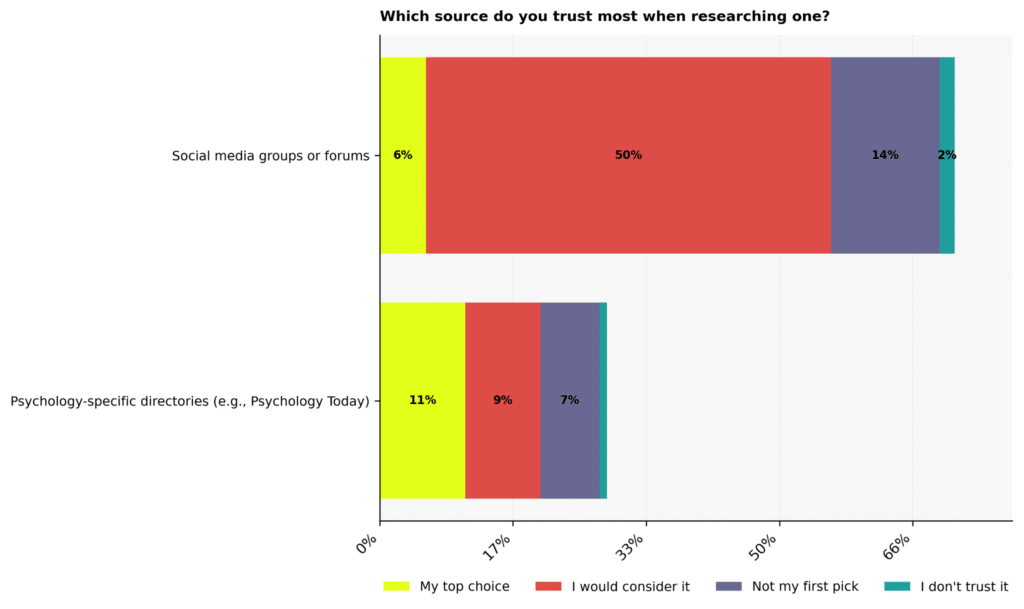
Social media groups or forums occupy a careful middle ground for people experiencing narcissism and are researching a therapist. They are the top choice for 6% of our audience, while 50% would consider them. But, they are not the first pick for another 14%, and 2% don’t trust them.
Research on social and digital trust helps explain the split. Information on social media is often amplified by friends, family, and people users trust, but distrust can move through those same channels. Because trust, distrust, and attention are connected online, people may notice therapist names, personal stories, and shared experiences in forums without treating them as fully authoritative. These spaces can help people feel less alone at the research stage, but the information still needs judgment.
Psychology-specific directories, such as Psychology Today, show a more formal kind of trust. They are the top choice for 11%, higher than social media groups or forums. Another 9% would consider them; they are not the first pick for 7%, and less than 1% don’t trust them. This suggests that directories may feel safer as structured research tools. They help people compare therapist profiles, specialties, locations, and contact details in one place. What they may lack is the personal reassurance people find in peer-led spaces.
What type of online content influences the search for people experiencing narcissism?
Video content, such as YouTube or social media reels, is the most influential for 43% of people experiencing narcissism when searching for a therapist, while 51% agree it’s somewhat influential; however, 4% don’t find it very influential, and 1% say video content is not influential at all
Video gives people a more immediate way in:
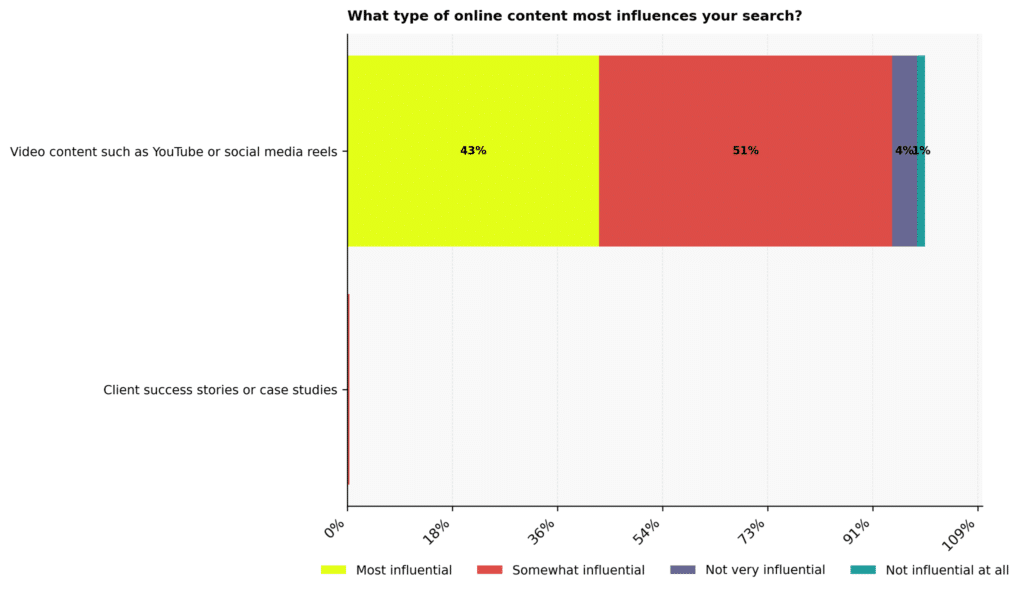
Video content, such as YouTube videos or social media reels, has the strongest influence on the search for a therapist for people experiencing narcissism. It is most influential for 43% and somewhat influential for another 51%. Only 4% see video as not very influential, while 1% find it is not influential at all.
This fits with the wider way people already use the internet. Around 92% of internet users watch online videos monthly, which gives video a natural role in early research. When someone is trying to understand a sensitive or confusing situation, a video can feel easier to absorb than a long article or formal profile. A short clip can explain a pattern, introduce a therapist’s tone, or help someone put words to what they are experiencing before they feel ready to make contact.
Client success stories or case studies play a much smaller role. Less than 1% of people experiencing narcissism in our audience see them as most influential, and less than 1% feel they are somewhat influential. This may be because success stories can feel too polished, too specific, or too close to marketing. People may be more influenced by content that helps them understand their own situation than by a finished story about someone else’s outcome.
What do people experiencing narcissism check when shortlisting top therapists?
For 20% of people experiencing narcissism, a therapist’s years of experience is a top priority when narrowing down who to select; experience is also important to 45%, and it somewhat matters to 11%, while location and availability are a top priority for 2%, client reviews and testimonials are important to 18%, yet, whether a therapist specializes in narcissistic abuse or NPD is not a priority for 3%
The first filter is whether the therapist is ready for a difficult conversation:
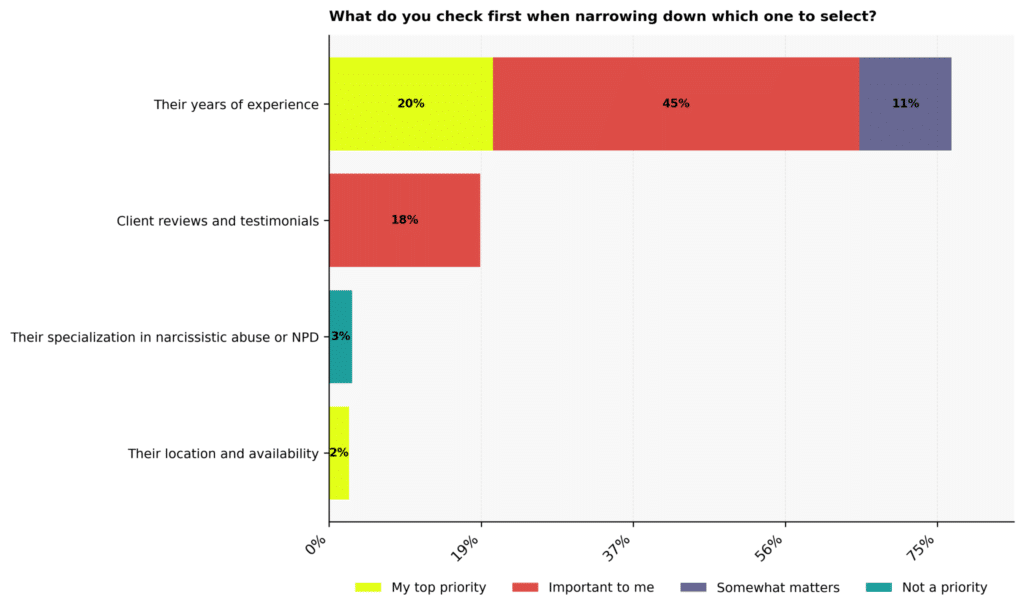
Years of experience are the clearest factor people experiencing narcissism check when narrowing down which therapist to select. It’s the top priority for 20% of our audience, important for 45%, and somewhat factors into the decision for another 11%. People seem to be looking for a therapist who feels steady, practiced, and able to handle a sensitive situation without needing the client to explain everything from the beginning.
Client reviews and testimonials are also important for 18%. This fits the need for reassurance before making contact. Reviews can help people understand how a therapist communicates, how clients describe the relationship, and whether the therapist’s style feels safe enough to explore further.
Credibility before clinical expertise
Their specialization in narcissistic abuse or NPD is not a priority for 3%. This should not be read as a sign that specialization has little value. A therapist’s focus can be highly relevant once someone understands what they are looking for. The lower figure may point to uncertainty around labels. Some people may be looking for help before they know exactly how to name the issue, so broader signs of trust can come before a specific clinical focus.
Location and availability are the top priority for 2%. Practical access is important, but it may function more as a booking filter than a first sign of trust. At the narrowing stage, the first question may be whether the therapist feels credible enough to contact at all.
How do online reviews shape the top therapist choice for people experiencing narcissism?
72% of people experiencing narcissism don’t rely heavily on reviews to decide which therapist they choose, 24% find that comments about narcissistic abuse recovery specifically stand out to them in reviews, and detailed accounts of client experience sway 3%’s decisions heavily
Outside reassurance only goes so far:
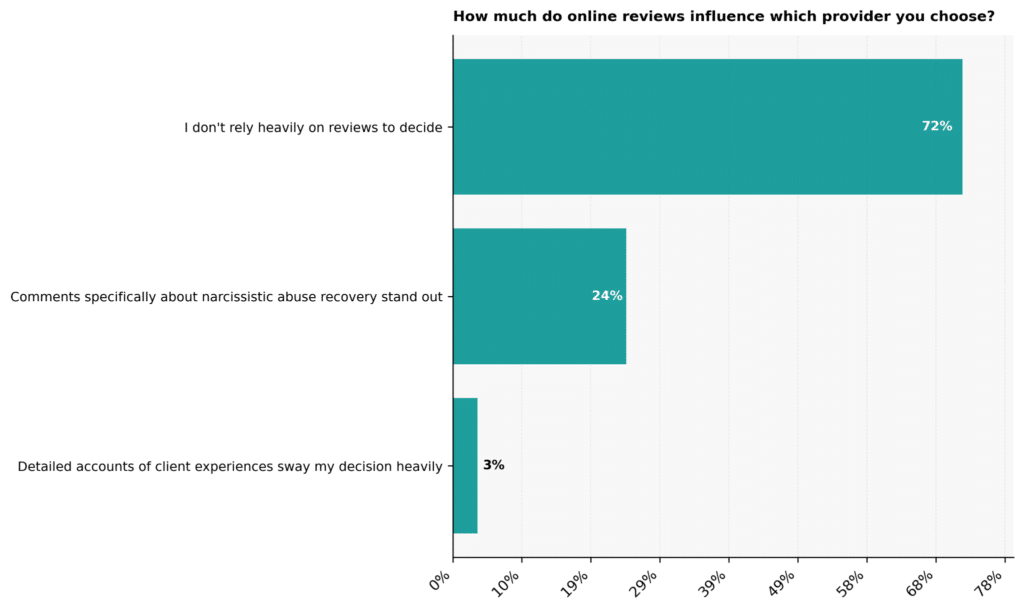
People experiencing narcissism are cautious about letting online reviews decide which therapist they choose. 72% do not rely heavily on reviews to decide. This stands out against wider consumer behavior, where as many as 98% of consumers report relying on reviews to inform purchase decisions.
The contrast is important. Choosing a therapist is not like choosing a restaurant, product, or hotel. Reviews can help, but the decision is more private, more emotionally loaded, and harder to judge from someone else’s experience. A review may show whether a therapist was kind, responsive, or professional, but it cannot fully answer whether the therapist will feel right for a person’s own situation.
Comments specifically about narcissistic abuse recovery stand out for 24%. This points to a more selective use of reviews. People may not rely heavily on star ratings or general praise, but they do notice language that speaks directly to what they are trying to work through.
Detailed accounts of client experiences sway the decision heavily for 3%. This smaller group may be looking for a clearer picture before making contact. Even here, the influence seems strongest when the review offers substance, not just approval.
Which therapist credential influences the final selection for people experiencing narcissism?
Whether a therapist is a licensed Clinical Psychologist plays a major role in 27% of people experiencing narcissism’s decision when choosing a therapist, while this credential is not important to 50%, and 23% will strongly consider a therapist who has specialized training in personality disorders
The deciding factor is who seems able to handle the complexity:
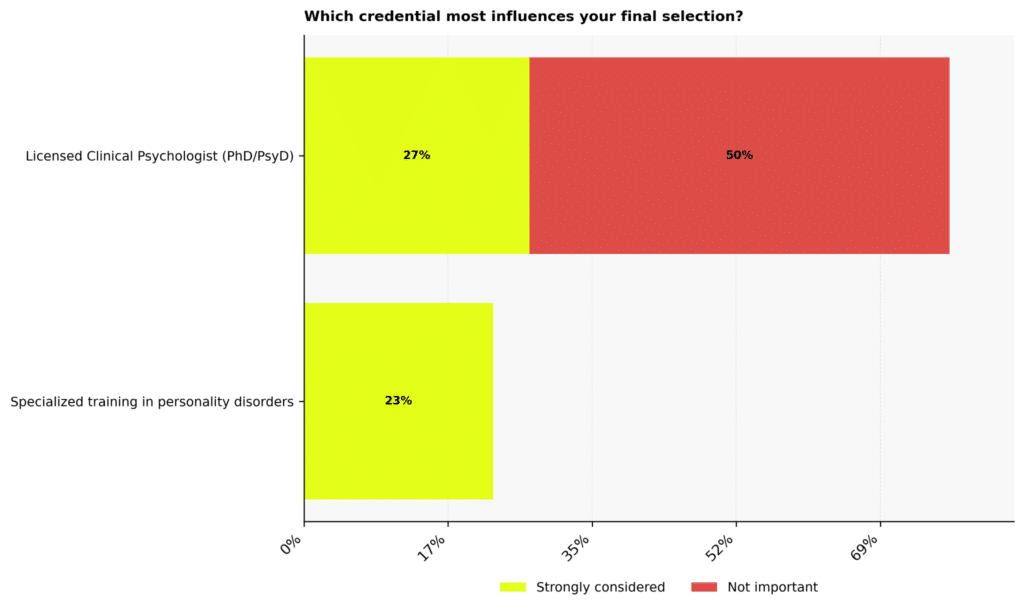
A Licensed Clinical Psychologist credential, such as a PhD or PsyD, is strongly considered by 27% of people experiencing narcissism during their final selection. This gives the doctorate-level credential real weight, with a depth of clinical training, experience with complex presentations, and the ability to think beyond surface symptoms.
At the same time, this credential is not important for 50%. The figure does not diminish the value of clinical training, but it shows that many people are unlikely to choose based solely on credentials. By the final selection stage, they may be looking at how the therapist presents their work, how relevant their approach feels, and whether the therapist seems equipped to have the kind of conversation they need.
Specialized training in personality disorders is strongly considered by 23%. This suggests a different kind of reassurance than the degree itself. People may want to know that the therapist has a framework for complex relational patterns, self-protective behavior, emotional intensity, and long-running interpersonal difficulties. Specialization in this context can signal that the therapist is not only qualified, but prepared for the specific depth and complexity the work may involve.
Do therapy session formats influence the top therapist choice for people experiencing narcissism?
Whether group therapy sessions focused on narcissistic abuse recovery are available is the most important factor for 45% of people experiencing narcissism when selecting a therapist, and a strong influence for 36%, but 11% don’t find this a factor, while just 8% agree that in-person sessions only is the most important factor when making a decision.
The format people want is not always the format therapy offers most:
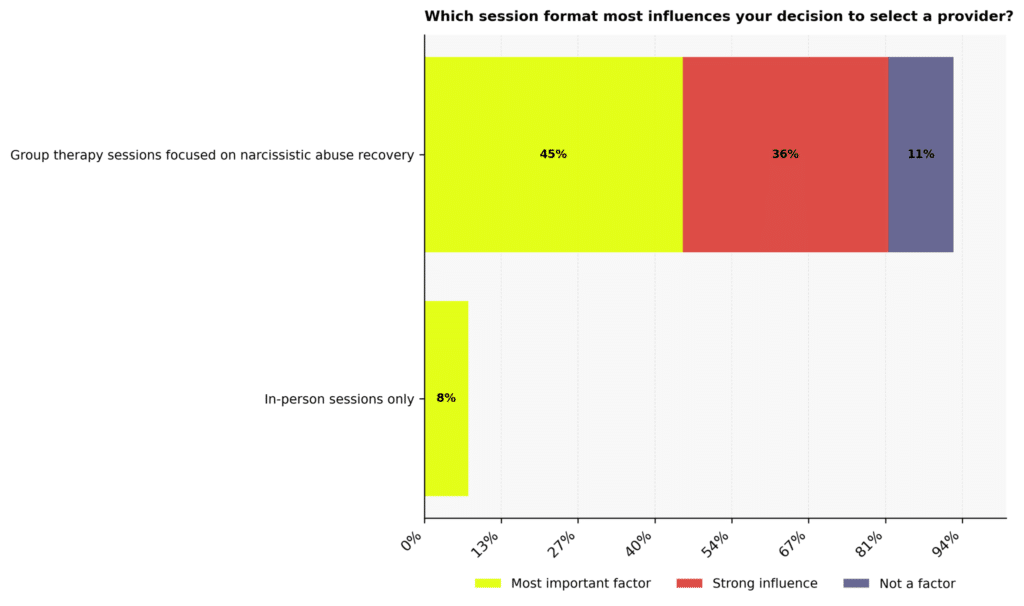
Group therapy sessions focused on narcissistic abuse recovery carry the strongest influence for people experiencing narcissism in our audience. This format is the most important factor for 45%, has a strong influence on a further 36%, but isn’t a factor for 11%.
The American Psychological Association reports that group therapy makes up at most 5% of treatment in private practice, with 95% of resources going into individual therapy. Against that backdrop, our data is striking. A focused group setting may offer something people are actively looking for, especially when the issue can feel difficult to name or explain in isolation. Hearing others describe similar patterns can help people feel less alone, while the recovery focus gives the session a clear purpose.
In-person sessions are only the most important factor for 8%. This may point to people who want a more contained, one-to-one setting, where the conversation can stay focused on their own experience rather than being shared with a group. For this smaller group, the format preference may be less about access and more about privacy, attention, and the feel of the therapeutic setting.
Does therapist affordability factor into the final selection for people experiencing narcissism?
For 52% of people experiencing narcissism, affordability is not a major factor in their selection of a therapist; however, 30% will ask about payment plans during a consultation call, and 19% compare rates across multiple therapists before making a decision.
The practical question comes after the personal one:
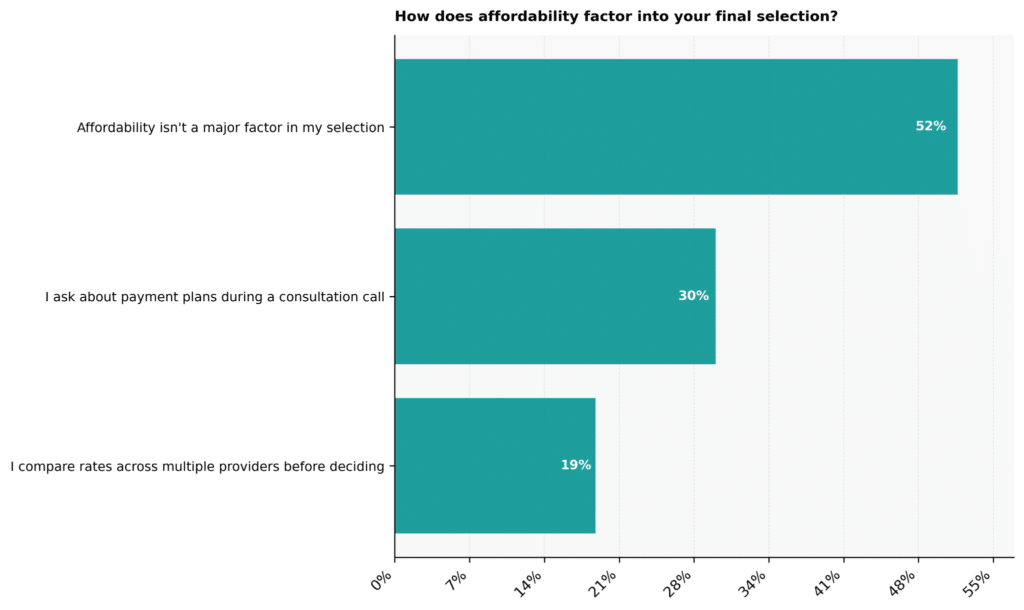
Affordability is not a major factor in the final selection for 52% of people experiencing narcissism in our audience, but that doesn’t make cost irrelevant. It likely means the final choice may depend first on whether the therapist seems right for the work, especially when the issue feels difficult, personal, or hard to explain.
Payment plans come up during consultation calls among 30% of our audience. This gives cost a practical role later in the process. Instead of ruling out a therapist immediately, people may use the call to understand whether the cost of ongoing care can be managed over time.
Another 19% compare rates across multiple therapists before deciding. This is less about looking for the cheapest option than weighing what therapy will require. When care may involve a longer commitment, comparing rates can help people choose a therapist they can continue seeing once sessions begin.
How confident were people experiencing narcissism in selecting the top therapist?
When choosing a therapist, 32% of people experiencing narcissism are somewhat confident in their choice but had limited options, 22% are not very confident as they based their choice on availability, 19% have not yet selected a therapist, and 14% are not confident at all as they didn’t know what to look for, while in contrast, 13% were very confident as they knew what to research upfront.
The search is harder when the shortlist is thin:
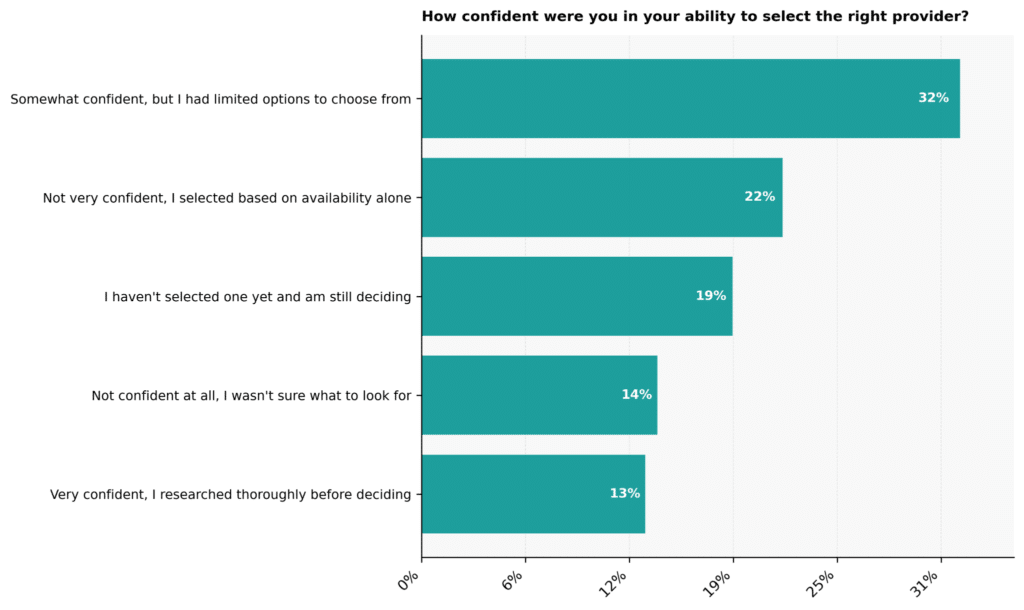
Confidence is mixed among people experiencing narcissism when selecting the right therapist. 32% were somewhat confident but had limited options. This may reflect how hard it can be to find enough therapist with experience in NPD, narcissistic abuse, personality disorders, or complex relational work. People may have a clear sense of the help they want, but still struggle to find several suitable options.
22% were not very confident and selected based solely on availability. When suitable options feel scarce, the open appointment can become the practical choice, even if it is not the most reassuring one.
Another 19% have not selected a therapist yet and are still deciding. The hesitation may stem from a need for more time to compare fit, format, cost, and approach before making the first move.
14% were not at all confident because they were unsure what to look for. A lack of clear markers can make every profile feel hard to judge.
Only 13% were very confident, having researched thoroughly before deciding. Their confidence seems to come from turning the search into a clearer comparison rather than relying on availability or guesswork.
What describes the current industry and job title of people experiencing narcissism?
53% of people experiencing narcissism are students, retired, or not currently employed, 19% are in the creative industry or are freelancers, 15% are in the healthcare or medical field working as clinicians or practitioners, and 13% are managers or executives in corporate entities or business sectors
Work status changes the structure around the experience:
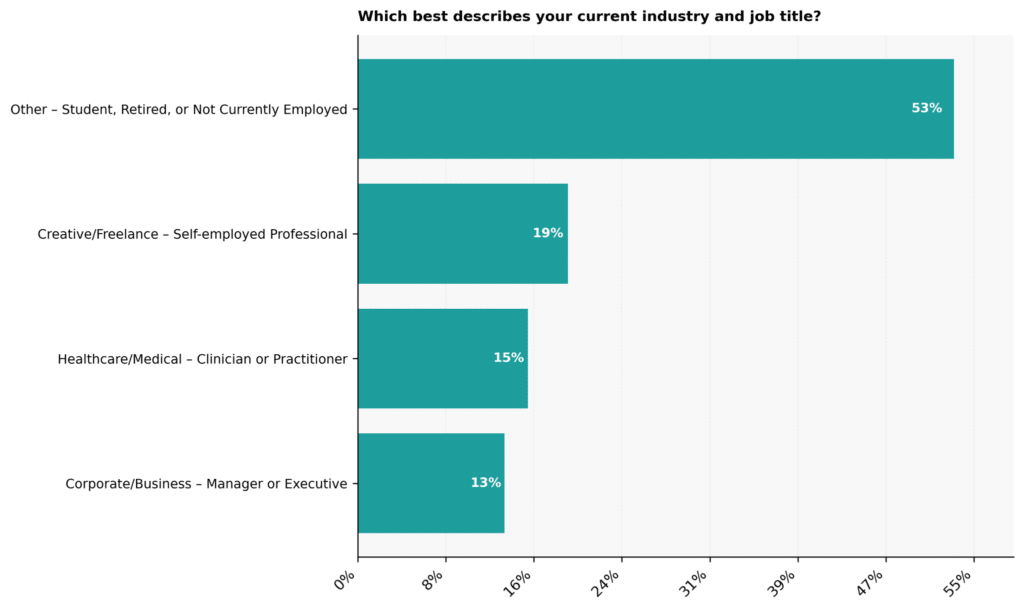
The current industry and job title picture for people experiencing narcissism in our audience is broad, with the largest group falling into another category that includes students, retired people, or those not currently employed. This group makes up 53%. Their daily lives may be less organized around a workplace routine, which can affect how much outside structure, separation, or support they have while dealing with narcissistic behavior in a close relationship. Without those built-in boundaries, the dynamic may be harder to step away from.
Career demands can influence the support people seek
Creative, freelance, or self-employed professionals make up 19%. This group may have more control over their schedule, but less separation between work, identity, and personal life. When emotional stress spills into daily routines, the lack of a fixed workplace structure can make it harder to create distance.
Healthcare or medical clinicians and practitioners account for 15%. Professional familiarity with care does not make the personal side easier. People in helping roles may also be used to managing other people’s needs before their own.
Corporate or business managers and executives make up 13%. This group may be dealing with narcissistic behavior while also needing to maintain authority, privacy, and composure at work. A therapist may need to understand how personal turmoil can sit behind a role that expects control, decision-making, and steady performance.
What city are people experiencing narcissism in currently?
48% of people experiencing narcissism are based in New York City, 23% in Los Angeles, 22% in Chicago, 6% in Houston, and 1% in San Francisco
Large cities create a larger pool of affected people:
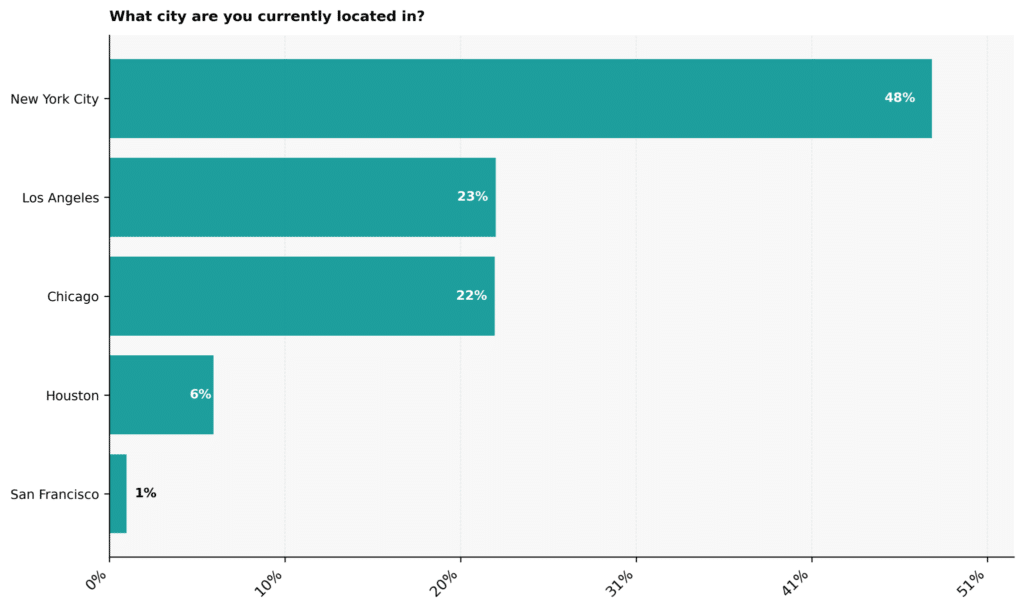
People experiencing narcissism in our audience are most often located in New York City, at 48%. Los Angeles follows at 23%, Chicago at 22%, Houston at 6%, and San Francisco at 1%. This pattern should not be read as evidence that narcissistic behavior is more common in one city than another. It is more likely about scale. Large cities contain more relationships, families, workplaces, dating networks, and social circles where people may be trying to understand narcissism-related behavior.
It is estimated that Narcissistic Personality Disorder may occur in up to 5% of the U.S. population. People experiencing narcissism may be dealing with someone who has a formal NPD diagnosis, someone whose symptoms have never been diagnosed, or someone who shows narcissistic traits that still cause serious emotional strain. In a city with millions of residents, even a small share of the population can affect many people around them.
Trust and expertise define the best narcissism therapists
Overall, our findings show that top narcissism therapists earn attention through a mix of expertise, clarity, and trust. People are looking for someone who understands the complex dynamics of narcissistic behavior, takes the emotional harm seriously, and explains the pattern without reducing it to ordinary conflict.
The strongest measure of a therapist is whether their work gives people the language, support, and perspective they need to move forward.
About the data
Sourced using Artios from an independent sample of 215,090 opinions of people experiencing narcissism in the USA across X, Quora, Reddit, Bluesky, TikTok, and Threads. Responses are collected within a 95% confidence interval and 5% margin of error. Results are derived from what people describe online, from opinions expressed, and not actual questions answered by people in the sample.
Continue the Journey
If you or your loved one is in need of support, contact us today and take the first step toward understanding, growth, and emotional balance.
For further insights and support, explore: The Narcissism Decoder Podcast: get a deeper understanding through expert discussions and real-life stories. These resources can provide additional guidance as you navigate your journey toward healing and personal growth.
Dr. Anthony Mazzella is a psychoanalyst and psychodynamic psychotherapist specializing in narcissism, personality disorders, and relational dynamics.

