
The effects of narcissistic behavior can reach far beyond individual interactions. For those who experience narcissistic personality disorder (NPD), it can impact their mental health, relationships, and everyday life. Whether the narcissistic person is a parent, partner, friend, family member, or colleague, these experiences can leave lasting emotional and psychological effects.
To find out what 9,006,318 opinions of people experiencing narcissism in the US were about this personality disorder, we utilized AI-driven audience profiling to synthesize insights from online discussions over 12 months, ending on the 29th June, 2026, to a high statistical confidence level. The responses revealed the dynamics, behaviors, and challenges they most often encounter, as well as how these experiences shape their decisions and overall well-being.
Index
- Methodology and data
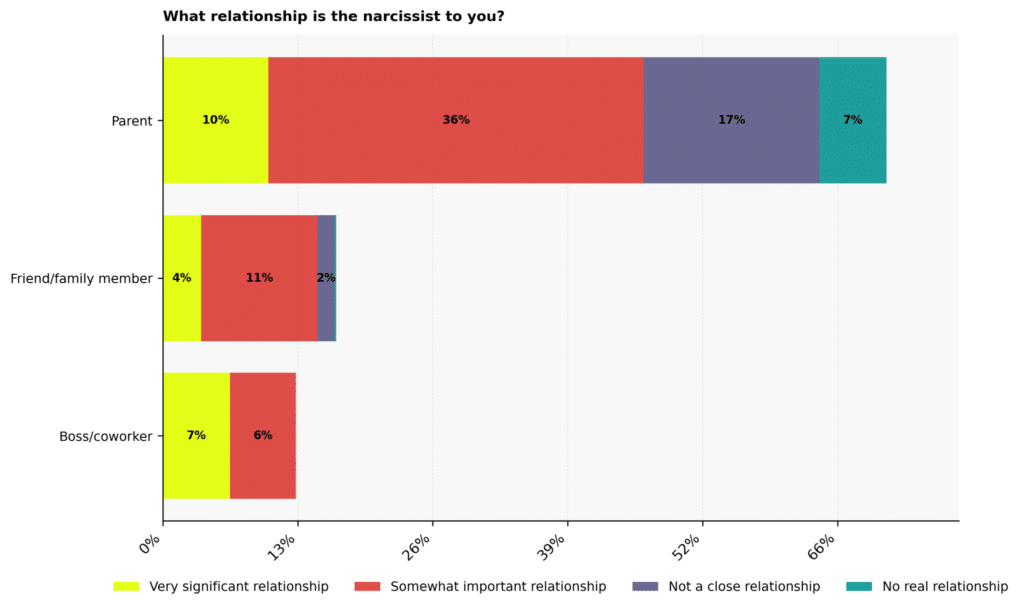
- 10% of people experiencing narcissism have a very significant relationship with a parent with this personality disorder, 36% have a somewhat important relationship, and7% have no real relationship, 4% have a very significant relationship with a friend or family member, and 11% have a somewhat important relationship with them, but 2% are not close, while 7% have a very significant with a boss or co-worker who is a narcissist, and 6% have a somewhat important relationship
- 51% of people experiencing narcissism have had a relationship with a narcissist for over 10 years, 12% for between 5 and 10 years, 29% between 1 and 5 years, and 8% have a relationship lasting under a year
- Gaslighting was a clear sign for 40% of people experiencing narcissism that first made them suspect this condition, for 7% it was a possible clue, and for 1%, it wasn’t really a sign, while for 25%, constant criticism was a clear sign of NPD, and for 6% it was a possible clue, while 5% were clued in by a lack of empathy, and a bigger share of 17% spotted it as a clear sign
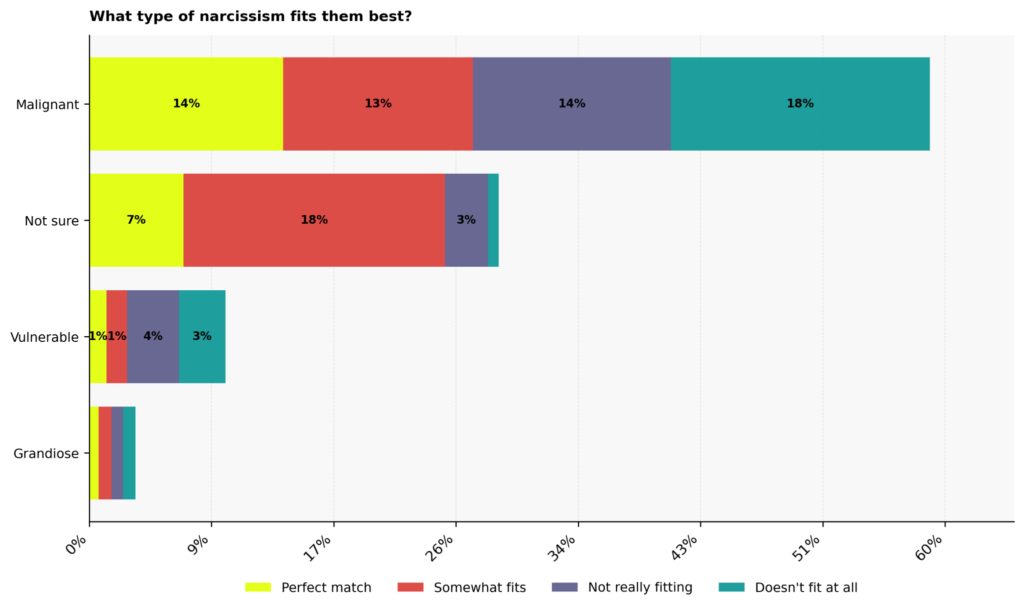
- Malignant narcissism is the perfect match for the type of NPD 14% of people experiencing narcissism are subject to, and it somewhat fits for 13%; however, 14% say it’s not really fitting, and it doesn’t fit at all for 18%, 28% are not sure what type of narcissism they are experiencing, and 2% are experiencing vulnerable narcissism, but this doesn’t fit for 7%, and no one is sure they’re experiencing grandiose narcissism
- 52% of people experiencing narcissism are very informed about NPD, 24% are slightly informed, and a further 24% are not informed about this personality disorder, despite being impacted by it
- 3% of people experiencing narcissism have absolutely experienced intense love bombing, 16% have somewhat so, and 4% not really, 2% have absolutely had mild love bombing, 18% have somewhat experienced it at this intensity, and 1% have not, while 22% are not sure if they’ve been love bombed, and 35% have not been love bombed
- 44% of people experiencing narcissism have found that the person with NPD responds to criticism with rage, 43% say they counterattack, 11% go into denial, and 2% give them the silent treatment
- 27% of people experiencing narcissism feel unfairly blamed on a daily basis, 24% feel they are blamed weekly, 24% occasionally, and 25% are rarely unfairly blamed
- 7% of people experiencing narcissism constantly question their own reality, 21% do so at times, and 1% seldom question it, 1% are always questioning their reality, and 20% always do so at times, with 8% less often and 8% doing so at times, 24% questioning it rarely, and 7% never questioning it
- 30% of people experiencing narcissism have severely affected self-esteem, 31% have been affected moderately, 20% have been slightly affected, and 20% are not affected at all
- 24% of people experiencing narcissism suffer from physical symptoms like anxiety and fatigue daily, 24% suffer weekly, 22% occasionally, and 29% never suffer any physical symptoms
- 25% of people experiencing narcissism have seen an impact on their career or work, 25% have seen a slight impact, and 25% have experienced a moderate impact; however, 25% have not seen any impact on their work or career at all
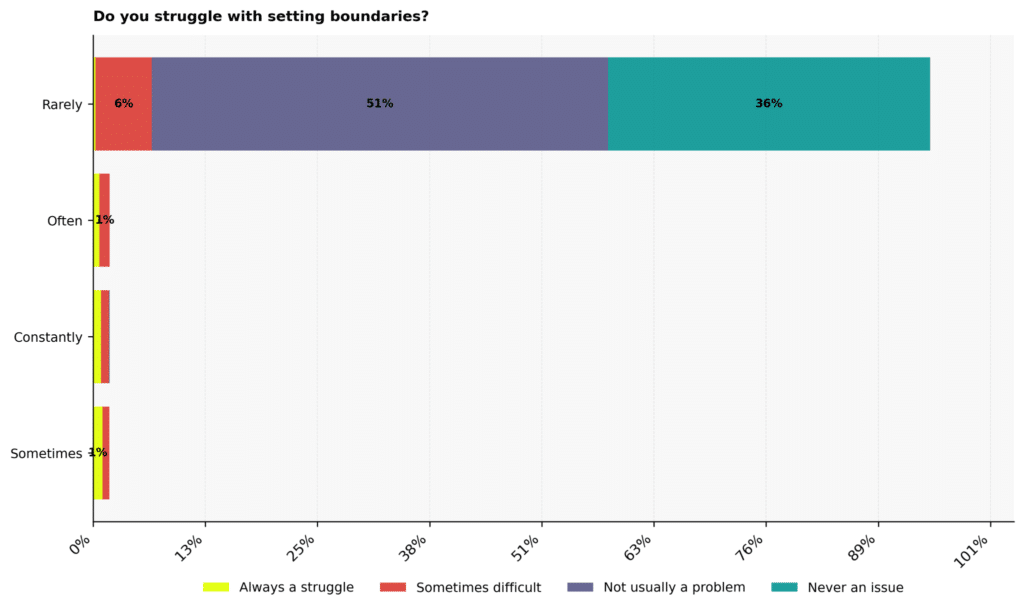
- 6% of people experiencing narcissism find setting boundaries difficult sometimes, 51% don’t usually find this a problem, and boundary-setting is never an issue for 36%, while 1% struggle to set boundaries often, and 2% battle sometimes
- 36% of people experiencing narcissism are considering leaving the relationship but are unsure how to do so, 8% are absolutely considering it but not yet seriously. It’s on 9% of people’s minds, and 6% are absolutely actively planning on leaving, with another 4% thinking about it, and 2% not really considering it, while 33% are not considering leaving whatsoever
- Fear is a major reason 12% of people experiencing narcissism don’t leave a narcissist, and it’s somewhat of a reason for 16%, but 38% are not really scared to leave, and fear is not a reason to leave at all for 22%, while 4% are staying because of children being involved, this is somewhat of a reason for 1%, and not a reason at all for 5%
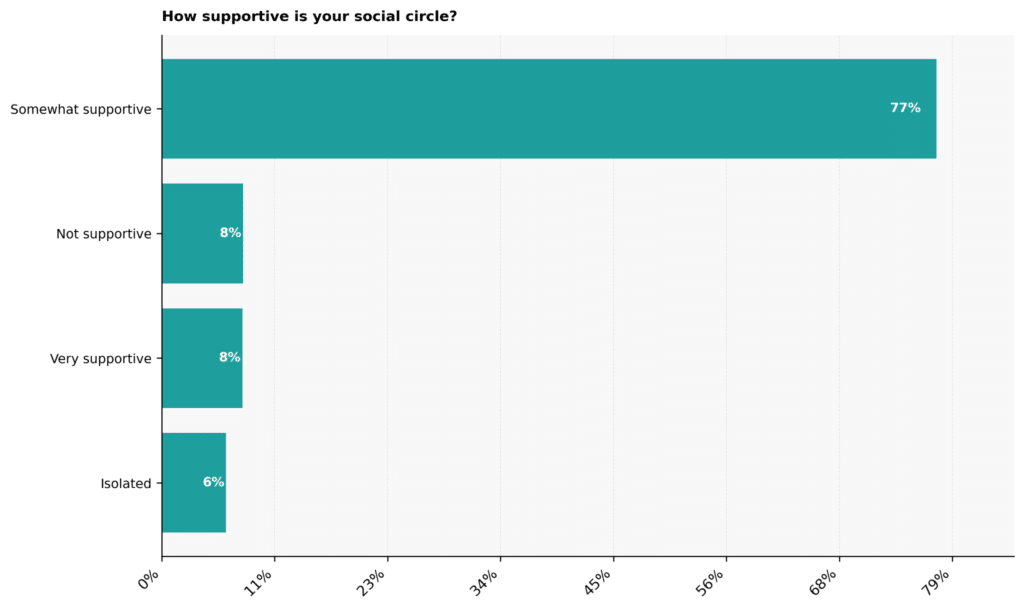
- Social circles are somewhat supportive for 77% of people experiencing narcissism, are very supportive for 8%, but not supportive for another 8%, and 6% feel isolated by their social circle
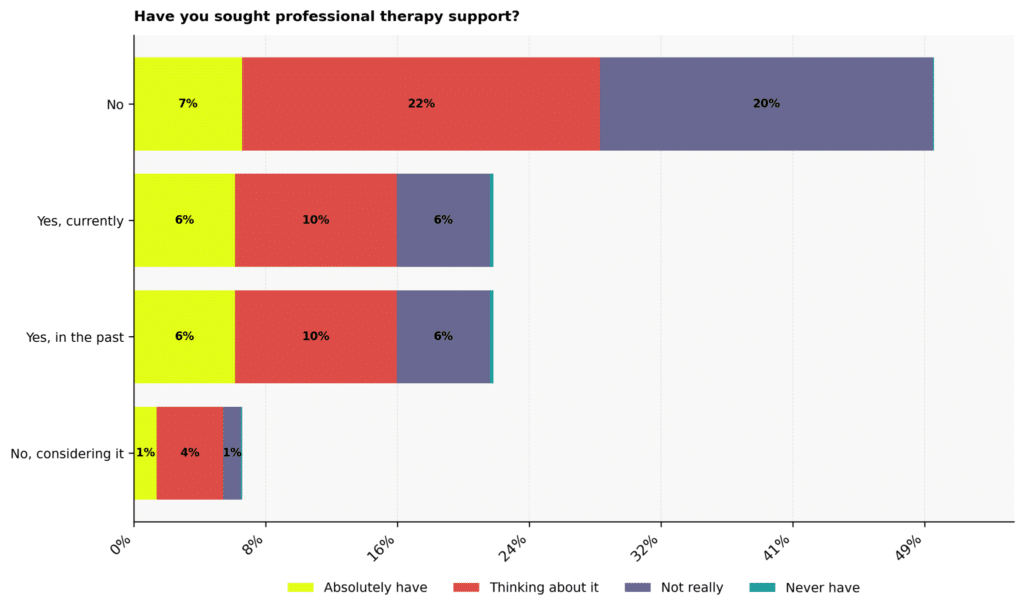
- 16% of people experiencing narcissism have sought professional therapy support, and 6% have not really, 16% have sought this assistance in the past, and 6% haven’t really, 5% have not yet sought therapy but are thinking about it, and 49% have not sought support ever
- While 6% of people experiencing narcissism would attend an online support group, 34% might consider attending one, and 11% are not sure, 2% would not attend an online group, 21% would not consider attending any type of group, but 14% might, and 3% aren’t sure, and just 2% might consider attending an in-person group
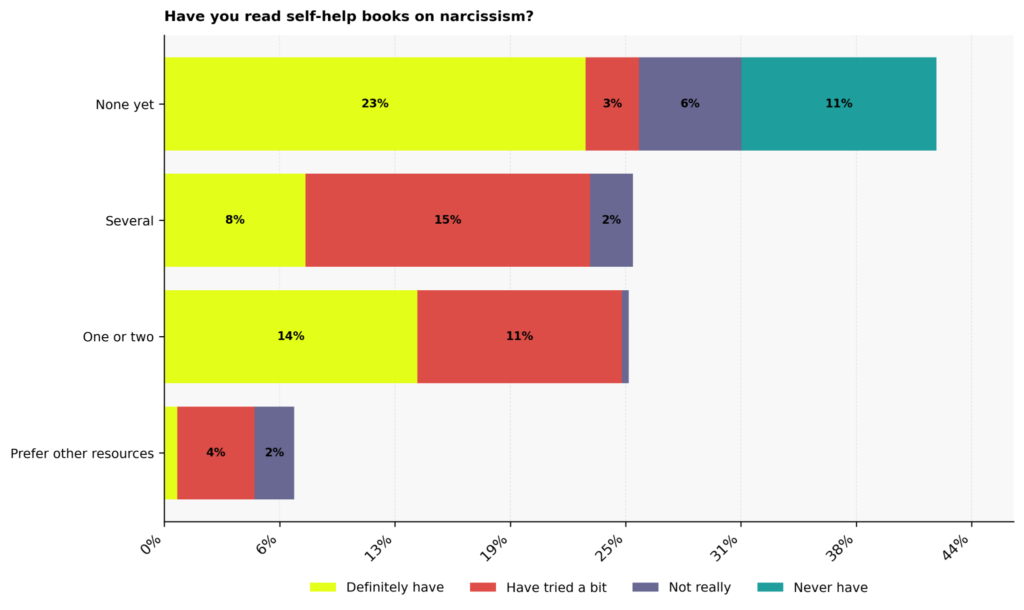
- 23% of people experiencing narcissism have read or tried to read several self-help books on the topic. But 2% haven’t really, 25% have read one or two books, 43% have not read any books, and 4% prefer other resources they’ve tried a bit, and 2% don’t really prefer self-help book alternatives
- AI chatbots are a top choice for just 2% of people experiencing narcissism, and 5% would consider them, but they are not a preference for 50%, and 20% avoid them, videos and podcasts are a top choice for 10%, 5% would consider them, and they’re not a preference for 3%, while 2% prefer articles or guides, and 1% could consider them
- 11% of people experiencing narcissism have tried AI tools for emotional support, but 16% haven’t really, 14% have tried them once, and 10% not really, while 4% use them regularly, and 17% don’t really, compared to 25% who have never used these tools for emotional support
- Validation is the AI use case that’s helped 8% of people experiencing narcissism the most, but 21% didn’t find it very helpful in this area, and 9% say it’s not helpful at all, 2% find it useful for understanding behavior patterns, but 3% feel the opposite, while 56% have found it mildly helpful for other use cases related to NPD
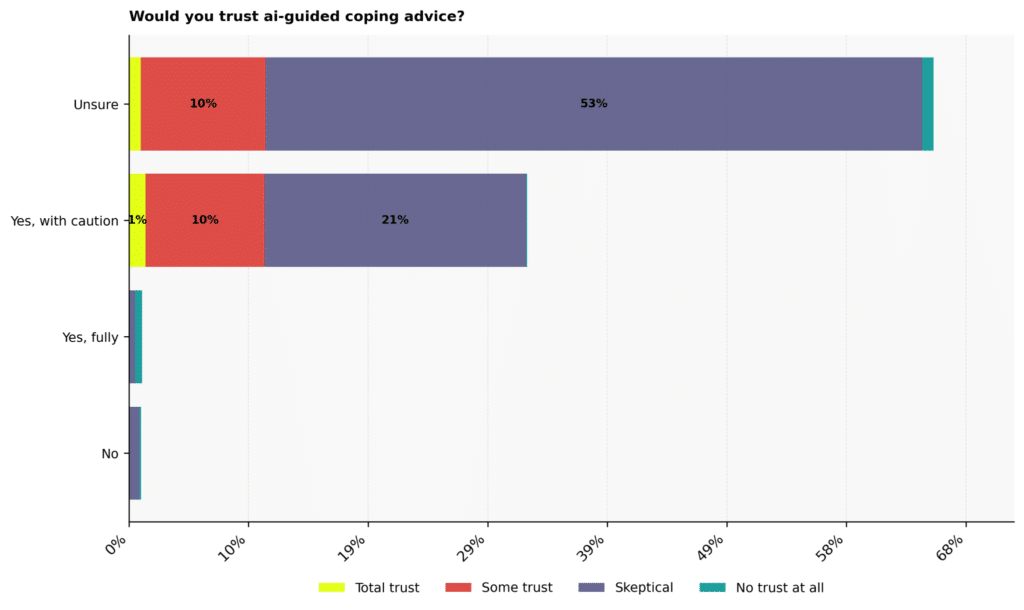
- While 20% of people experiencing narcissism are unsure but have some trust in AI-guided coping advice, 53% are skeptical about it, and 21% feel the same but would trust it with some caution, and 1% have total trust in it but are still cautious
- Therapy is extremely helpful for 8% of people experiencing narcissism, somewhat helpful for another 8%, and not very helpful for 12%, while 8% don’t find it helpful at all, support groups hel 8% but are nit very helpful for 23%, and not helpful at all for 7%, and journaling helios 6%, but is not really a help for 11%, and no help for 3%, and 2% don’t find limited contact very helpful either
- The top question for 1% of people experiencing narcissism is how to heal, and for 52% it’s also a big question, while 5% are somewhat curious, and just 1% don’t really question this, another 16% question how to leave safely, and for 11%, how to cope daily is a big question, with 9% also wondering if the narcissist will change
- Looking beyond the diagnosis
Methodology and data
Sourced using Artios from an independent sample of 9,006,318 opinions of people experiencing narcissism in the USA across X, Quora, Reddit, Bluesky, TikTok, and Threads. Responses are collected within a 95% confidence interval and 5% margin of error. Results are derived from what people describe online, from opinions expressed online, not actual questions answered by people in the sample.
How significant is the relationship between people experiencing narcissism and the narcissist in their lives?
10% of people experiencing narcissism have a very significant relationship with a parent with this personality disorder, 36% have a somewhat important relationship, and 7% have no real relationship, 4% have a very significant relationship with a friend or family member, and 11% have a somewhat important relationship with them, but 2% are not close, while 7% have a very significant working relationship with a boss or co-worker who is a narcissist, and 6% have a somewhat important relationship
Close relationships are commonplace:
According to Harvard Health Publishing, narcissistic personality disorder may occur in up to 5% of the population of the United States of America. While only a relatively small percentage of Americans meet the diagnostic criteria, the ripple effect of the disorder is much larger, as many people are affected by the behavior associated with someone with narcissism.
Parents emerge as the relationship most commonly associated with narcissism among our audience of people experiencing narcissism. Whereas 36% describe a narcissistic parent as having a somewhat important role in their lives, another 10% regard this relationship as very significant. In comparison, 17% indicate that their relationship with a narcissistic parent is not particularly close, 7% reveal that they have no relationship with that parent at all.
A further 11% of our audience is somewhat involved in an important relationship with a narcissist experience it via their friends or family members. 4% describe this connection as a very prominent one, and for 2%, there is no close relationship with friends or family with narcissism.
7% of those affected by narcissism are in this position because of a very significant relationship with a boss or coworker exhibiting these traits, and 6% describe these connections as somewhat important relationships. Broadly, these figures show that the impact of narcissistic behavior extends well beyond romantic relationships and can affect family dynamics, friendships, and workplaces, too.
How long has the relationship between people experiencing narcissism and the narcissist in their lives lasted?
51% of people experiencing narcissism have had a relationship with a narcissist for over 10 years, 12% for between 5 and 10 years, 29% between 1 and 5 years, and 8% have a relationship lasting under a year
Long-term relationships lead the way:
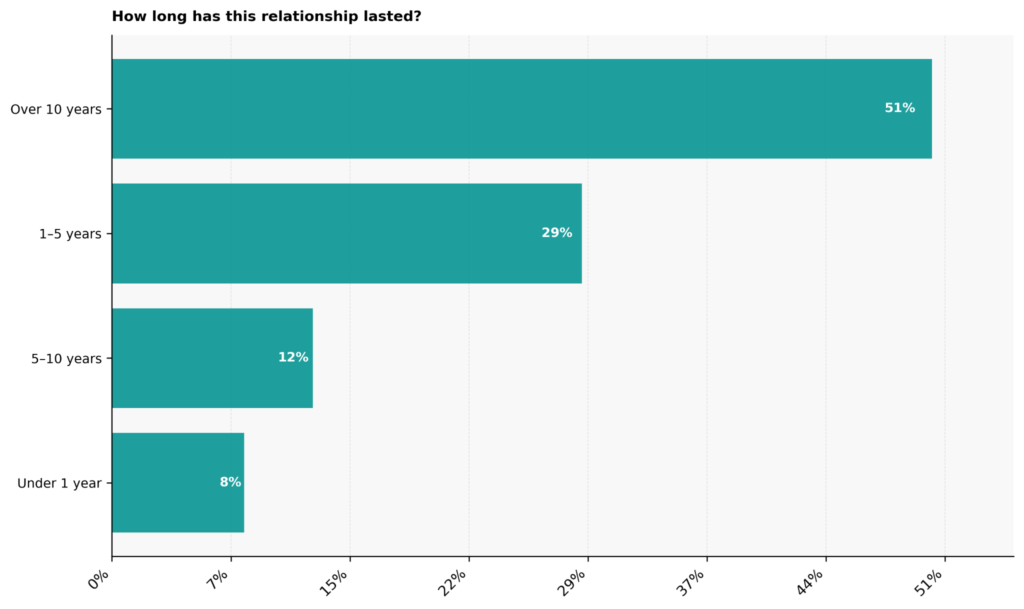
51% of people experiencing narcissism have had relationships with people with NPD for more than a decade, and this duration is by far the most common timeframe. This indicates that narcissistic relationships are typically enduring rather than short-lived, with many people staying connected for extended periods.
For 29%, the relationship has lasted between 1 and 5 years. While it’s a lower percentage than the people experiencing a relationship with a narcissist for more than 10 years, it still represents three in 10 people, confirming that multi-year relationships are more common than shorter ones.
And yet another 12% of people experiencing relationships with someone who has NPD have remained connected for between five and 10 years. In comparison, just 8% of our audience have done so for less than 12 months.
What first made people experiencing narcissism suspect narcissism?
Gaslighting was a clear sign for 40% of people experiencing narcissism that first made them suspect this condition, for 7% it was a possible clue, and for 1%, it wasn’t really a sign, while for 25%, constant criticism was a clear sign of NPD, and for 6% it was a possible clue, while 5% were clued in by a lack of empathy, and a bigger share of 17% spotted it as a clear sign.
Some signs stand out more than others:
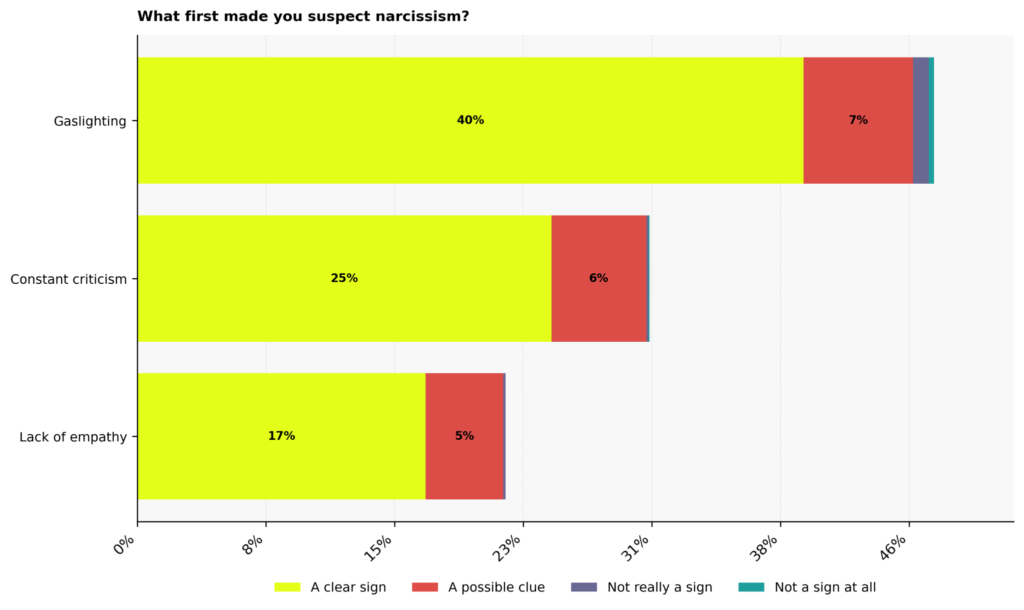
Certain behaviors are more likely than others to make people question whether someone in their life is narcissistic, but gaslighting stands out as the strongest indicator that this is so for our audience. For 40%, this manipulation tactic was a clear sign that they were experiencing narcissism, and it was a possible clue for a further 7%. Less than 1% didn’t really see it as a sign, or feel it was one at all.
Constant criticism is an additional behavior that leads people experiencing narcissism to suspect it. For 25% of our audience, this is a clear sign; for 6%, it’s a possible clear sign, and it’s not really a sign or not at all a sign for less than 1%
A lack of empathy is also widely associated with narcissism. 17% of our audience views this behavior as a clear sign, and 5% as a possible clue. Less than 1% see it as not really a sign. The behaviors themselves appear to be what prompts people to question the relationship they’re in before they recognize narcissism.
What type of narcissism best fits the person involved?
Malignant narcissism is the perfect match for the type of NPD 14% of people experiencing narcissism are subject to, and it somewhat fits for 13%; however, 14% say it’s not really fitting, and it doesn’t fit at all for 18%, 28% are not sure what type of narcissism they are experiencing, and 2% are experiencing vulnerable narcissism, but this doesn’t fit for 7%, and no one is sure they’re experiencing grandiose narcissism
Experiences of types of narcissism vary:
Narcissism doesn’t present in the same way in everyone. Whereas some people display more aggressive or overt behaviors, others exhibit less obvious traits. This doesn’t always make it easy for people experiencing narcissism to determine what subtype best describes the person they’re dealing with.
According to Psychology Today, malignant, vulnerable (or covert), and grandiose narcissists share many of the same characteristics, but each subtype displays these traits differently, so it’s more challenging to distinguish one from the other.
Malignant narcissism is the subtype most closely associated with the person involved. For 14% of our audience, this subtype is a perfect match, and 13% find that this somewhat fits. For another 14%, this label is not a good fit, but for 18%, it does not fit at all.
Uncertainty also features prominently, with 18% of our audience not sure which subtype best describes the person involved but feel one somewhat fits, while a further 7% aren’t sure despite finding one to be the perfect match. Just 3% are not really sure, and less than 1% haven’t found a suitable subtype.
Vulnerable narcissism is not often associated with the person involved, with just 1% of our audience describing it as a perfect match and 1% agreeing that it somewhat fits. By comparison, it’s not really fitting to describe for 4%, and it doesn’t fit at all for 3%.
Grandiose narcissism is the least frequently matched subtype, with less than 1% seeing this type as the perfect match, a somewhat fitting match, not really fitting, and not fitting at all, respectively.
How informed do people experiencing narcissism feel about NPD?
52% of people experiencing narcissism are very informed about NPD, 24% are slightly informed, and a further 24% are not informed about this personality disorder, despite being impacted by it
Not everyone understands NPD:
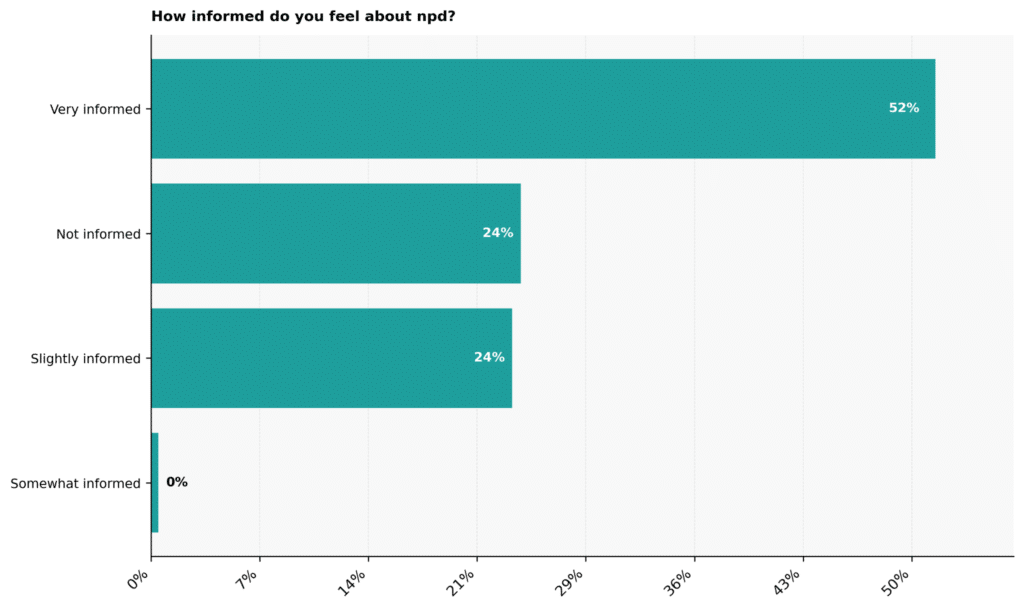
Understanding NPD can help people experiencing it recognize behaviors, make sense of their experiences, and identify patterns that might otherwise go unnoticed. Our audience demonstrates varying levels of knowledge about this condition, though many have developed a strong understanding.
At 52%, more than half of our audience is very informed, compared with 24% who are not informed or slightly informed. Evidently, many have actively sought information that will help them better understand the various behaviors associated with NPD, with 0% being only somewhat informed.
Have people experiencing narcissism experienced love bombing early on?
3% of people experiencing narcissism have absolutely experienced intense love bombing, 16% have somewhat so, and 4% not really, 2% have absolutely had mild love bombing, 18% have somewhat experienced it at this intensity, and 1% have not, while 22% are not sure if they’ve been love bombed, and 35% have not been love bombed
Love bombing intensity varies or is non-existent:
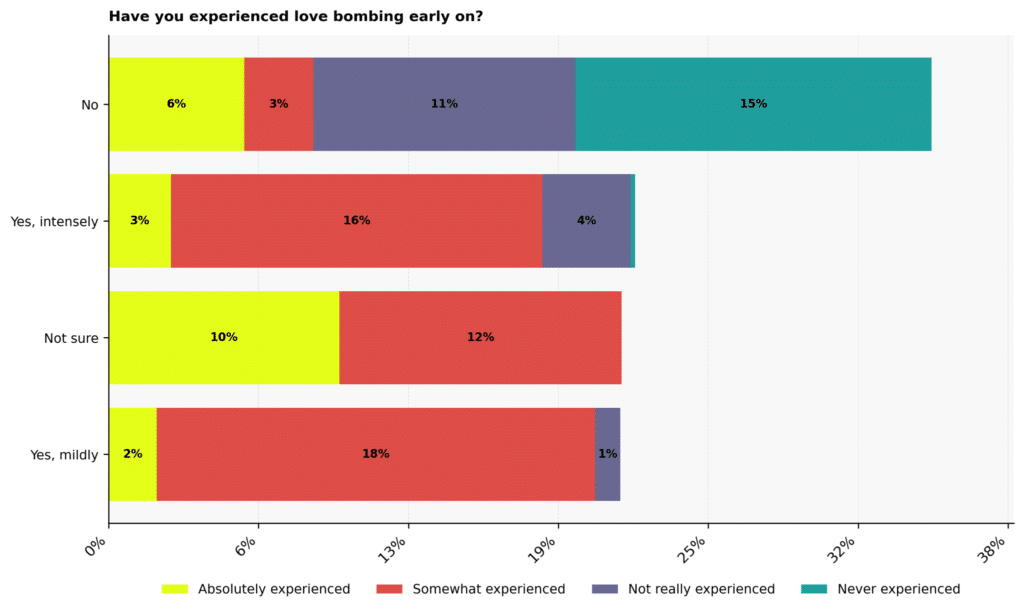
Love bombing is a common feature of many narcissistic relationships, although the intensity does vary. Mild love bombing is the most common pattern, with 18% of our audience somewhat experiencing it, whereas an additional 2% absolutely did. By comparison, just 1% have not really experienced even mild love bombing.
16% have somewhat experienced intense love bombing, while 3% experienced it to a greater extent. For 4%, it wasn’t really part of the relationship, whereas less than 1% have never experienced it.
Uncertainty is also evident, with 10% absolutely believing that they’ve experienced love bombing but remaining unsure about it, while 12% somewhat believe they’ve experienced it. On the other hand, 15% have never experienced love bombing, 11% have not really experienced it, 6% absolutely believe that they’ve not been love bombed, and 3% somewhat believe they’ve not been love bombed.
A Shane Co. survey found that 70% of Americans have experienced love bombing, reinforcing the idea that this kind of emotional manipulation extends beyond narcissistic relationships and affects a significant proportion of the wider population.
How does the narcissist react to criticism?
44% of people experiencing narcissism have found that the person with NPD responds to criticism with rage, 43% say they counterattack, 11% go into denial, and 2% give them the silent treatment
Reactions follow set patterns:
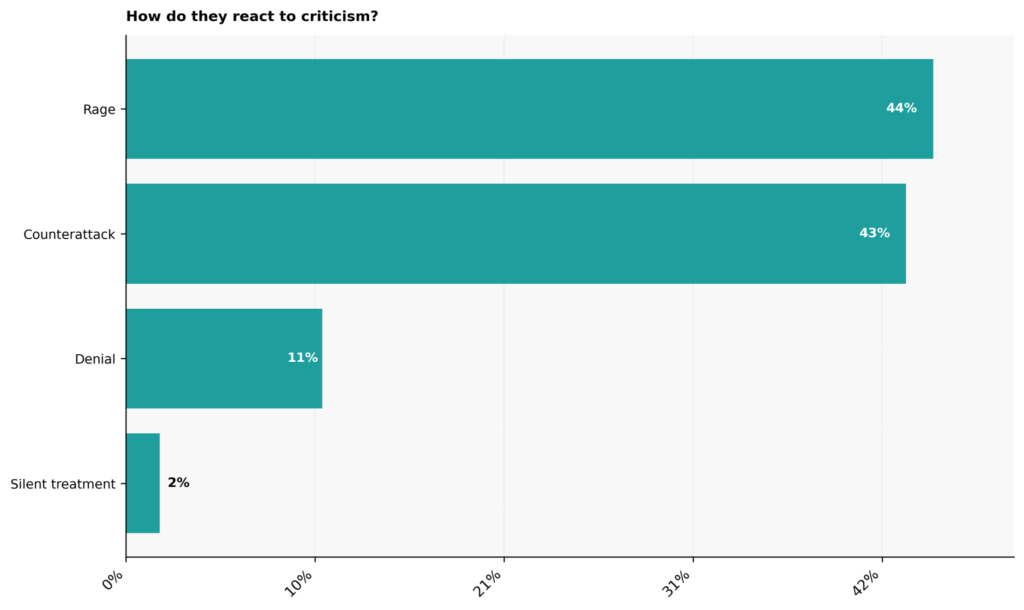
Because they have a fragile and fragmented sense of self, criticism often triggers a strong emotional reaction in people with NPD. It’s usually perceived as a threat to the narcissist’s self-image, and criticism prompts responses that include narcissistic rage, denial, blame-shifting, or strong attempts to regain control of the situation.
Rage is the most commonly associated narcissistic reaction to criticism, accounting for 44% of our audience’s experiences. Counterattacks follow closely, at 43%, showing that criticism is a lot more likely to provoke an aggressive, confrontational response than any other kind of reply.
Denial is not as common, accounting for only 11% of experiences. This section of our audience has had individuals simply reject or dismiss the negative feedback altogether.
Getting the silent treatment is the experience of 2%. This tells us that criticism is far more likely to elicit an immediate outward response than avoidance or withdrawal.
How often do people experiencing narcissism feel blamed unfairly?
27% of people experiencing narcissism feel unfairly blamed on a daily basis, 24% feel they are blamed weekly, 24% occasionally, and 25% are rarely unfairly blamed.
Unfair blame is evenly split:
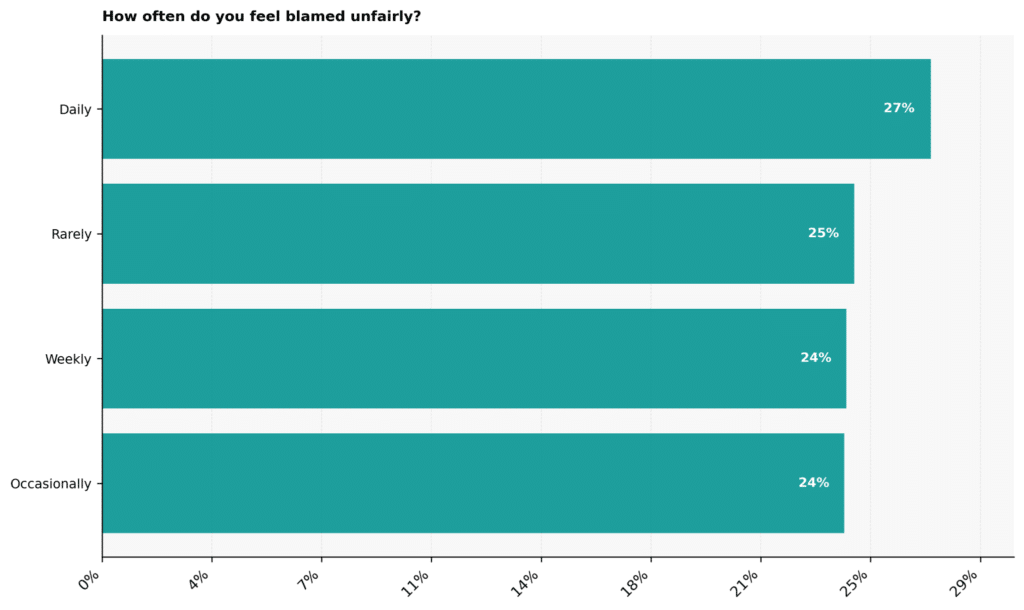
Because they often feel unstable, diminished, or deeply vulnerable, unfairly blaming the people around them is a common tactic for narcissists. Feeling unfairly blamed is a regular experience for many people experiencing narcissism, with daily blame being the most common pattern, affecting 27%. Weekly and occasional blame each account for 24%, showing that people face this behavior on a recurring basis rather than as an isolated event. Rarely feeling blamed accounts for the feelings of 25% of our audience.
The small difference between timeframes indicates that unfair blame isn’t confined to a single pattern and can occur with similar frequency across different relationships. For many, it’s an ongoing factor, whether it happens every day or less often.
Do people experiencing narcissism often question their own reality?
7% of people experiencing narcissism constantly question their own reality, 21% do so at times, and 1% seldom question it, 1% are always questioning their reality, and 20% always do so at times, with 8% less often and 8% doing so at times, 24% questioning it rarely, and 7% never questioning it.
Questioning reality is not unusual:
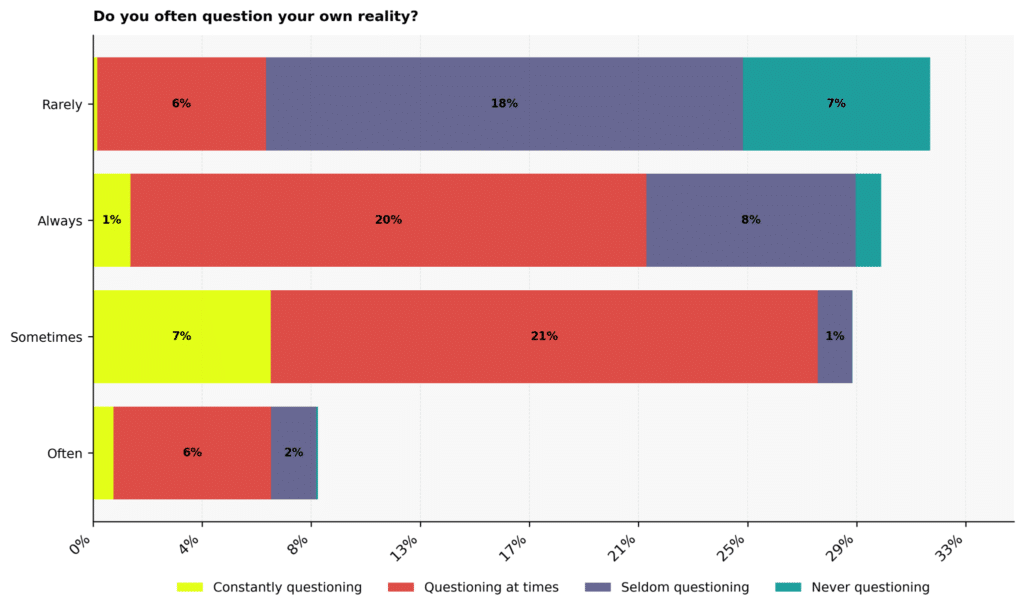
Having to question reality is a common consequence of narcissistic behavior, and for those experiencing narcissistic behavior, this tends to happen more often than not.
On the one hand, 6% rarely question their own reality at times, 18% do so seldom, and 7% never question it, compared to the rest of our audience who fall into the always, sometimes, and often categories.
Of these, 1% are constantly questioning their reality, 20% are always doing so at times, and 8% are seldom doing so, but it’s an ever-present thought. 7% are sometimes constantly questioning what is real, another 21% are constantly doing so at times, and 1% are seldom doing so. 6% question their reality at times, and 2% do so less often, but still on a regular basis.
How has self-esteem been affected for people experiencing narcissism?
30% of people experiencing narcissism have severely affected self-esteem, 31% have been affected moderately, 20% have been slightly affected, and 20% are not affected at all.
The knock to self-esteem is not evenly distributed:
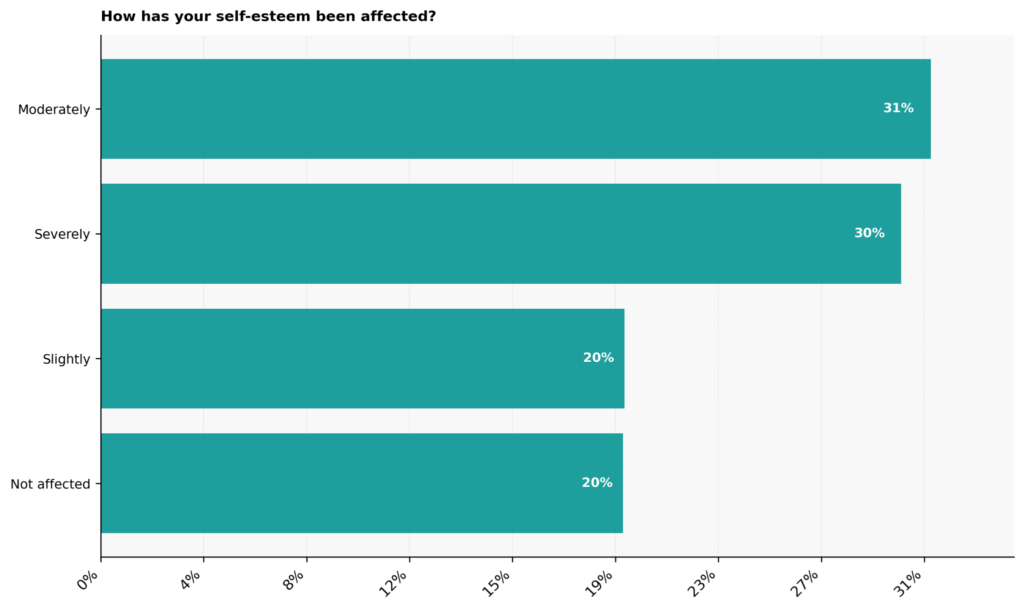
Narcissistic behavior often affects self-esteem first. Constant criticism, ongoing manipulation, blame-shifting, and emotional abuse can gradually undermine a person’s self-confidence, leaving them doubting their worth.
Moderate damage to self-esteem is the most common outcome for our audience, affecting 31%. Severe effects follow closely at 30%, meaning that more than six in 10 people report that their self-esteem is affected to a greater than moderate degree.
Research shows that narcissists frequently have fragile self-esteem and try to protect it by making those around them feel inferior. This explains why moderate and severe effects on self-esteem are so prevalent among people experiencing narcissistic behavior.
On a more positive note, 40% of our audience is evenly split between those whose self-esteem has been only slightly affected (20%) and those who are not affected at all (20%).
Although not everyone experiences the same level of emotional impact, this information shows that narcissistic relationships typically reduce self-esteem.
How often do physical symptoms appear for people experiencing narcissism?
24% of people experiencing narcissism suffer from physical symptoms like anxiety and fatigue daily, 24% suffer weekly, 22% occasionally, and 29% never suffer any physical symptoms
Exposure to NPD can lead to physical symptoms:
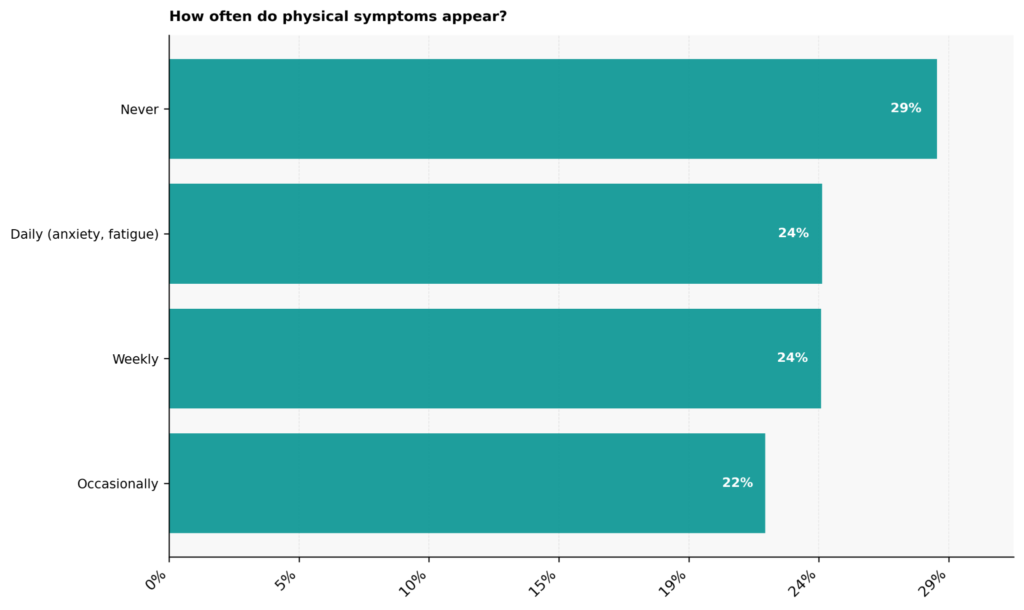
Physical symptoms are a common response to prolonged emotional stress, and people experiencing narcissistic behavior may notice these at various stages of their relationships.
Although 29% never experience physical symptoms, 24% of our audience experience daily symptoms like anxiety and fatigue, and an additional 24% experience them weekly, while 22% experience physical symptoms occasionally.
Although no single pattern dominates by a large margin, overall, 70% of our audience experiences physical symptoms to one degree or another. This tells us that the emotional impact of narcissistic behavior frequently extends beyond psychological well-being and can affect physical health, too.
How has narcissism affected career or work for those experiencing it?
25% of people experiencing narcissism have seen an impact on their career or work, 25% have seen a slight impact, and 25% have experienced a moderate impact; however, 25% have not seen any impact on their work or career at all.
Work and career impact is not one-size-fits-all:
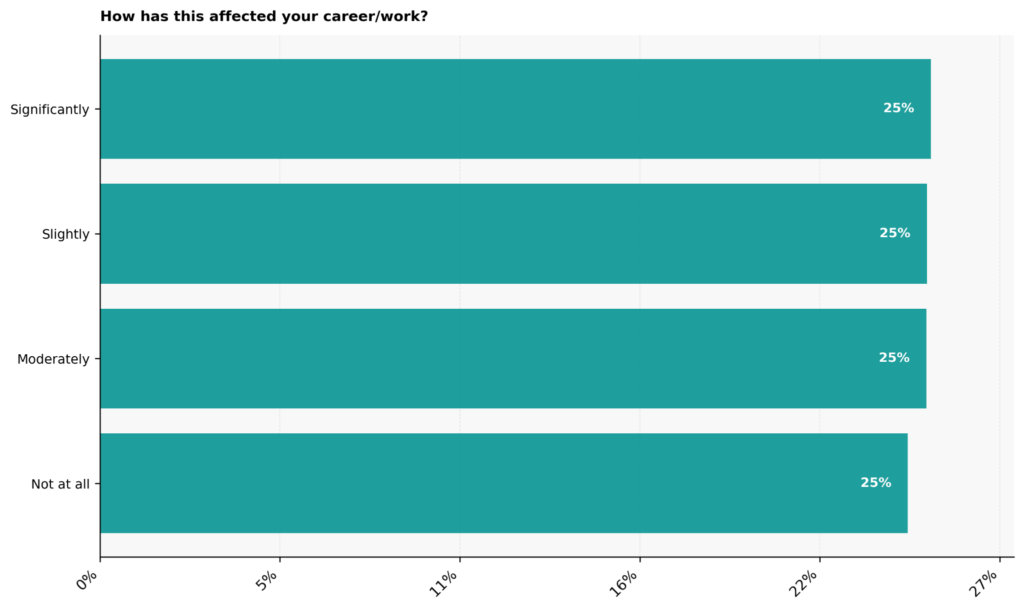
The emotional strain and loss of confidence associated with NPD can significantly impact performance, motivation, and overall well-being at work. This is evident in the 25% of our audience whose work has been significantly affected by narcissism, while 25% describe the impact as moderate. A further 25% have felt only slight effects, while another 25% have felt no impact at all.
These figures mean that for 75%, the workplace is a setting where the consequences of NPD are felt.
Do people experiencing narcissism struggle with setting boundaries?
6% of people experiencing narcissism find setting boundaries difficult sometimes, 51% don’t usually find this a problem, and boundary-setting is never an issue for 36%, while 1% struggle to set boundaries often, and 2% battle sometimes.
Boundary-setting has limited challenges:
According to Psychreg, guilt and obligation are the biggest obstacles for Americans regarding setting healthy boundaries for their families, with these factors affecting as many as 72%. The study also identifies giving family or friends support (43%) and fear of disappointing others (36%) as the most frequently cited reasons people use to avoid establishing boundaries.
For people experiencing narcissism, setting boundaries is not too much of a struggle. 6% rarely struggle but sometimes find it difficult, 51% agree that it’s not usually a problem, and 36% say it’s so rare, it’s never an issue. Only 1% always find it difficult and struggle often, while the same number agree that they sometimes struggle.
None of the conversations amongst our audience focused on setting boundaries as a constant struggle, nor did they mention struggling constantly. This illustrates that overall, boundary setting is something most feel comfortable with,
Have people experiencing narcissism considered leaving the relationship?
36% of people experiencing narcissism are considering leaving the relationship but are unsure how to do so, 8% are absolutely considering it but not yet seriously, it’s on 9% of people’s minds, and 6% are absolutely actively planning on leaving, with another 4% thinking about it, and 2% not really considering it, while 33% are not considering leaving whatsoever.
Leaving is not the clear choice:
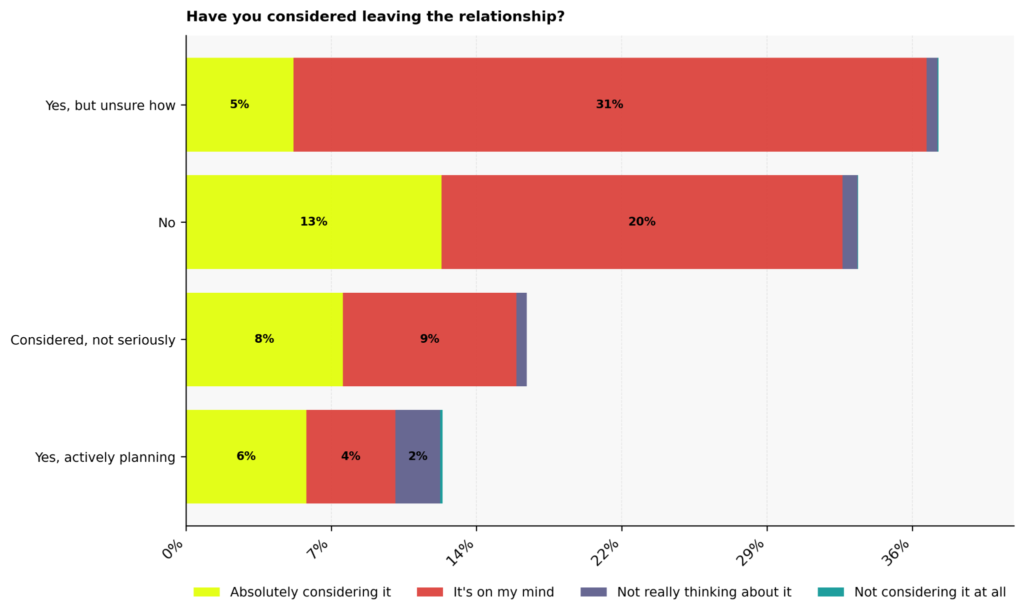
Whether it’s an interpersonal or family relationship, there is always the choice to leave or to cut contact. For people experiencing narcissism, 5% are absolutely considering leaving the relationship but are unsure how to do so, and another 31% have leaving on their mind but have not yet worked out how to go about it.
While 13% have absolutely considered leaving, they decided not to, but 20% still have it on their mind. 8% have absolutely considered leaving but not seriously, and 9% have thought about it, but also not on a serious level. There are, however, those who are actively planning on leaving, with 6% absolutely considering doing so, 4% who have it on their mind. Yet, 2% who are actively planning to leave are not really thinking about it.
With so many varied opinions, one clear trend emerges. Many people experiencing narcissism have at least considered leaving the relationship, even if they haven’t yet acted on it. While some feel ready to move on, many others remain caught between recognizing the need for change and facing the practical or emotional challenges of taking that next step.
What stops people experiencing narcissism from leaving the narcissist?
Fear is a major reason 12% of people experiencing narcissism don’t leave a narcissist, and it’s somewhat of a reason for 16%, but 38% are not really scared to leave, and fear is not a reason to leave at all for 22%, while 4% are staying because of children being involved, this is somewhat of a reason for 1%, and not a reason at all for 5%.
Fear is not keeping everyone in a relationship:
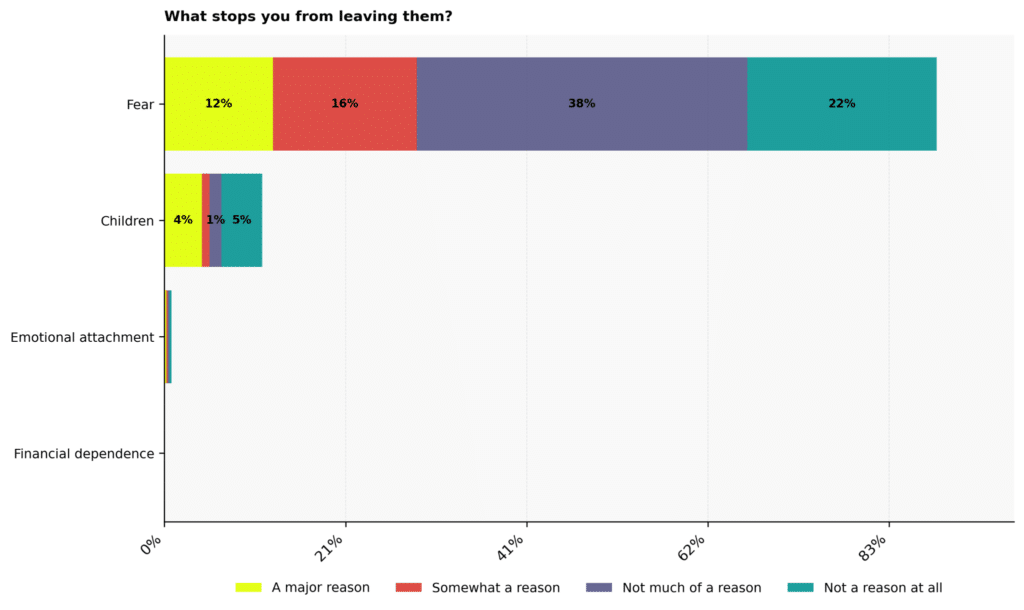
Narcissism is frequently driven by underlying insecurity rather than genuine self-confidence. Because of this, narcissists may depend on the people closest to them to reinforce their sense of self-worth, making it more difficult for these relationships to change or end. But for people experiencing narcissism, fear is the number one reason they don’t leave.
Being scared to leave is a major reason cited by 12%, and 16% consider it somewhat of a reason. On the flip side, fear isn’t much of a reason for not leaving a narcissist, and 22% are not scared to leave at all.
Having children together is a major reason for 4% to remain in a relationship, but for 1% of our audience, this isn’t much of a reason, and 55 say it’s not a reason at all. This is likely because staying for the sake of the children doesn’t always have the best result if the parents are dealing with relationship issues.
How supportive is the social circle for people experiencing narcissism?
Social circles are somewhat supportive for 77% of people experiencing narcissism, are very supportive for 8%, but not supportive for another 8%, and 6% feel isolated by their social circle
Social circle support is stronger than weaker:
According to Healthline, coercive control often involves separating people from their friends, family, and other sources of support as a way of increasing dependence and reducing the influence of outsiders. This pattern is also common in narcissistic relationships, where controlling behavior gradually limits access to the people who might encourage someone to seek help or leave.
However, most of our audience of people experiencing narcissism describe their social circle as somewhat supportive. 77% fall into this category, and 8% say that they have a very supportive network. By contrast, 8% don’t consider their social circle supportive, and 6% feel isolated. While this is the majority, it is still concerning, as external support is incredibly important in these cases.
Have people experiencing narcissism sought professional therapy support?
16% of people experiencing narcissism have sought professional therapy support, and 6% have not really, 16% have sought this assistance in the past, and 6% haven’t really, 5% have not yet sought therapy but are thinking about it, and 49% have not sought support ever
Seeking support is debated:
People experiencing narcissism often develop codependent patterns with others that make it more difficult to prioritize their own needs or leave unhealthy situations. A 2026 systematic review found that codependent traits affect an estimated 10% to 20% of the general US population, and this condition is very common in people exposed to trauma or chronic stress.
Since professional therapy is often used to address these challenges, many people experiencing NPD have sought this out. For our audience, 6% absolutely have sought professional therapy support and are currently seeing a therapist, 10% are currently thinking about doing so, and just 6% aren’t really interested in this assistance right now.
In the past, 6% have absolutely sought professional therapy support, 10% thought about doing so, and 6% didn’t really consider it.
For those who have not sought this type of support but are considering it, 1% absolutely have thought about it, 4% are thinking about it, and 1% aren’t really.
The biggest percentage of our audience (49%) have not had therapy, but 7% have absolutely thought about it, 22% are thinking about it, and 20% are not really considering it still. This points to a gap where those who could benefit are not yet ready to accept this type of support. This is wholly understandable as everyone moves at their own pace and seeks help in different ways.
Would people experiencing narcissism attend a support group?
While 6% of people experiencing narcissism would attend an online support group, 34% might consider attending one, and 11% are not sure, 2% would not attend an online group, 21% would not consider attending any type of group, but 14% might, and 3% aren’t sure, and just 2% might consider attending an in-person group
Online support groups top the list:
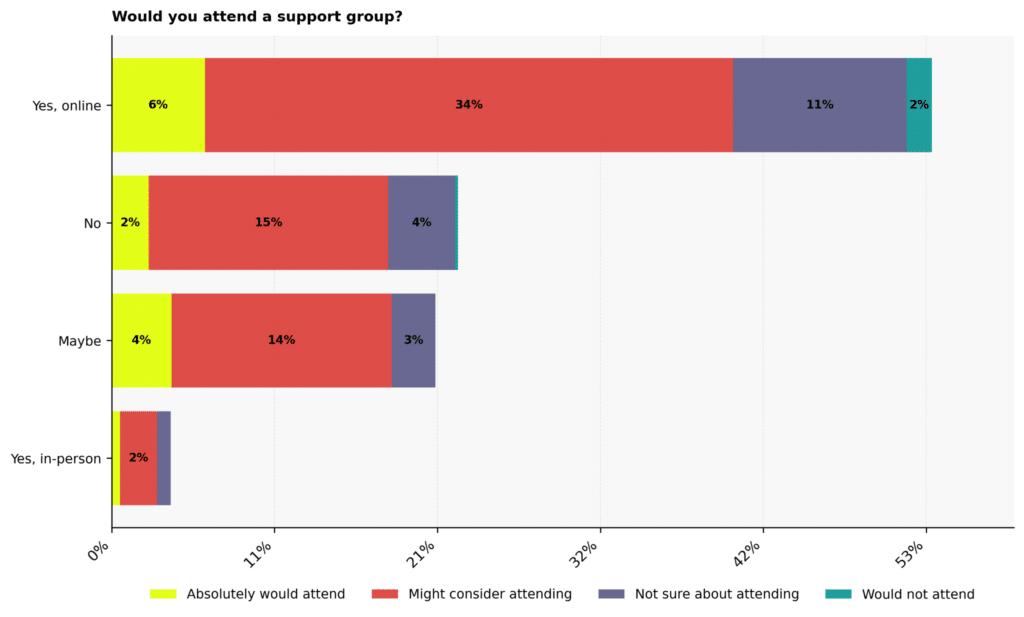
Online support groups have shown considerable growth over the last two decades, both for those with mental health concerns and those impacted by them. 6% of people experiencing narcissism absolutely would attend a support group if it were online, 34% might consider attending, and 11% are not sure about whether they’d attend. Just 2% say they wouldn’t attend online support groups. In contrast, 2% might consider attending an in-person support group.
Those who wouldn’t attend a group number 2% who absolutely would not, 13% who say no but may still consider, and 4% who say no but are not sure. Some of our audience is also on the fence, with 4% saying they maybe would absolutely attend, 14% who might consider it, and 3% who aren’t sure.
Have people experiencing narcissism read self-help books on narcissism?
23% of people experiencing narcissism have read or tried to read several self-help books on the topic. But 2% haven’t really, 25% have read one or two books, 43% have not read any books, and 4% prefer other resources they’ve tried a bit, and 2% don’t really prefer self-help book alternatives.
Reading is a helpful tool for some:
Self-help books are often one of the first resources people turn to when trying to understand their experience of narcissistic behavior. These can explain manipulation tactics, relationship dynamics, and practical ways to rebuild confidence and establish healthier boundaries.
However, this trend isn’t seen among our audience of people experiencing narcissism. 23% definitely haven’t read any self-help books on narcissism, and another 11% have never read one. 6% don’t really agree that they haven’t read any, and 3% have read a little.
Reading several books attracts far more interest. 15% of our audience has read several books to some extent, and 8% definitely have. 2% haven’t really read several books, and a further 1% have never done so. Reading one or two books also appeals to many people. 14% have definitely done so, and 11% have to some extent. Less than 1% have not really done so.
Very few people prefer other resources. 4% have somewhat explored this approach, but 2% don’t really agree that they look elsewhere for guidance. Less than 1% definitely have never done so.
This tells us that people seek out information on experiences with narcissism in different ways. Many turn to books, and sometimes more than one; others choose different types of guidance.
What resource format do people experiencing narcissism prefer most?
AI chatbots are a top choice for just 2% of people experiencing narcissism, and 5% would consider them, but they are not a preference for 50%, and 20% avoid them, videos and podcasts are a top choice for 10%, 5% would consider them, and they’re not a preference for 3%, while 2% prefer articles or guides, and 1% could consider them.
AI is not a strong preference:
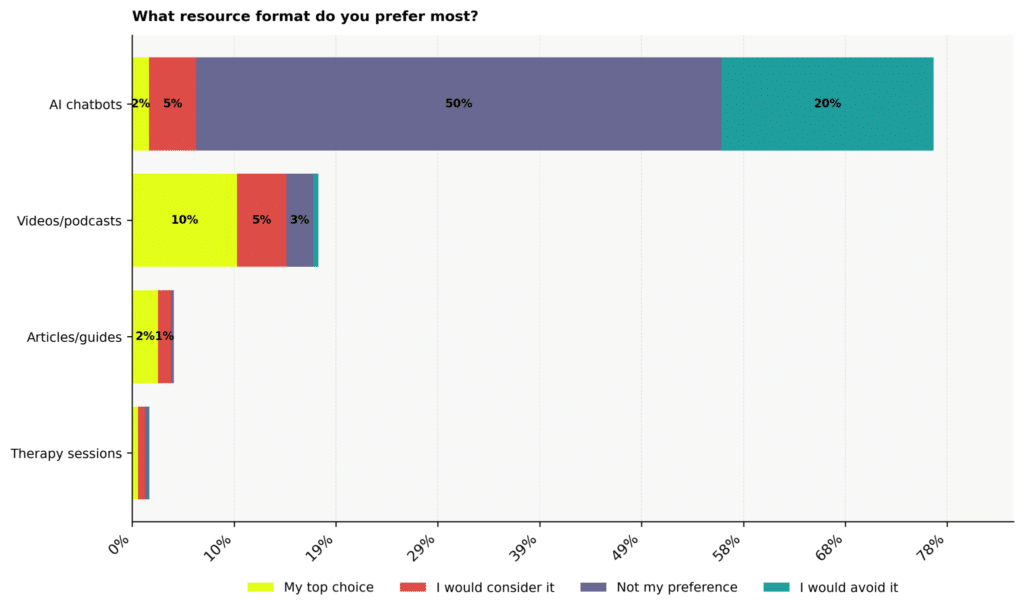
Self-help books are just one way people experiencing narcissism learn more about it. Many also look to other types of resources for counsel and advice. Of these, AI chatbots are the least popular with our audience, with 50% not considering them their preferred method and 20% actively avoiding them. Just 5% would consider using them, and only 2% would have this as their top choice.
This information contrasts with the findings of a survey undertaken by the American Psychological Association, which revealed that AI is, in fact, becoming a part of many people’s mental health journeys. 39% of the psychologists who took part in the survey have worked with patients who’ve used AI to diagnose themselves. Around a third (33%) have also seen their patients using AI to assist in their treatment, and 34% have noticed their patients using it to assist with treatment they’re currently undergoing. 35% of these mental health workers’ patients are using it as an extra source of mental health guidance.
Videos and podcasts receive a much warmer reception from our audience, with 10% listing them as their primary choice and 5% admitting they’d think about them. Conversely, they are not a preference for 3%, and less than 1% would avoid them.
Articles and guides attract a lot less interest, with 2% making this method their top choice, 1% considering it, and less than 1% steering clear of this route. While no one stated a preference for therapy sessions, this may simply reflect that the topic didn’t arise in the conversations.
Have people experiencing narcissism used AI tools for emotional support?
11% of people experiencing narcissism have tried AI tools for emotional support, but 16% haven’t really, 14% have tried them once, and 10% not really, while 4% use them regularly, and 17% don’t really, compared to 25% who have never used these tools for emotional support
AI tools are not a strong emotional support:
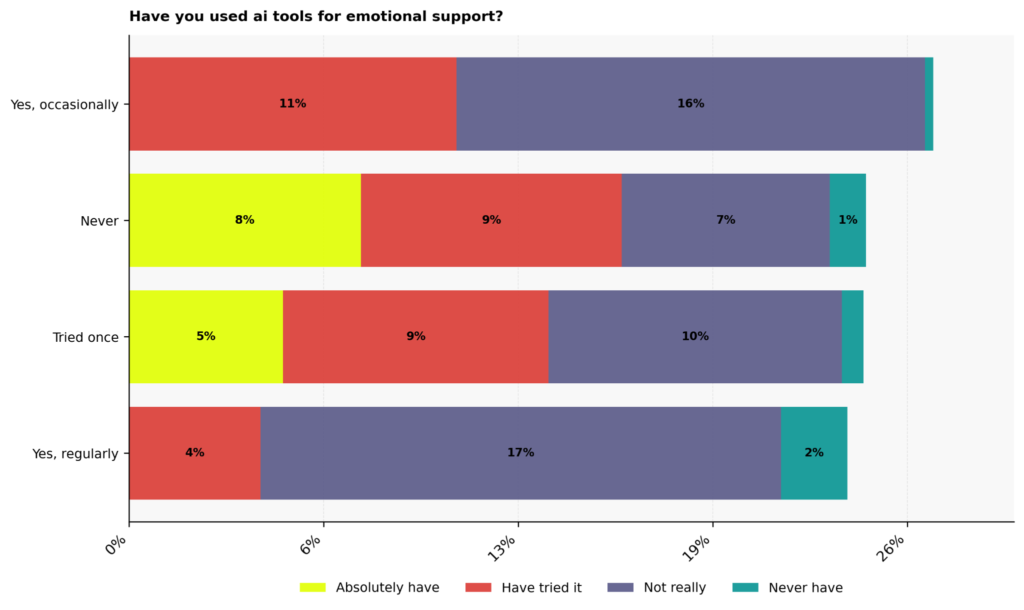
A report from the American Psychological Association found that 77% of psychologists have treated patients who use AI for emotional support, companionship, or other mental health-related purposes. This somewhat aligns with our audience, as 11% of people experiencing narcissism occasionally use AI tools for emotional support, and 16% don’t really, 4% have tried these tools regularly, 17% have tried them but don’t use them regularly, and just 2% never have.
5% have absolutely tried AI tools for emotions support once, 9% have tried them, and 10% not really compared to the 25% overall who have never tried them.
With adoption rates on the lower side and most people not using these tools, it seems that while they are trialed, they’re not considered a consistent support system.
What AI use case helped people experiencing narcissism most?
Validation is the AI use case that’s helped 8% of people experiencing narcissism the most, but 21% didn’t find it very helpful in this area, and 9% say it’s not helpful at all, 2% find it useful for understanding behavior patterns, but 3% feel the opposite, while 56% have found it mildly helpful for other use cases related to NPD.
AI use cases are of minimal help:
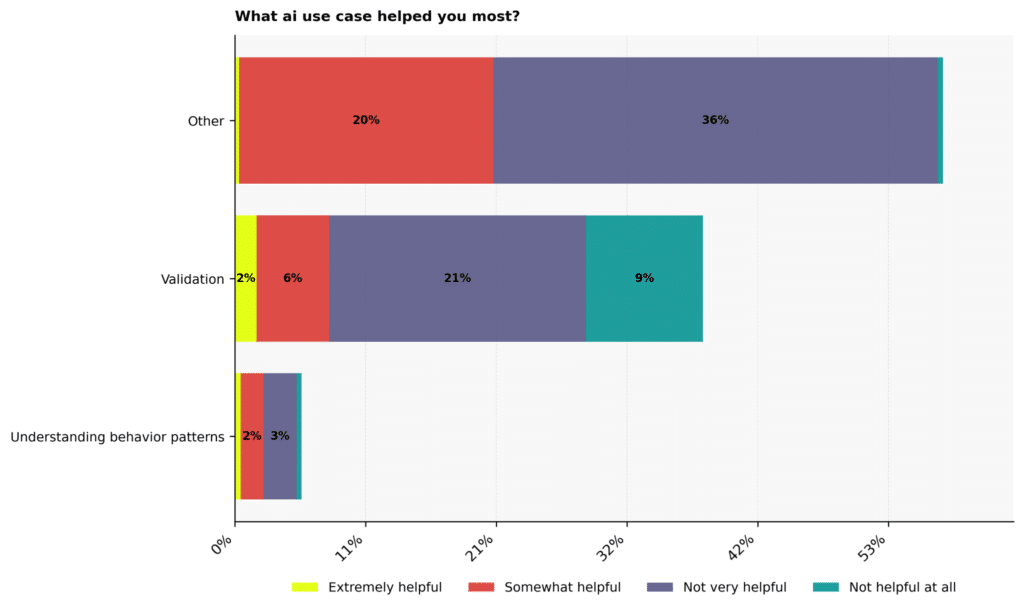
While we saw that not that many people experiencing narcissism were using AI tools for emotional support, AI use cases helped many in different ways.
2% found AI extremely helpful for validation, and 6% found it somewhat helpful. However, 21% didn’t find AI very helpful for validating their feelings, and 9% didn’t find it helpful at all.
Just 2% found it somewhat helpful for understanding behavior patterns, and 3% felt that it was not very helpful in this regard.
Those who cited AI as being somewhat helpful in other areas related to undertaking narcissism numbered 20%, yet 36% felt it wasn’t very helpful for this purpose.
Drawing on these results, AI certainly seems like a nice-to-have rather than a useful or relied-upon emotional support tool.
Would people experiencing narcissism trust AI-guided coping advice?
While 20% of people experiencing narcissism are unsure but have some trust in AI-guided coping advice, 53% are skeptical about it, and 21% feel the same but would trust it with some caution, and 1% have total trust in it but are still cautious.
AI-guided advice comes with skepticism:
Researchers at Stanford’s Institute for Human-Centered Artificial Intelligence warn that AI isn’t yet equipped to provide safe, reliable mental health care on its own. They found that some chatbots can respond poorly to people in crisis, reinforce harmful stereotypes about mental illness, and offer advice that may be inappropriate or misleading, showing why human oversight remains essential.
Our audience is also not convinced of the trustworthiness of AI-guided coping advice. 10% of people experiencing narcissism are unsure and only have some trust in it, and 53% are skeptical. This is far higher than the 1% who have total trust in AI-guided coping advice and the 10% who have some trust, while the remaining 21% are also skeptical.
No conversations surrounding fully trusting this advice or not trusting it all were recorded, revealing that everyone is still very uncertain about AI’s capabilities in this area.
What coping method works best for people experiencing narcissism?
Therapy is extremely helpful for 8% of people experiencing narcissism, somewhat helpful for another 8%, and not very helpful for 12%, while 8% don’t find it helpful at all, support groups hel 8% but are nit very helpful for 23%, and not helpful at all for 7%, and journaling helios 6%, but is not really a help for 11%, and no help for 3%, and 2% don’t find limited contact very helpful either.
Coping methods differ in their helpfulness:
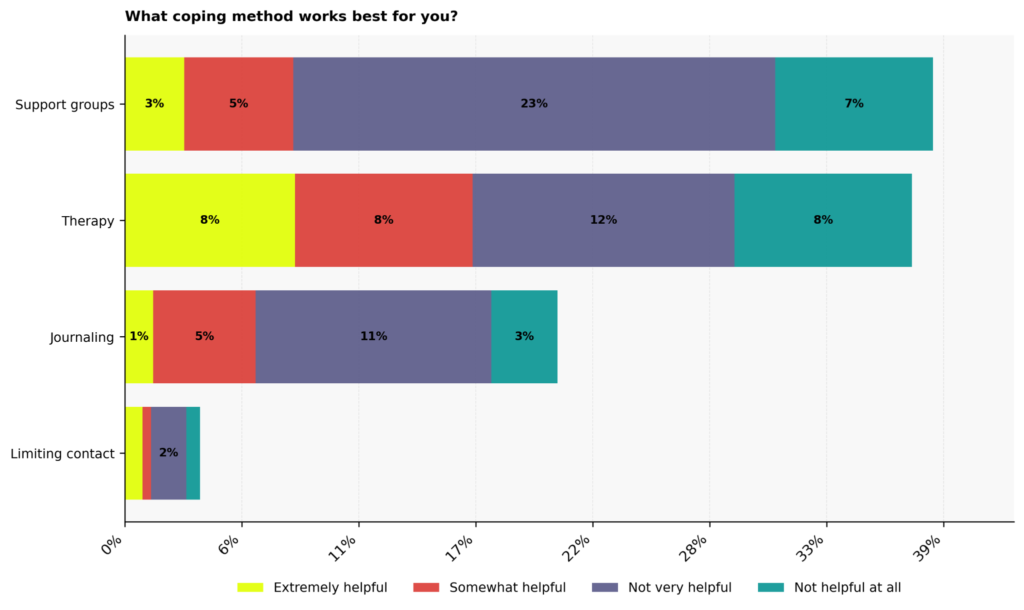
People experiencing narcissism adopt different coping methods, but no single approach works for everyone. 3% find support groups extremely helpful, and a further 5% find them somewhat helpful. Yet, 23% don’t find them helpful, and 7% see them as not helpful at all.
In terms of therapy, 8% find this approach invaluable, 8% marginally useful, 12% mostly ineffective, and 8% not helped by it at all.
1% of our audience finds journaling extremely helpful, and 5% find it somewhat helpful. 11% disagree with this claim to some degree, and 3% see it as useless. Limiting contact has been extremely or somewhat helpful for less than 1%; 2% have found that it’s not a good coping method, and another less than 1% have found no benefit from it.
This suggests that finding an effective coping method frequently involves trial and error.
What is the biggest unanswered question for people experiencing narcissism?
The top question for 1% of people experiencing narcissism is how to heal, and for 52% it’s also a big question, while 5% are somewhat curious, and just 1% don’t really question this, another 16% question how to leave safely, and for 11%, how to cope daily is a big question, with 9% also wondering if the narcissist will change.
Some questions weigh more heavily than others:
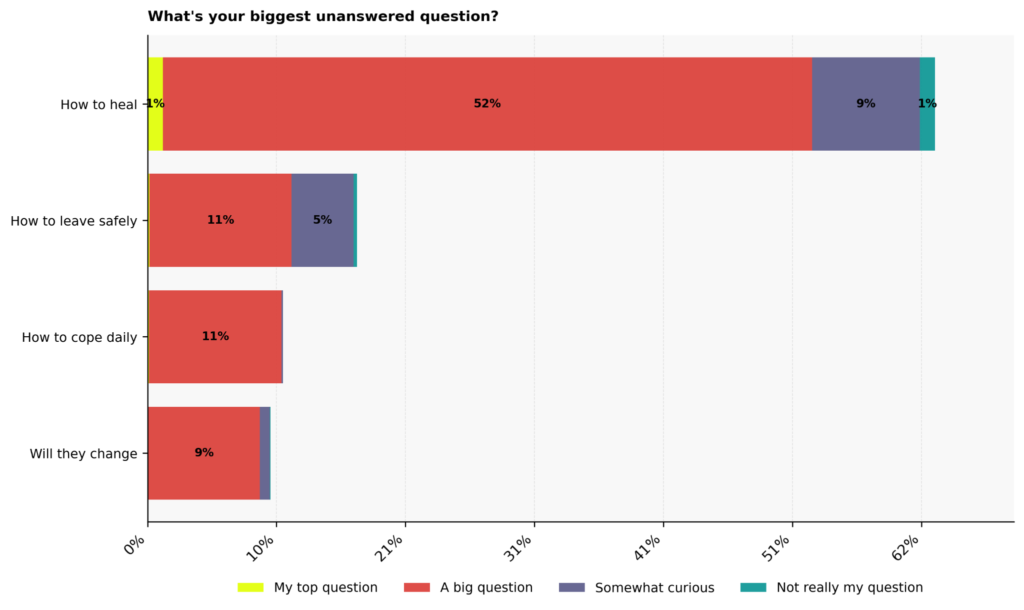
People experiencing narcissism often search for answers that can help them understand their situation and decide what to do next. How to heal is by far the biggest unanswered question for our audience. 1% see this issue as their top question, and 52% describe it as a major one. Another 9% are curious about it, and just 1% don’t have it as their question.
Leaving the relationship safely is the next most important concern, with 11% seeing this as a big question and 5% somewhat curious about it. Less than 1% have this either as their top question or as not really something they are wondering about.
Coping with everyday life is a major concern for many, with 11% of our audience seeing it as a major question. Less than 1% feel this is their top question.
Whether or not the narcissist will change is a big question for 9%, and less than 1% are somewhat curious about this.
It’s clear from this that the biggest questions don’t seem to be about why narcissism happens but rather how to recover from it and move on.
Looking beyond the diagnosis
Overall, these findings show that experiencing narcissistic behavior can have a profound and lasting impact on many aspects of a person’s life. From family relationships and friendships to workplaces and romantic partnerships, the effects often extend far beyond individual interactions.
The results also reinforce the importance of awareness, support, and healthy boundaries, while illustrating that every person’s experience is unique and influenced by the nature of their relationship and the challenges they face.
Continue the Journey
If you or your loved one is in need of support, contact us today and take the first step toward understanding, growth, and emotional balance.
For further insights and support, explore: The Narcissism Decoder Podcast: get a deeper understanding through expert discussions and real-life stories. These resources can provide additional guidance as you navigate your journey toward healing and personal growth.
Dr. Anthony Mazzella is a psychoanalyst and psychodynamic psychotherapist specializing in narcissism, personality disorders, and relational dynamics.

