
Covert narcissism can be difficult to identify because its behaviors may be subtle, inconsistent, or easily mistaken for ordinary insecurity or sensitivity. For people experiencing these dynamics, putting a name to what they are seeing can be complicated, particularly when the behavior is difficult to explain to others. According to Dr. Anthony Mazzella, the impact of covert narcissism can extend beyond the relationship itself, causing people to question their own perceptions, lose confidence in their interpretation of events, and change how they approach conflict and communicate.
To find out what 1,504,002 opinions of people experiencing narcissism in the USA were about covert narcissism, we utilized AI-driven audience profiling to synthesize insights from online discussions over 12 months, ending on August 13th, 2026, to a high statistical confidence level. The results reveal people’s lived experiences with covert narcissism, from recognizing its signs to dealing with the challenges it can create in relationships.
Index
- Methodology and data
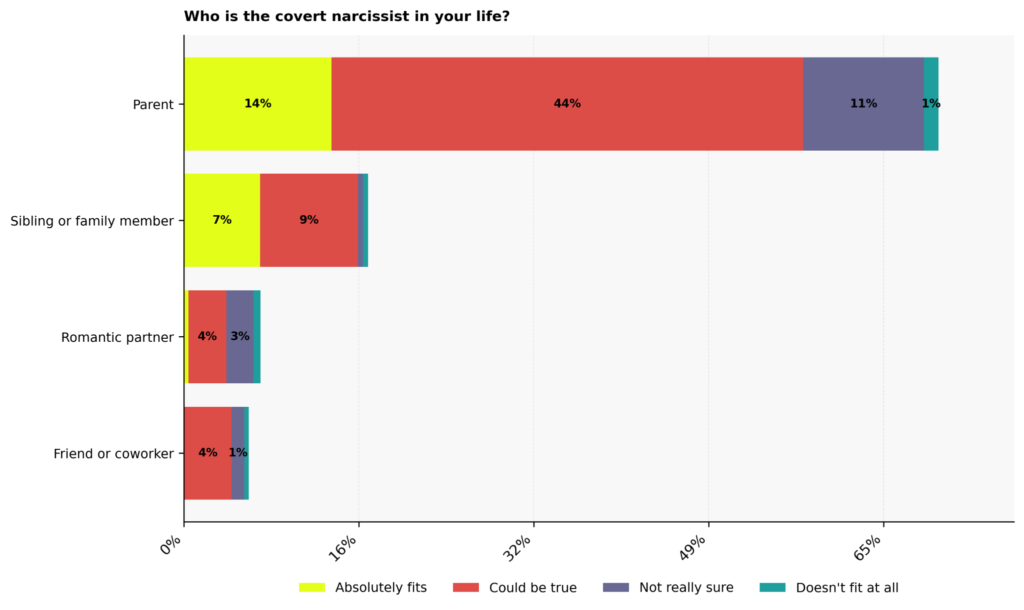
- 14% of people experiencing narcissism agree that in their life, a parent is absolutely a covert narcissist, 44% say this could be true, 11% are not really sure, and 1% don’t think that this diagnosis fits at all, while 7% agree that a sibling or family member is absolutely a covert narcissist, and 9% think it could be true, 4% feel the same about a romantic partner, and 3% are not really sure, and 4% agree a friend or coworker could be a covert narcissist, but 1% are not sure if they are
- 40% of people experiencing narcissism were in a relationship for 6 months to 2 years before noticing covert narcissism, 21% were in the relationship for more than 5 years, 3% for between 2 and 5 years, and 36% noticed it in less than 6 months
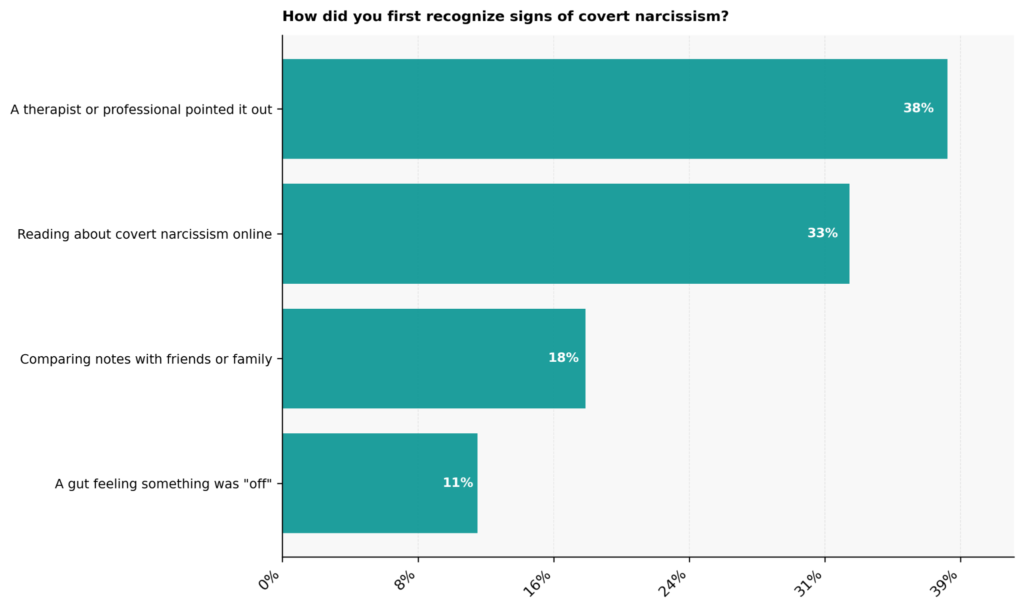
- 38% of people experiencing narcissism first had the signs of covert narcissism pointed out to them by a therapist or professional, 33% noticed the signs after they read about covert narcissism online, 18% compared notes with friends or family, and 11% had a gut feeling that something was “off”
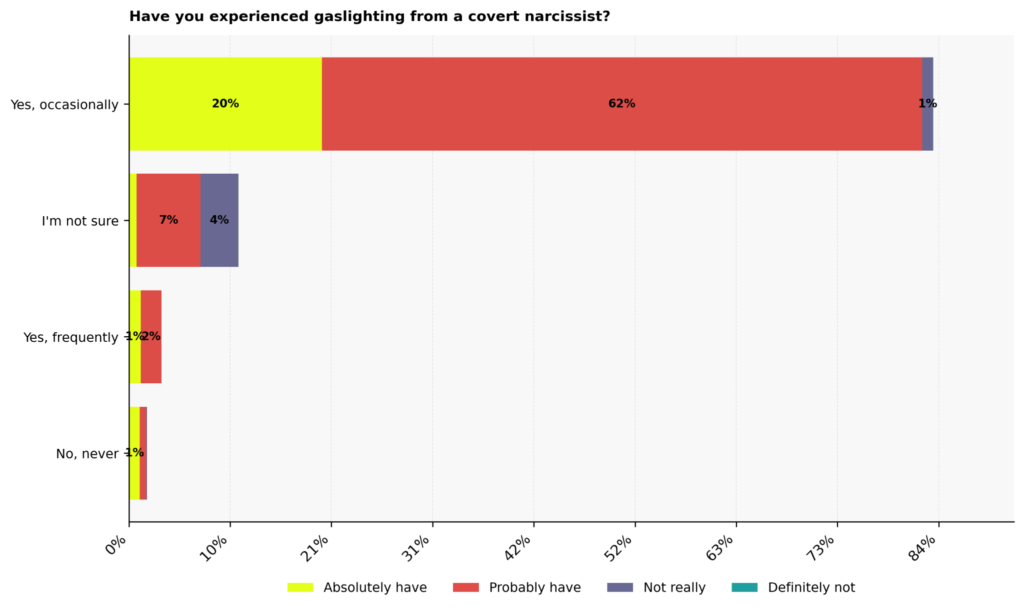
- 20% of people experiencing narcissism have absolutely experienced gaslighting from a covert narcissist occasionally, and 62% probably have, but 1% haven’t really, while 1% have frequently experienced gaslighting, and 2% probably have; only 1% have never experienced it, and 7% are not sure but probably have been gaslit, and 4% think they haven’t really, but are unsure
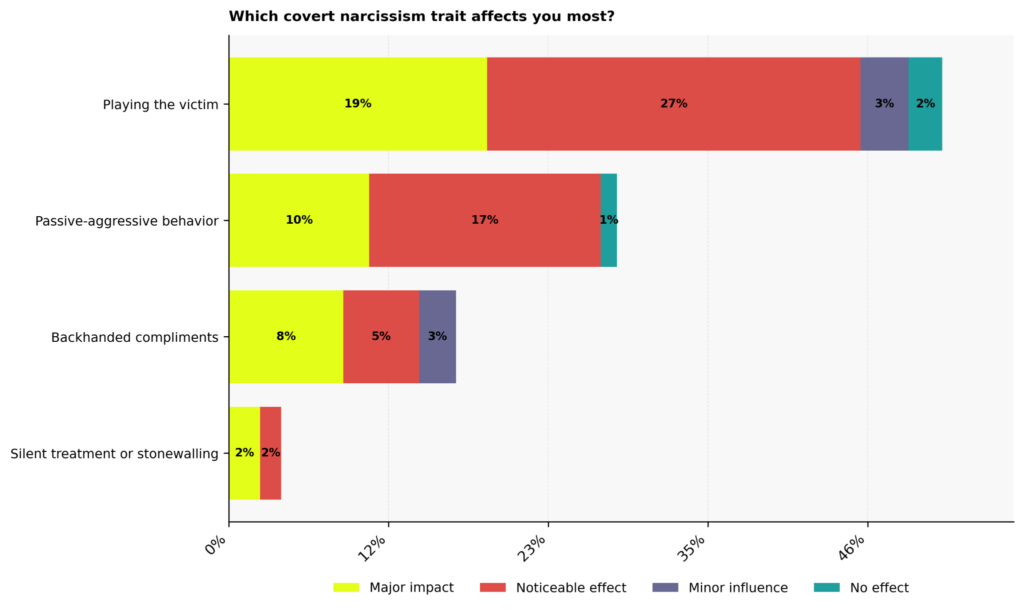
- Playing the victim is a covert narcissism trait that has a major impact on 19% of people experiencing narcissism, a noticeable effect on 27%, and a minor influence on 3%, but it has no effect on 2%, 10% find that passive-aggressive behavior has a major impact on them, 17% agree it has a noticeable effect, and 1% don’t find it has any effect, while backhanded compliments majorly impact 8% of those experiencing narcissism, and it has a noticeable effect for 5%, and a minor influence for 3%, and silent treatment or stonewalling has a major impact on 2% and a noticeable impact on a further 2%
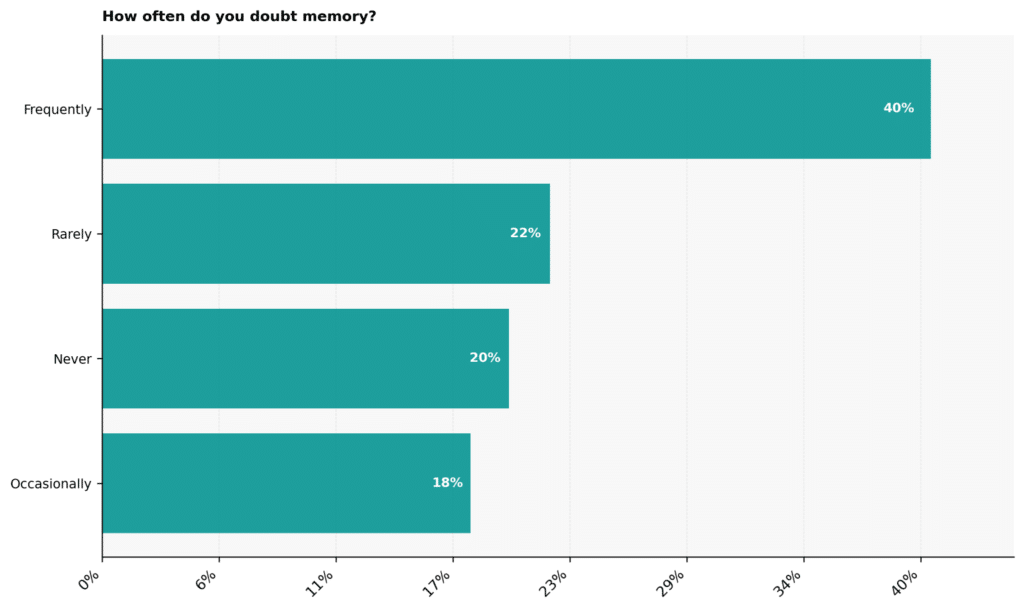
- 40% of people experiencing narcissism frequently doubt their memory; however, 22% rarely doubt it, 20% never doubt their memory, and 18% only doubt it occasionally
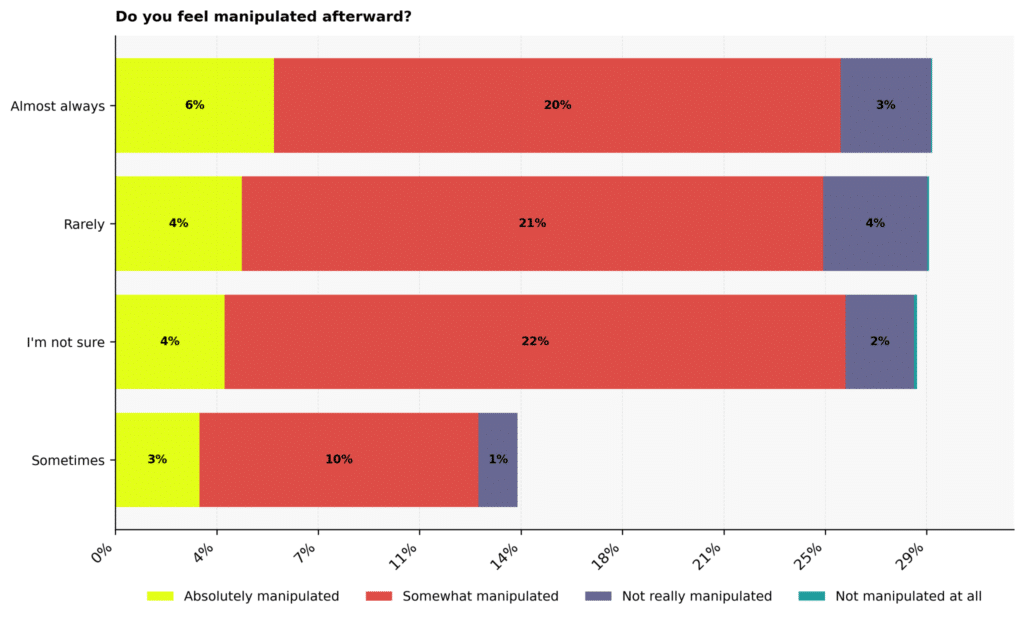
- 6% of people experiencing narcissism almost always feel absolutely manipulated, 20% feel somewhat so, and only 3% don’t really feel manipulated after any interaction with a narcissist, 3% sometimes feel absolutely manipulated, and 10% feel somewhat so sometimes, but 1% don’t really, while 4% rarely feel manipulated, 21% feel somewhat manipulated rarely, and 4% don’t feel this way at all, and 28% are not sure if they feel manipulated after interacting with a narcissist
- 26% of people experiencing narcissism absolutely feel confused after a confrontation with a covert narcissist, 16% sometimes feel confused, and 1% rarely feel this emotion, 10% absolutely feel anger after a confrontation, and another 10% are sometimes angry, while 7% always feel sad, and 7% sometimes feel sad, but 1% are rarely saddened, while 2% absolutely feel relief, 3% are sometimes relieved, 9% rarely so, and 9% never feel relief when the confrontation has passed
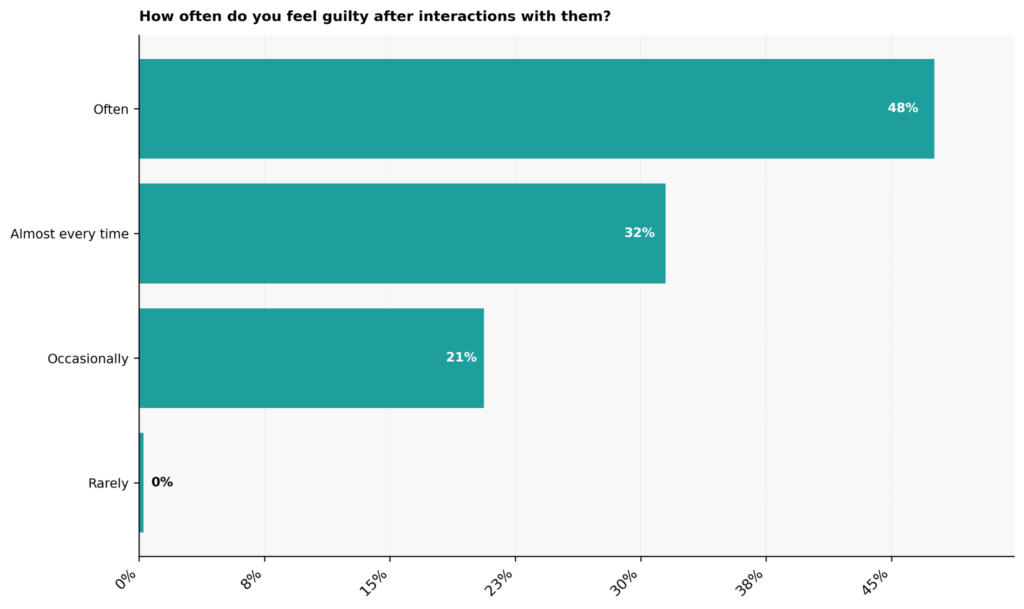
- 48% of people experiencing narcissism often feel guilty after interactions with a covert narcissist, 32% feel guilty after almost every interaction, and 21% occasionally feel guilt, while no one rarely feels this emotion after confronting a narcissist
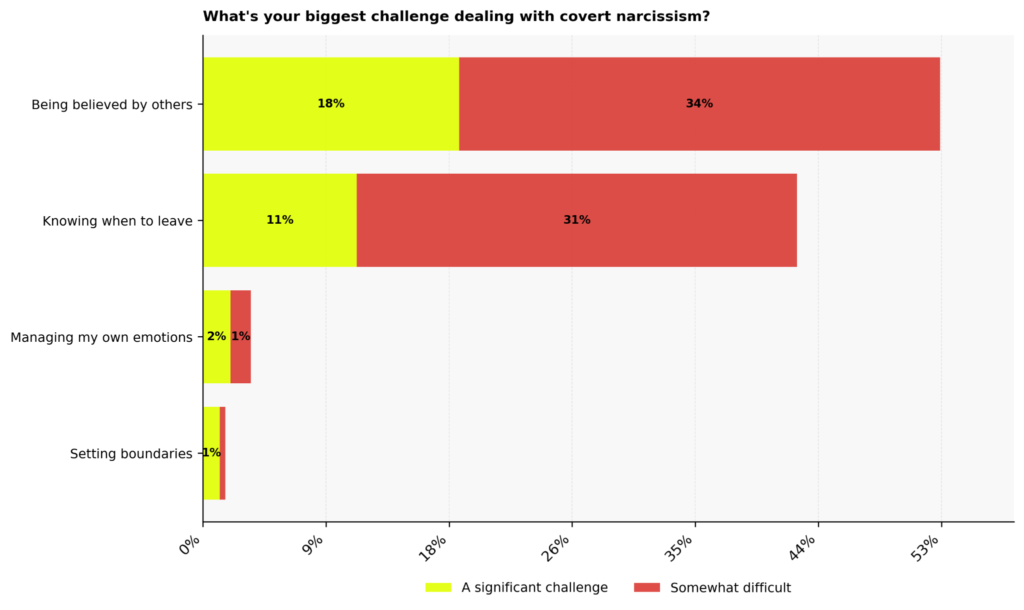
- 18% of people experiencing narcissism find that being believed by others is a significant challenge when dealing with covert narcissism, and 34% find this somewhat difficult, 11% battle with knowing when to leave, and 31% agree this is somewhat difficult, 2% find managing their own emotions a significant challenge, and 1% agree this is somewhat difficult, while setting boundaries is a significant challenge for 1%
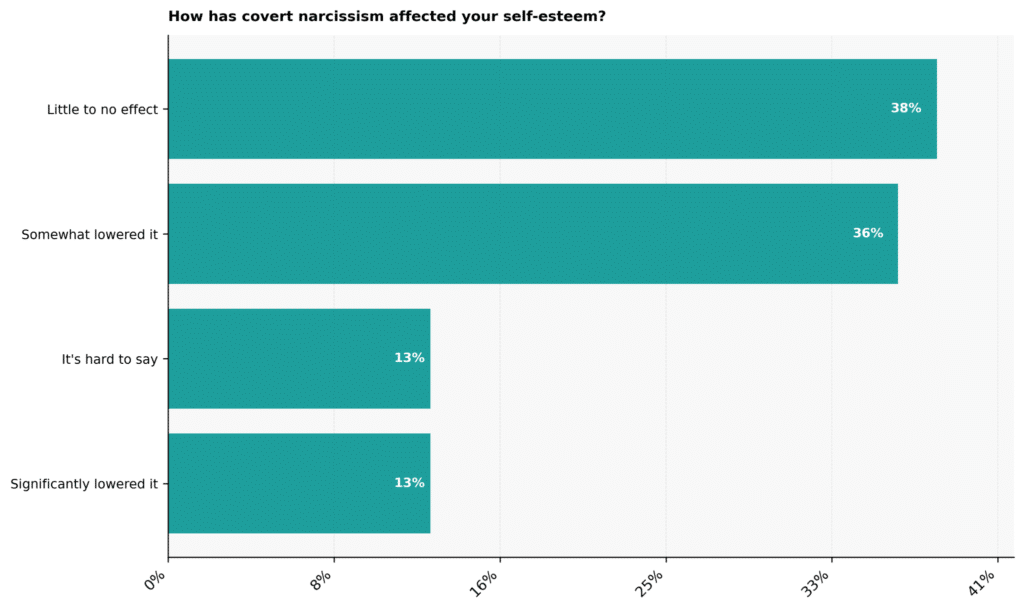
- For 38% of people experiencing narcissism, covert narcissism has had little to no effect on their self-esteem; however, for 36% it has somewhat lowered it, 13% find their self-esteem is significantly lowered, and for the remaining 13% it’s hard to say if there’s been any impact on their self-esteem
- 53% of people experiencing narcissism cope with stonewalling from a covert narcissist by addressing it directly, 27% still don’t know how to address it, and 20% simply walk away when stonewalled
- Talking to a therapist is the main coping strategy for 33% of people experiencing narcissism, 37% use this avenue of support sometimes, 16% rarely use it, and 3% say that therapy is not their approach, while 5% use journaling or self-reflection as their main strategy to cope, and 2% sometimes set boundaries, while no one mentions limiting contact to cope with a covert narcissist
- 67% of people experiencing narcissism set boundaries now by using clear, direct statements that cannot be misunderstood, 9% involve a third party, and 25% still struggle with boundary setting
- 8% of people experiencing narcissism journal their feelings as a habit, and 36% do so sometimes when they need to; 14% do so daily, but this isn’t really 12% of people’s thing; 2% occasionally journal as a habit, and 25% do so occasionally too, while 2% never journal but know they can if they need to
- 81% of people experiencing narcissism don’t explain it at all to others, while 19% describe specific incidents, and no one mentions sharing articles or resources to explain their experience
- 94% of people experiencing narcissism feel completely alone and are not supported by friends or family, 4% are somewhat supported, and just 2% are very supported by those closest to them
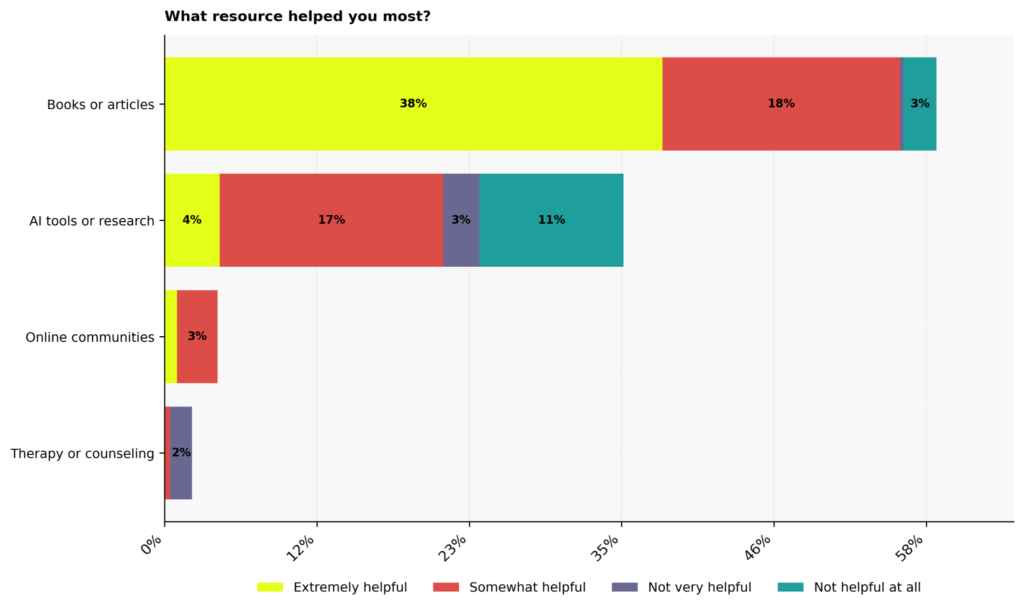
- Books or articles are an extremely helpful resource for 38% of people experiencing narcissism, and are somewhat helpful for 18%, but they don’t help 3% at all, AI tools or research are extremely helpful for 4%, and somewhat so for 17%, but 14% don’t find them helpful, while 3% agree online communities help them somewhat, and 2% don’t find therapy or counseling very helpful when coping with narcissism
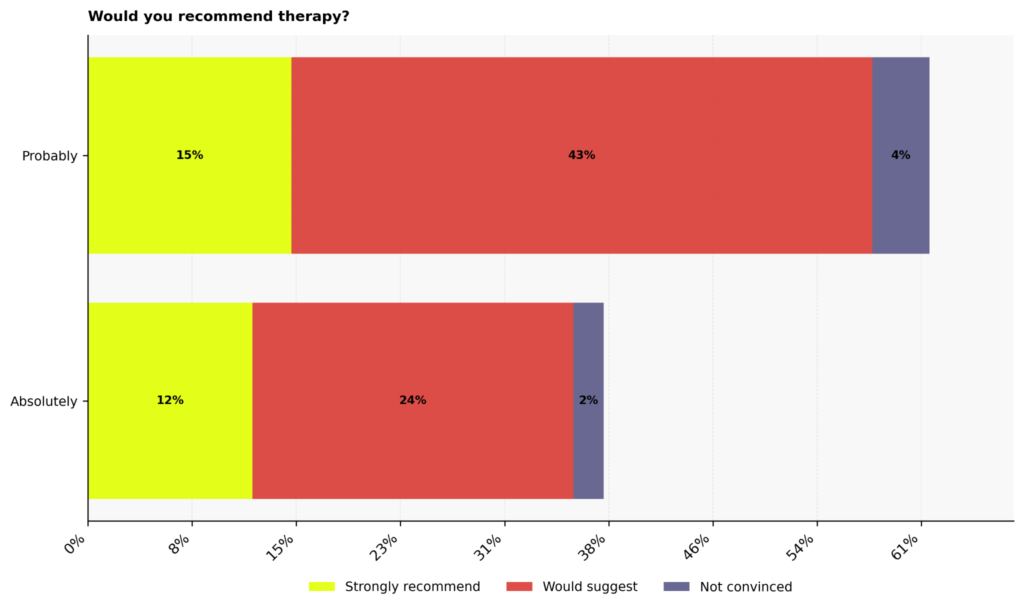
- 15% of people experiencing narcissism probably would strongly recommend therapy, 43% would probably strongly suggest it, and only 5% are not convinced they’d probably recommend therapy, while 12% would absolutely recommend therapy, and 24% would suggest it, 2% are not convinced they would absolutely recommend this treatment route
- 66% of people experiencing narcissism rebuild their confidence by going to therapy, and 34% are still working on rebuilding their confidence
- Moving forward from covert narcissism
Methodology and data
Sourced using Artios from an independent sample of 1,504,002 opinions of people experiencing narcissism in the USA across X, Quora, Reddit, Bluesky, TikTok, and Threads. Responses are collected within a 95% confidence interval and 5% margin of error. Results are derived from what people describe online, from opinions expressed, and not actual questions answered by people in the sample.
Who is the covert narcissist in the lives of people experiencing narcissism?
14% of people experiencing narcissism agree that in their life, a parent is absolutely a covert narcissist, 44% say this could be true, 11% are not really sure, and 1% don’t think that this diagnosis fits at all, while 7% agree that a sibling or family member is absolutely a covert narcissist, and 9% think it could be true, 4% feel the same about a romantic partner, and 3% are not really sure, and 4% agree a friend or coworker could be a covert narcissist, but 1% are not sure if they are.
Relationships with narcissists extend beyond familiar bounds:
It’s estimated that between 0.5% and 5% of Americans may have narcissistic personality disorder (NPD). However, the less visible nature of covert narcissism means that its true prevalence is challenging to measure.
Yet, for our audience of people experiencing narcissism, there’s definite awareness of this condition and of who is suffering from it in their lives. For 14%, the description of covert narcissism absolutely fits their parents, and 44% agree that this could be true. Comparatively, 11% aren’t really sure, and 1% feel it doesn’t fit. For 7%, the description of a covert narcissist absolutely fits their sibling or family member, 9% recognize that this might be true, and less than 1% don’t believe it fits at all.
On the lower end, 4% feel that the covert narcissist in their lives could be a romantic partner, friend, or coworker. Romantic partners have a further 3% who aren’t really sure, while less than 1% say this description doesn’t fit at all. Friends and coworkers show a similar pattern, with 1% being unsure and less than 1% saying it doesn’t fit.
These lower numbers show that covert narcissism isn’t limited to relationships with long histories or family ties and that there are people who encounter this behavior in relationships built on different foundations, including choice, attraction, and work.
How long were people experiencing narcissism in the relationship before noticing covert narcissism?
40% of people experiencing narcissism were in a relationship for 6 months to 2 years before noticing covert narcissism, 21% were in the relationship for more than 5 years, 3% for between 2 and 5 years, and 36% noticed it in less than 6 months.
Long-term relationships dominate:
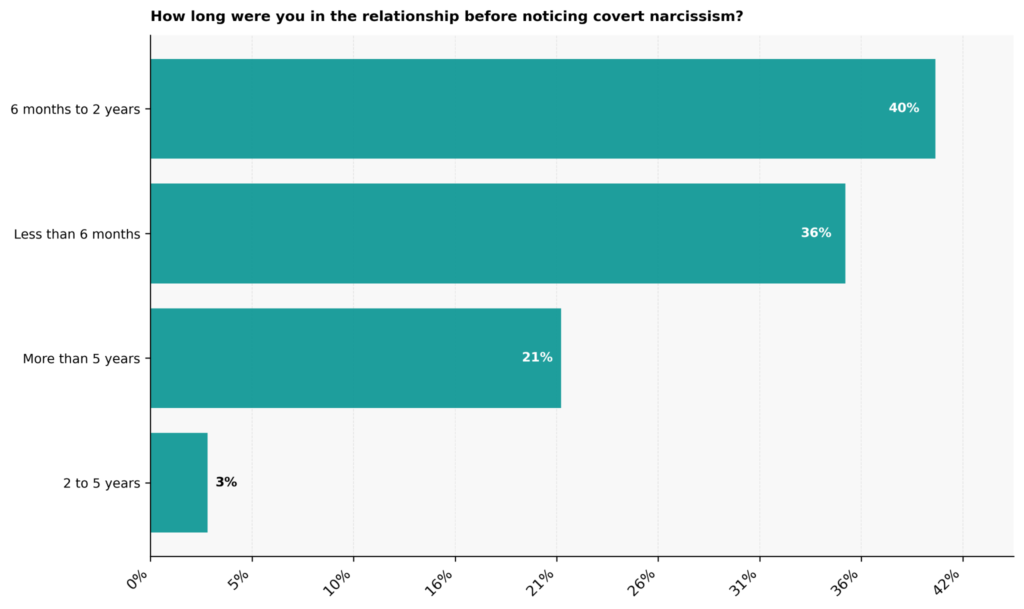
Recognizing covert narcissism can take time. For our audience, 21% took more than five years to see the patterns characterizing this disorder, and 3% took between two and five years. The majority (40%) took between six months and two years, but 36% were able to spot them in less than six months.
Spotting a covert or vulnerable narcissist can take longer than recognizing an overt one because the grandiosity that defines this disorder may initially be concealed behind a convincing veneer of shyness, self-deprecation, insecurity, and a persistent victim mentality.
How did people experiencing narcissism first recognize signs of covert narcissism?
38% of people experiencing narcissism first had the signs of covert narcissism pointed out to them by a therapist or professional, 33% noticed the signs after they read about covert narcissism online, 18% compared notes with friends or family, and 11% had a gut feeling that something was “off”.
Spotting the signs may require a professional:
The way people experiencing it first recognize covert narcissism depends on how visible the underlying behavior is and whether there is a reliable perspective to help make the situation they’re in make sense.
Among our audience, professional input plays the largest role in how people experiencing narcissism first recognize the signs of covert NPD, with a therapist or professional pointing it out for 38%. A further 33% first recognized the signs after reading about the disorder online, indicating that professional guidance and self-directed research about expert views on the subject are the two main routes to recognizing the patterns of covert NPD.
The remaining 18% of our audience compared notes with their friends or family, while 11% sensed that something was “off.” Although intuition alone cannot confirm that someone is experiencing covert narcissism, it can be an important prompt to pay closer attention to behaviors and seek further information or professional advice. A 2026 survey found that 71% of adults report listening to their intuition at least some of the time, indicating that gut feelings play a significant role in how many people make sense of situations that don’t feel quite right.
Have people experiencing narcissism experienced gaslighting from a covert narcissist?
20% of people experiencing narcissism have absolutely experienced gaslighting from a covert narcissist occasionally, and 62% probably have, but 1% haven’t really, while 1% have frequently experienced gaslighting, and 2% probably have; only 1% have never experienced it, and 7% are not sure but probably have been gaslit, and 4% think they haven’t really, but are unsure.
Gaslighting is a common experience:
Gaslighting can involve denying that events have occurred, questioning memories of them, feelings being dismissed, and other behaviors that leave people experiencing narcissism uncertain about their own perceptions. Psych Central notes that it can occur alongside narcissistic traits, but it isn’t exclusive to NPD, and having NPD doesn’t necessarily mean that a person will use gaslighting as a way to gain power and control.
This context may help explain why people involved with someone showing covert narcissistic traits may struggle to make sense of their interactions. They may encounter isolated incidents without being sure they’re part of a wider pattern, especially when the behavior is subtle or mixed with genuine disagreements and misunderstandings.
62% of our audience confirms that they’ve probably encountered gaslighting from a covert narcissist occasionally, while 20% say they absolutely have. Comparatively, just 1% feel that they’ve not really gone through this. Among those who aren’t sure, less than 1% have definitely encountered gaslighting, 7% probably have, and 4% aren’t really sure whether it occurred.
A smaller proportion describe more frequent exposure, with 1% definitely having experienced it and 2% probably having done so. Lastly, just 1% say they’ve never experienced gaslighting from a covert narcissist, putting them firmly in the minority.
This gap between occasional and frequent gaslighting tells us that it doesn’t necessarily have to be a constant encounter to have an impact on how someone experiencing narcissism is interpreting their relationship.
Which covert narcissism trait affects people experiencing narcissism most?
Playing the victim is a covert narcissism trait that has a major impact on 19% of people experiencing narcissism, a noticeable effect on 27%, and a minor influence on 3%, but it has no effect on 2%, 10% find that passive-aggressive behavior has a major impact on them, 17% agree it has a noticeable effect, and 1% don’t find it has any effect, while backhanded compliments majorly impact 8% of those experiencing narcissism, and it has a noticeable effect for 5%, and a minor influence for 3%, and silent treatment or stonewalling has a major impact on 2% and a noticeable impact on a further 2%.
Some traits have more impact than others:
Covert narcissism behaviors can take different forms, ranging from indirect hostility and criticism to total withdrawal as a form of punishment and presenting oneself as the injured party. These behaviors often stem from a profound sense of insecurity, a pathological fear of rejection, extreme difficulty expressing anger, and learned, maladaptive responses to conflict.
Playing the victim affects people experiencing narcissism the most, with it having a major impact for 19% and a noticeable effect for 27%. For 3% and 2%, respectively, it has a minor influence or no effect.
Passive-aggressive behavior affects 10% in a major way; 17% cite it as having a major impact; and 1% say it has had no effect on them. For 8%, backhanded compliments have had a major impact, and this behavior has had a noticeable effect for a further 5%. 3% feel that these have had only a minor influence on them.
2% name silent treatment or stonewalling as the covert NPD trait that has had a major impact, and another 2% describe the effect as noticeable.
The stronger impact associated with victim-playing may reflect how it can shift attention away from the original conflict and towards the perceived suffering of the person displaying the behavior.
How often do people experiencing narcissism doubt their memory?
40% of people experiencing narcissism frequently doubt their memory; however, 22% rarely doubt it, 20% never doubt their memory, and 18% only doubt it occasionally.
Memory may not be considered reliable by everyone:
Having a little uncertainty about your memory is normal because it’s reconstructive, so details can become less clear and even change slightly over time, especially when we’ve gone through something emotional or are trying to remember an incident from long ago. However, natural uncertainty can become harder to navigate for people experiencing narcissism.
Repeated denials, defensiveness, conflicting accounts, and subtle blame-shifting can leave you questioning your recollection, and over longer periods, this uncertainty makes it harder to distinguish ordinary lapses from doubt that’s developed because of difficult interactions.
Among people experiencing narcissism, 40% frequently doubt their memories, and a further 18% do so occasionally. This means that 58% of our audience question their memories on a fairly regular basis. However, 22% rarely doubt their memories, and 20% never do, combining for a total of 42%.
Memory may also be relevant from the other side of the relationship. Research by Miranda Giacomin and colleagues found that people with higher levels of NPD performed less well on memory tests involving faces, lecture information, and objects. Greater self-focus was linked to poorer recall, making it possible that attention directed towards the self may leave fewer mental resources available for taking in and retaining other information. While this research concerns people with higher levels of NPD rather than those experiencing narcissism, it adds another dimension to the relationship between narcissism and memory.
Do people experiencing narcissism feel manipulated afterward?
6% of people experiencing narcissism almost always feel absolutely manipulated, 20% feel somewhat so, and only 3% don’t really feel manipulated after any interaction with a narcissist, 3% sometimes feel absolutely manipulated, and 10% feel somewhat so sometimes, but 1% don’t really, while 4% rarely feel manipulated, 21% feel somewhat manipulated rarely, and 4% don’t feel this way at all, and 28% are not sure if they feel manipulated after interacting with a narcissist.
Manipulation is felt at different levels:
The experience of feeling manipulated after interacting with someone with covert narcissism varies in both frequency and degree, with people feeling manipulated almost always, rarely, or sometimes, or remaining unsure whether manipulation has occurred.
Somewhat manipulated is the largest category within each group, and this result gives the findings a clear emphasis on moderate, rather than absolute, perceptions of influence. In the almost always category, 20% describe themselves as somewhat manipulated, while 6% feel they absolutely are, and 3% feel that they’re not really being controlled.
The “rarely” category follows a similar pattern. Here, 21% of people experiencing narcissism describe themselves as somewhat manipulated, compared with 4% who absolutely are and the same percentage who are not really. The difference between the 20% and 21% figures is just 1%, making the level of somewhat manipulated nearly identical across these two categories.
In the I’m not sure category, 22% feel somewhat manipulated compared to 4% and 2% who are absolutely and not really, respectively. The “sometimes” category is even smaller, with 10% agreeing that they feel somewhat manipulated, 3% as absolutely, and 1% as not really.
These percentages show a clear distinction between experiencing manipulation and being certain you have done so. Somewhat manipulated consistently accounts for the largest share of the online conversation, while absolutely manipulated remains considerably smaller.
What emotion do people experiencing narcissism feel most after confrontation?
26% of people experiencing narcissism absolutely feel confused after a confrontation with a covert narcissist, 16% sometimes feel confused, and 1% rarely feel this emotion, 10% absolutely feel anger after a confrontation, and another 10% are sometimes angry, while 7% always feel sad, and 7% sometimes feel sad, but 1% are rarely saddened, while 2% absolutely feel relief, 3% are sometimes relieved, 9% rarely so, and 9% never feel relief when the confrontation has passed.
Confusion is a common emotion:
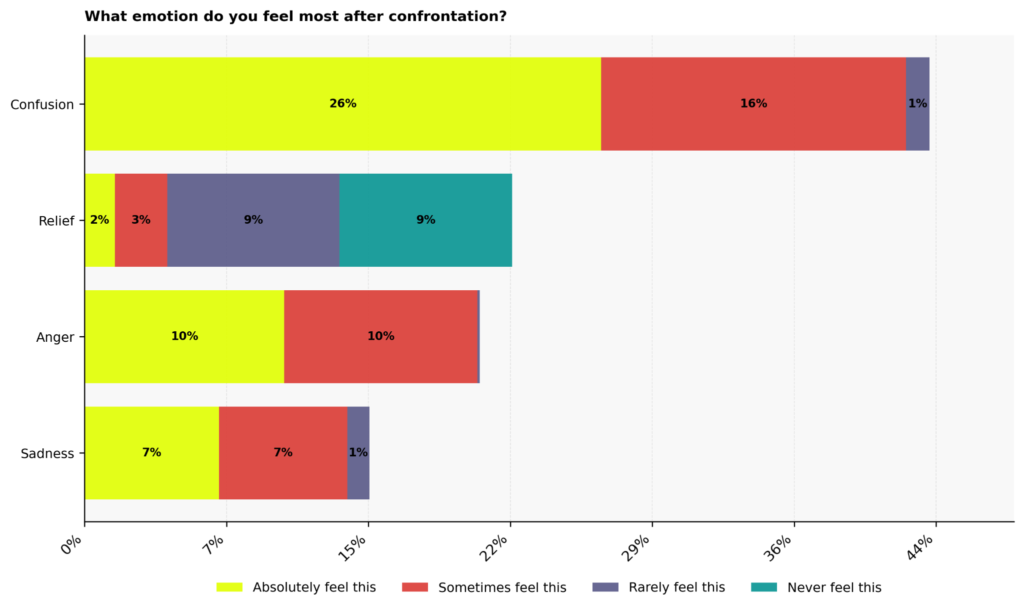
The aftermath of confrontation varies considerably among people experiencing narcissism, but confusion stands out as the most common takeaway. 26% absolutely feel confused after they’ve confronted someone or been confronted by them, 16% sometimes feel uncertain, and just 1% rarely do. Just 2% absolutely feel relieved, and 3% sometimes experience a sense of release, while 9% rarely experience reassurance and another 9% never do.
Anger is more evenly divided, with 10% absolutely experiencing it and another 10% reporting frustration only occasionally. Just 1% rarely experience it.
People’s emotional response appears to be tied more closely to uncertainty than to resolution, and these findings could help explain why confrontation doesn’t always bring a sense of emotional closure.
The clear contrast between these reactions points to the emotional aftermath of confrontation having its own impact on people experiencing narcissism, rather than simply ending when the interaction does.
How often do people experiencing narcissism feel guilty after interactions with the narcissist?
48% of people experiencing narcissism often feel guilty after interactions with a covert narcissist, 32% feel guilty after almost every interaction, and 21% occasionally feel guilt, while no one rarely feels this emotion after confronting a narcissist.
Guilt and narcissism go hand-in-hand:
The Minds Journal discusses several possible reasons for guilt persisting after encounters with people suffering from NPD. In addition to learned guilt about setting boundaries and prioritizing someone else’s needs, other reasons include gaslighting that leaves people questioning their experiences, grieving an imagined future, and pressure from those around them that may have encouraged them to stay.
Among people experiencing narcissism, 48% of our audience often feel guilty after interactions with a narcissist, making this group the largest proportion. A further 32% experience guilt almost every time, and 21% do so only occasionally. Fewer than 1% of conversations centered around rarely feeling guilt after an interaction, meaning the experience is concentrated heavily at the upper end of the scale.
Dr. Anthony Mazzella, who has written extensively about guilt in covert narcissistic relationships, suggests that guilt may function less as an explicit demand and more subtly, by making the child feel responsible for the parent’s emotional state. In his clinical work on covert narcissistic parenting, he describes how a child’s growing independence or emotional separation can become linked with the parent’s distress, leaving the child feeling responsible for managing the parent’s feelings.
What are people experiencing narcissism’s biggest challenge when dealing with covert narcissism?
18% of people experiencing narcissism find that being believed by others is a significant challenge when dealing with covert narcissism, and 34% find this somewhat difficult, 11% battle with knowing when to leave, and 31% agree this is somewhat difficult, 2% find managing their own emotions a significant challenge, and 1% agree this is somewhat difficult, while setting boundaries is a significant challenge for 1%.
Dealing with a narcissist poses predominant challenges:
Dealing with covert narcissism can be difficult because the covert narcissist’s behavior may be too subtle for people outside the relationship to fully understand what’s going on. This strain can worsen when people struggle with boundaries, feel uncertain about whether a relationship is truly harmful, and face challenges with self-trust.
Being believed by others seems to be the biggest obstacle for people experiencing narcissism, with 34% describing it as somewhat difficult and 18% seeing it as a significant problem. Knowing when to leave follows, with 31% finding the task somewhat difficult and 11% regarding it as a real issue.
Managing personal emotions is a much smaller concern for our audience, with just 2% identifying it as a serious obstacle and 1% seeing it as somewhat of a challenge. 1% seriously struggle with setting boundaries, and fewer than 1% see this as sort of difficult.
Being believed by others accounts for 52% overall, making it 13 times as prominent as managing personal emotion. Knowing when to leave is responsible for 42%, which is over 21 times more prominent than setting boundaries.
Overall, these figures suggest that the biggest challenges are gaining validation from others and deciding when a relationship has become harmful enough to leave. For people experiencing subtle forms of narcissistic behavior, having confidence in their own perceptions can be difficult when those around them don’t see the same patterns.
How has covert narcissism affected the self-esteem of people experiencing narcissism?
For 38% of people experiencing narcissism, covert narcissism has had little to no effect on their self-esteem; however, for 36% it has somewhat lowered it, 13% find their self-esteem is significantly lowered, and for the remaining 13% it’s hard to say if there’s been any impact on their self-esteem.
Self-esteem is not something that always suffers:
Exposure to covert narcissism can affect self-esteem in very different ways, with some people noticing little change while others are able to see a clear decline. The split is particularly marked between those whose self-image remains largely intact and those who explain that theirs has been weakened by this type of NPD.
Little to no effect accounts for 38% of our audience’s experiences, with more than a third revealing that covert narcissism has made no real difference to their self-esteem. Somewhat lowered it follows closely at 36%. This accounts for 74% of the online conversation, showing that most people fall between experiencing little change and a moderate reduction in self-esteem.
A further 13% indicate that it’s hard to say whether or not their self-respect has been affected. This group is identical to the 13% who admit that their self-respect has significantly lowered. These equal proportions are notable because uncertainty about impact sits at exactly the same level as the most severe decline measured.
The figures tell us that the effect on their self-worth isn’t uniform for people experiencing narcissism. Healing and impact look entirely different for everyone, depending entirely on how deeply the abuse managed to breach their inner strength.
How do people experiencing narcissism cope with stonewalling?
53% of people experiencing narcissism cope with stonewalling from a covert narcissist by addressing it directly, 27% still don’t know how to address it, and 20% simply walk away when stonewalled.
Tackling stonewalling head-on leads the way:
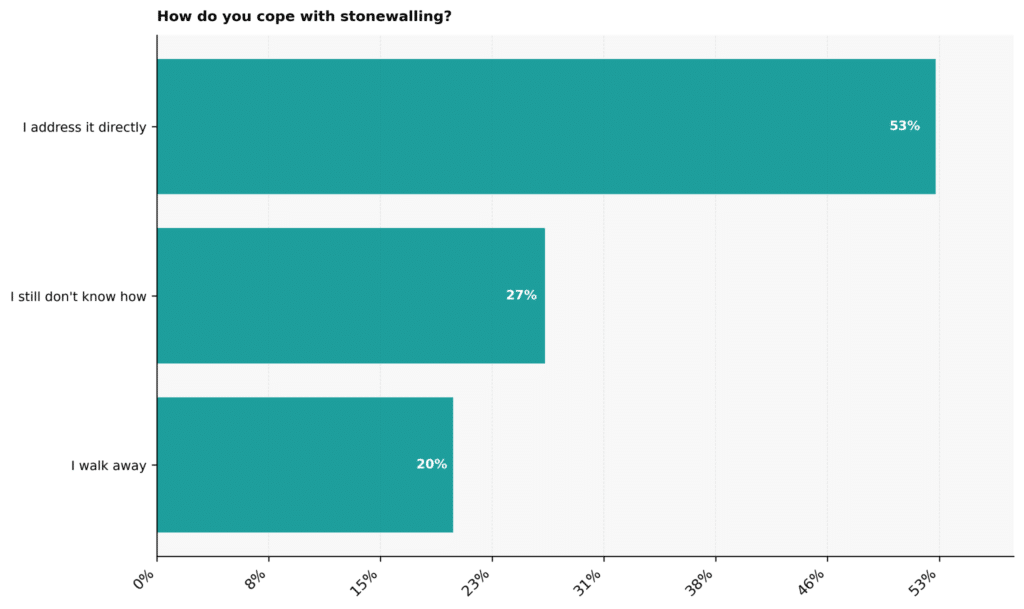
Stonewalling involves shutting down during conflict, refusing to communicate or engage, and can leave the person on the receiving end feeling confused, frustrated, and rejected. Among people experiencing narcissism, 53% address stonewalling directly, but 27% still don’t know how to cope with it, and 20% simply walk away.
The clearest pattern is that direct confrontation is the dominant coping strategy for people experiencing narcissism and stonewalling, but it doesn’t mean that they necessarily feel equipped to handle it 100%.
More than half address it directly, while almost half either remain unsure how to respond or disengage by walking away. Evidently, stonewalling creates a substantial divide between recognizing the behavior and knowing what to do with it.
What coping strategy do people experiencing narcissism rely on most?
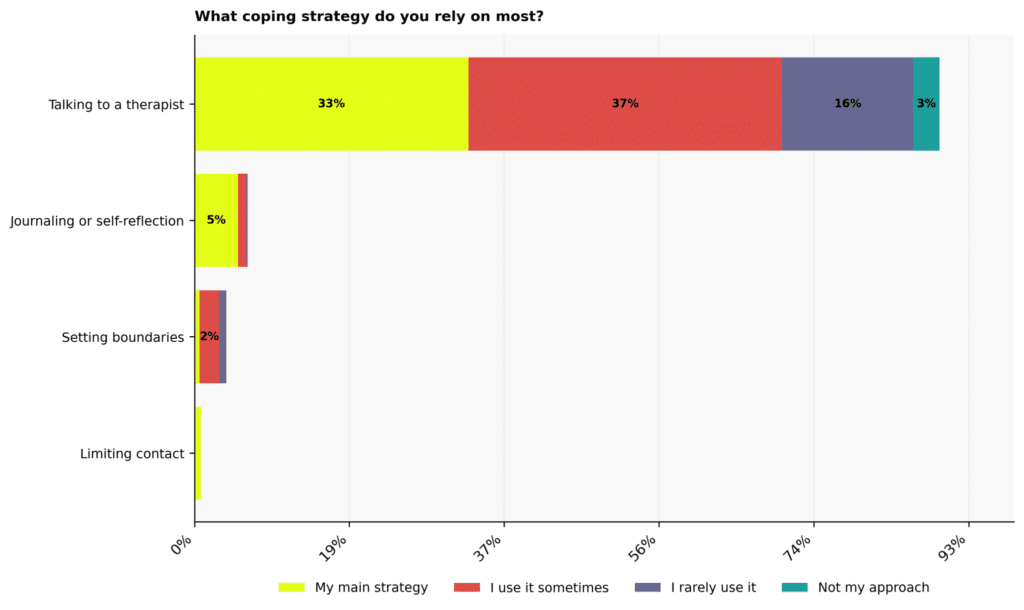
Talking to a therapist is the main coping strategy for 33% of people experiencing narcissism, 37% use this avenue of support sometimes, 16% rarely use it, and 3% say that therapy is not their approach, while 5% use journaling or self-reflection as their main strategy to cope, and 2% sometimes set boundaries, while no one mentions limiting contact to cope with a covert narcissist.
Talking it over makes it easier to cope:
People experiencing narcissism cope in very different ways, and therapy is one route for helping someone process difficult relationship dynamics. According to Statista, nearly 60 million adults in the US received mental health treatment in 2023. This list includes inpatient or outpatient treatment, prescription medication, telehealth services, or treatment received in a correctional setting.
For 33% of our audience, talking to a therapist is their main strategy, and another 37% use it sometimes. 16% rarely use it, and 3% describe this as “not my approach.” The potential benefits of this route can include accountability, emotional regulation, empathy building, and shame reduction.
Journaling or self-reflection accounts for 5% as their main strategy, with less than 1% doing this sometimes. Keeping a personal record can provide a clearer view of what’s happened prior, particularly when difficult interactions have left someone questioning their experiences.
While setting boundaries is how 2% of people cope sometimes, less than 1% see this as their main strategy or rarely use it. Although these percentages are small, establishing clear limits can help people experiencing narcissism protect their emotional resources and decide what behavior they are willing to accept. Less than 1% of people classify limiting contact as their main strategy.
The clearest trend here is a strong reliance on therapy compared with the other coping strategies measured. A combined 70% use therapy either as their main strategy or sometimes, while journaling, self-reflection, boundary-setting, and limiting contact account for much smaller proportions. This emphasizes that professional support is far more prominent than individual coping methods among this audience.
How do people experiencing narcissism set boundaries now?
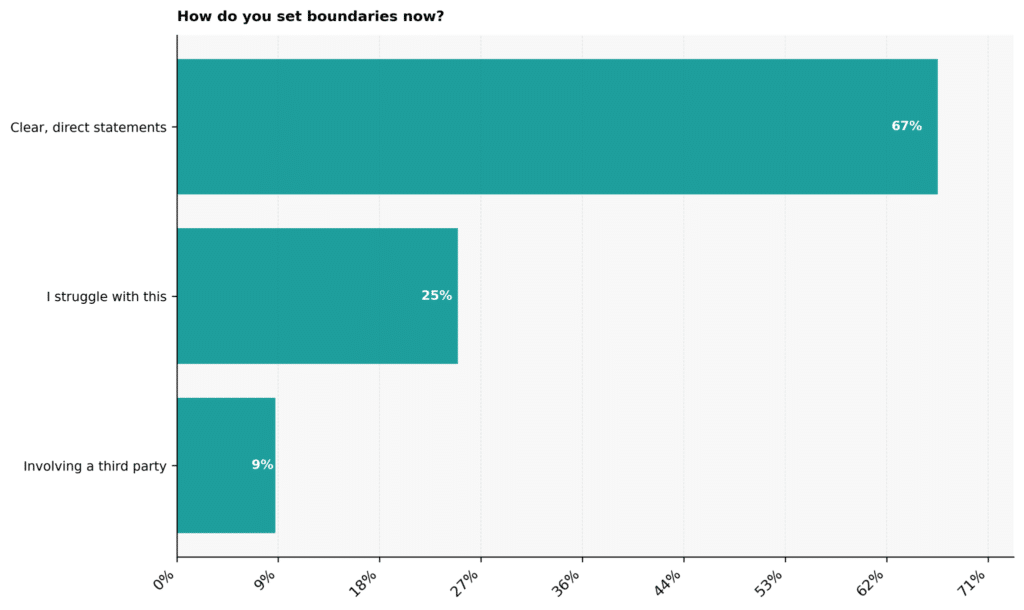
67% of people experiencing narcissism set boundaries now by using clear, direct statements that cannot be misunderstood, 9% involve a third party, and 25% still struggle with boundary setting.
Clarity creates the best boundaries:
Setting boundaries helps people dealing with narcissism protect their mental wellness, define the limits of behavior they will accept, and maintain a sense of personal autonomy. Clear limits may reduce exposure to harmful interactions, make non-negotiable expectations easier to communicate, and create a framework for responding when a covert narcissist challenges them.
Clear, direct statements are used by 67% of our audience when setting boundaries now; 25% struggle with it; and 9% involve a third party.
Clearly, difficulty with boundaries remains substantial, even though direct communication is the norm. One in four people struggles with boundary-setting, meaning that the ability to recognize unacceptable behavior doesn’t necessarily translate into confidence communicating limits.
Do people experiencing narcissism journal their feelings?
8% of people experiencing narcissism journal their feelings as a habit, and 36% do so sometimes when they need to; 14% do so daily, but this isn’t really 12% of people’s thing; 2% occasionally journal as a habit, and 25% do so occasionally too, while 2% never journal but know they can if they need to.
Journaling offers an outlet for everyone, but not all the time:

Psychoanalytic perspectives on journaling place particular importance on what emerges spontaneously when someone puts their thoughts into words without deliberately censoring or organizing them. Writing this way can capture associations, ideas, images, and memories that might otherwise pass unnoticed.
Among people experiencing narcissism, journaling is a habit for 8%, while 36% turn to it sometimes, when they need to. It’s a daily habit for less than 1%, used when necessary by 14%, and not something 12% do. Fewer than 1% have no experience with it.
For those who journal occasionally, 25% do it sometimes, when they need to, and 2% absolutely do it because it’s become a habit. The remaining 2% never journal, but are aware the option is there if they need it. WebMD notes that journaling doesn’t have to happen every day for it to be a useful tool. Even writing every now and then can help people gain a different perspective and pin down how they’re feeling.
How do people experiencing narcissism explain it to others?
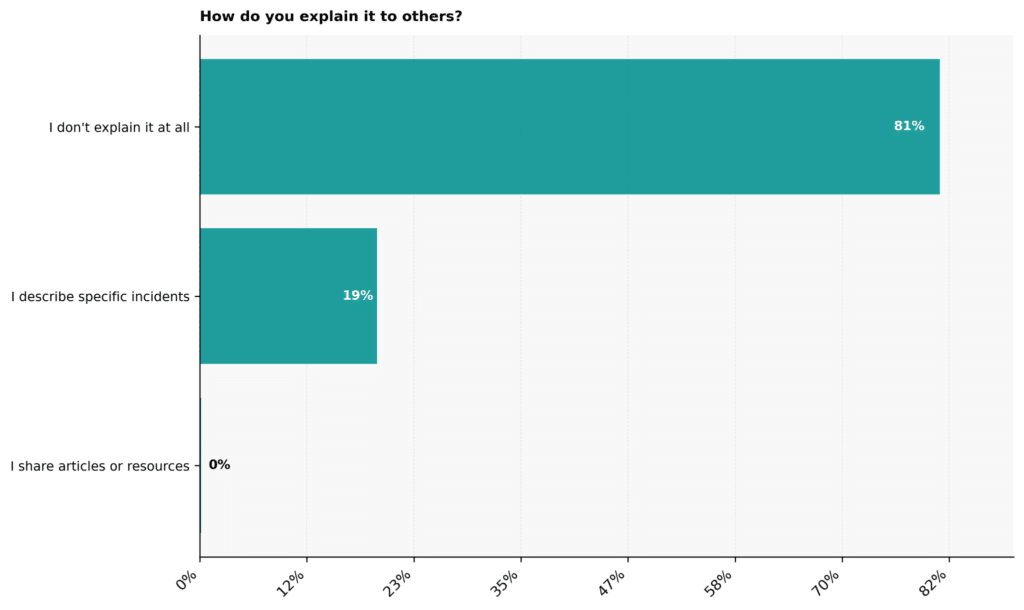
81% of people experiencing narcissism don’t explain it at all to others, while 19% describe specific incidents, and no one mentions sharing articles or resources to explain their experience.
Explaining narcissism is rare:
Explaining their experiences with narcissism to other people can be difficult for some because so much of what happens occurs privately and involves subtle patterns rather than clearly identifiable problematic incidents. Someone outside the relationship may struggle to reconcile what they’re hearing with the behavior they’ve personally witnessed, leaving the person inside it with limited choices.
In our audience, 81% of people experiencing narcissism don’t explain it at all, but 19% do describe specific incidents. No one shares articles or resources, although these can provide valuable context that people experiencing narcissism may struggle to create from isolated personal interactions.
How supported do people experiencing narcissism feel by friends and family?
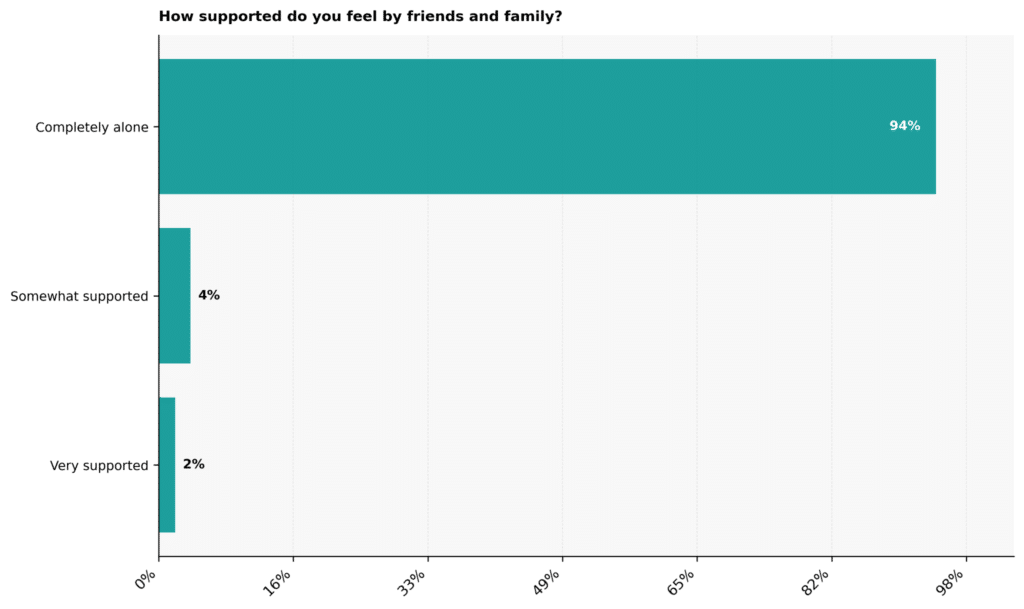
94% of people experiencing narcissism feel completely alone and are not supported by friends or family, 4% are somewhat supported, and just 2% are very supported by those closest to them.
Standing alone is experienced by the majority:
Support from friends and family can be especially significant for someone dealing with narcissism, providing that all-important reassurance, perspective, and a trusted person to turn to when difficult situations inevitably arise.
Yet the specific dynamics of private relationships are often difficult to explain, especially when outsiders have only seen the general positive features of the covert narcissist, including humility, self-sacrifice, and their deep sensitivity. For people experiencing narcissism, 94% describe their situation with friends and family as totally disconnected, explaining that they feel utterly alone. Another 4% feel only somewhat supported, and just 2% feel very supported.
This creates an unusual social interplay in which the people closest to the relationship have the least access to what’s happening within it. This can result in friends and family being shocked at a breakup because they only saw the happy outside image, them providing one-sided, unhelpful advice, isolation for the person experiencing narcissism, or tension as a result of those closest to these people feeling hurt or left out when private experiences become public knowledge at last.
What resource has helped people experiencing narcissism most?
Books or articles are an extremely helpful resource for 38% of people experiencing narcissism, and are somewhat helpful for 18%, but they don’t help 3% at all, AI tools or research are extremely helpful for 4%, and somewhat so for 17%, but 14% don’t find them helpful, while 3% agree online communities help them somewhat, and 2% don’t find therapy or counseling very helpful when coping with narcissism.
Available resources assist to varying degrees:
Reliable information can give people experiencing narcissism a better framework for understanding very subtle and difficult-to-recognize behavior. Trusted resources can help put unfamiliar patterns in their relationships into words, distinguish credible guidance from mere speculation, and provide them with a more grounded basis for deciding what information they need to act on.
38% of people experiencing narcissism rely on books or articles and find them extremely helpful, while 18% feel they are only somewhat helpful. A negligible percentage does not find them very helpful, and 3% do not view them as helpful at all.
AI tools or research provide practical advice that is extremely helpful for 4% of our audience, somewhat helpful for 17%, not very helpful for 33%, and not helpful at all for 11%.
Online communities and therapy account for the smallest shares among the resources measured, with the former being found extremely helpful by less than 1% of people experiencing narcissism and somewhat helpful by 3%. The latter has proven useful for few, with less than 1% considering it fairly worthwhile and 2% seeing it as not helpful.
These percentages imply that the type of information source makes a significant difference to how useful our audience finds it. Established written resources such as books and articles are viewed far more favorably than newer or more interactive sources, which may point to people placing greater trust in established sources when trying to make sense of complex or difficult relationship experiences.
Would people experiencing narcissism recommend therapy?
15% of people experiencing narcissism probably would strongly recommend therapy, 43% would probably strongly suggest it, and only 5% are not convinced they’d probably recommend therapy, while 12% would absolutely recommend therapy, and 24% would suggest it, 2% are not convinced they would absolutely recommend this treatment route.
Therapy comes highly recommended:
Therapy can provide a supportive space to explore the thoughts, emotions, and behaviors associated with narcissism. It can also help people develop healthier coping strategies and improve their relationships, making it useful to understand whether those experiencing narcissism would recommend it to others.
The majority of people experiencing narcissism agree with this, as 15% would strongly recommend therapy, and 43% would suggest it compared to the 4% who are not convinced. A further 12% are absolutely convinced therapy is something they would recommend, and 24% would absolutely suggest it, with only 2% not convinced.
The fact that such small numbers of people experiencing narcissism are not convinced they would recommend therapy indicates just how valuable talking to a professional can be, and how many people benefit from it.
How do people experiencing narcissism rebuild confidence?
66% of people experiencing narcissism rebuild their confidence by going to therapy, and 34% are still working on rebuilding their confidence.
Confidence and therapy are interlinked:
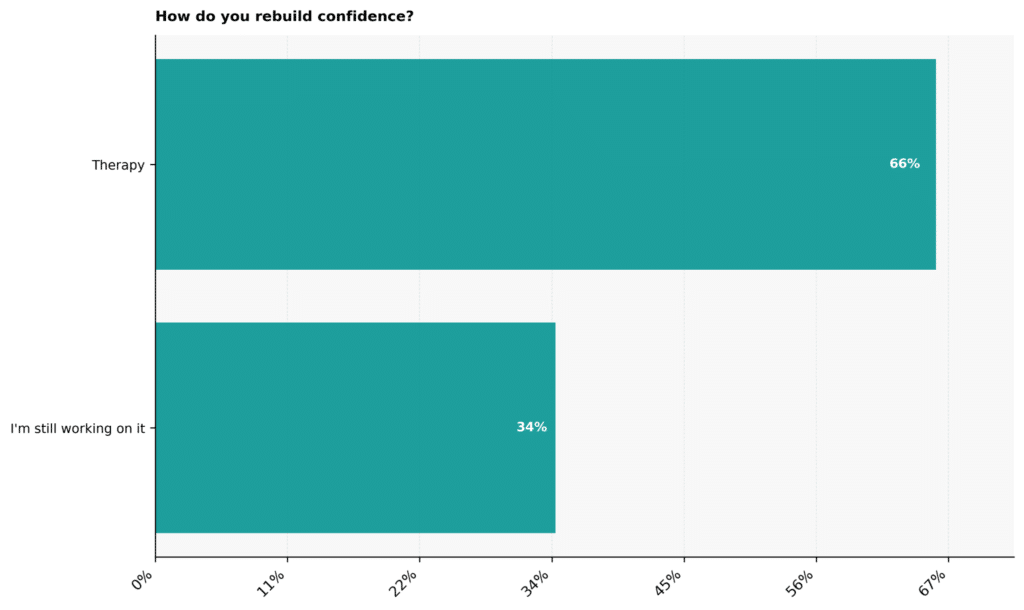
Cognitive behavioral therapy can help people identify negative thought patterns, challenge self-critical thinking, and build greater confidence and self-esteem. This bodes well for the 66% of our audience of people experiencing narcissism who are using therapy to rebuild their confidence.
CBT focuses on recognizing the thoughts and beliefs that can contribute to low self-esteem, then developing more constructive ways of thinking about themselves and their abilities. This can see people developing a more positive view of themselves over the long term.
Contrastingly, 34% are still working on it, highlighting that this can be a gradual process. Building confidence often involves changing established patterns of self-criticism rather than simply trying to think more positively, which can take time and repeated practice.
Moving forward from covert narcissism
Overall, these findings show how covert narcissism can leave people dealing with confusion, self-doubt, guilt, and feeling misunderstood. However, they also reinforce the value of professional support, reliable information, reflection, and stronger boundaries in helping people understand their experiences and rebuild confidence. By recognizing these patterns, those experiencing narcissism can focus on building healthier relationships and greater self-trust.
Dr. Anthony Mazzella is a psychoanalyst and psychodynamic psychotherapist specializing in narcissism, personality disorders, and relational dynamics.
Continue The Journey
If you or your loved one is in need of support, contact us today and take the first step toward understanding, growth, and emotional balance.
For further insights and support, explore:
The Narcissism Decoder Podcast: get a deeper understanding through expert discussions and real-life stories.
These resources can provide additional guidance as you navigate your journey toward healing and personal growth.

