
Narcissistic relationships can be difficult to identify, particularly when harmful behaviors develop gradually or occur alongside affection, promises, and periods of apparent normality. Whether the relationship involves a romantic partner, parent, friend, or colleague, understanding the dynamics can be challenging, especially when the person displaying narcissistic traits is someone the individual cares about or depends on.
To find out what 1,409,472 opinions of people experiencing narcissism in the US were about narcissistic relationships, we utilized AI-driven audience profiling to synthesize insights from online discussions over 12 full months ending October 10th, 2026, to a high statistical confidence level. What our audience shares about these relationships sheds light on the behaviors they encounter, the warning signs they recognize, and the questions they face as they try to make sense of their experiences.
Index
- Methodology and data
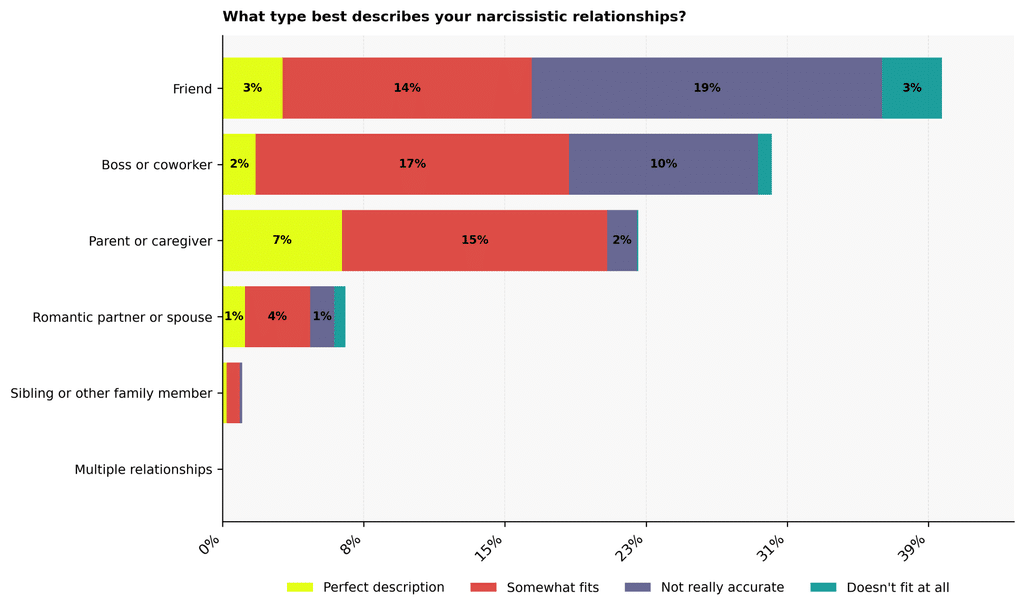
- 3% of people experiencing narcissism have a narcissistic friend; this somewhat fits for 14%, but not for 21%; 2% have a narcissistic relationship with a boss or coworker, and this somewhat fits for 17%, but is not really accurate for 10%, while 7% agree that they have a narcissistic relationship with a parent or caregiver, and this fits for 15% but less so for 2%; 1% have a narcissistic romantic partner or spouse, 15% agree they do somewhat, but this isn’t really accurate for 2%, while fewer than 1% voice an opinion about a narcissistic relationship with their sibling or other family member or with multiple relationships
- For 32% of people experiencing narcissism, only they were affected by a narcissistic relationship, 6% were somewhat affected, 1% barely affected, and 3% not affected at all; 17% had children that were most affected, and 5%’s children were somewhat affected; 7% had work colleagues that were most affected by their narcissistic relationship, 13% were somewhat affected, and only 1% were not affected at all, while 5% saw their friends most affected by their relationship and 3%’s friends were somewhat affected, and 5% agree that everyone around them was most affected
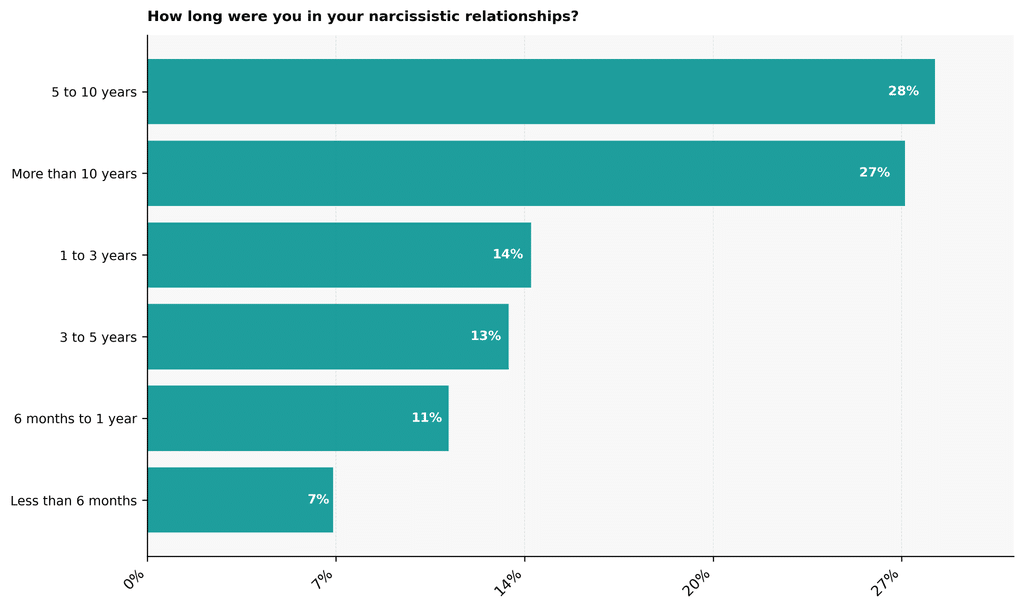
- 27% of people experiencing narcissism were in a narcissistic relationship for more than 10 years, 28% for between 5 and 10 years; 14% for 1 to 3 years, and 13% for 3 to 5 years, while 11% stayed in a narcissistic relationship for 6 months to 1 year, and just 6% were in a relationship for less than 6 months
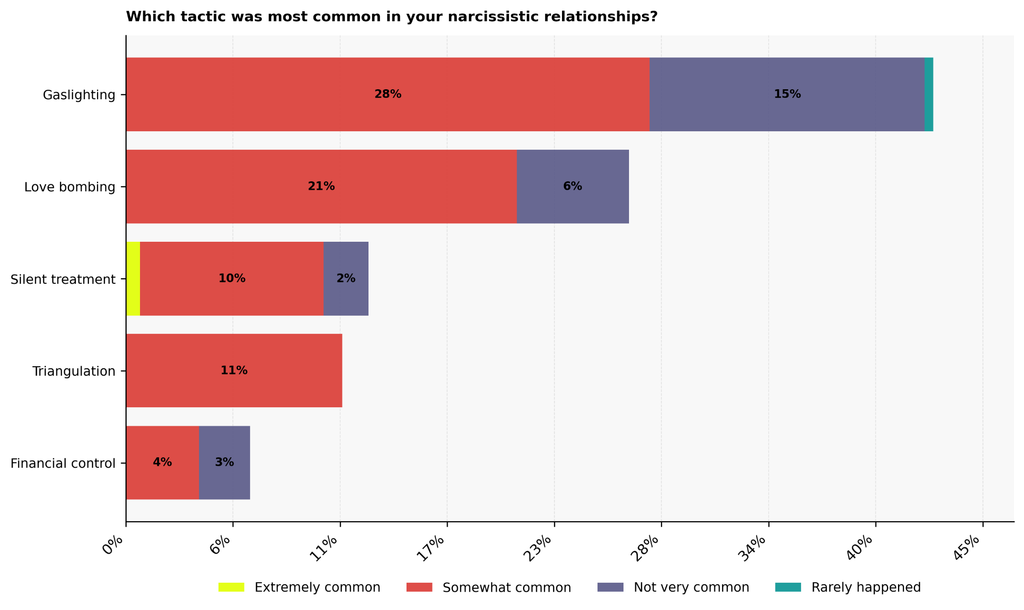
- 28% of people experiencing narcissism found that gaslighting was somewhat common in their narcissistic relationship, but this tactic wasn’t very common for 15%; 21% were often subjected to love bombing, but 6% didn’t experience this very often; 10% were regularly given the silent treatment, but 2% didn’t experience this much; triangulation was somewhat common for 11%, and financial control was also somewhat common for 4%, but less so for 3%
- For 1% of people experiencing narcissism, gaslighting and denial of reality were a clear sign of being in a narcissistic relationship and were somewhat noticeable for 8%, but for 36%, they were not really a sign; 16% found controlling or jealous behavior to be somewhat noticeable but was not really a sign for 15%; another 12% didn’t really notice love bombing followed by withdrawal, but 5% did see signs of this somewhat, while a lack of empathy was not really a sign for 4%, and neither was a friend or therapist pointing the narcissist relationship out for 2%
- 38% of people experiencing narcissism are still unsure how long it took to recognize a narcissistic relationship, but for 32%, they noticed within 1 to 3 years, and 27% noticed within 6 months to a year; 2% only realized they were in a narcissistic relationship once it ended, and another 2% noticed within the first few months
- Love and emotional attachment were the main reason 16% of people experiencing narcissism stayed in the relationship for a long time, with this also being a significant factor for 50%, and a minor factor for 3%, but not a factor for 6%; low self-worth was the main reason 5% stayed, and a significant factor keeping 9% in the relationship; 9% stayed due to financial dependence, and 2% remained in the relationship mostly due to children or family ties
- Financial concerns are a significant difficulty for 37% of people experiencing narcissism when leaving a relationship, and a minor issue for 8%; emotional attachment is the biggest challenge for 3%, a significant difficulty for 17%, and a minor issue for 1%, while 18% fear for their safety, making it hard to leave, 3% struggle with co-parenting or custody issues the most, and this makes it very difficult for 6%, 3% struggle with losing shared friends, and 2% find hoovering attempts a significant difficulty when trying to leave
- 39% of people experiencing narcissism ended the relationship themselves, but 38% had the relationship ended by the narcissist, and 4% ended the relationship with help from family and friends; however, 18% haven’t left yet and are still in a relationship with a narcissist
- 33% of people experiencing narcissism suffered from self-doubt and confusion, 21% had low self-esteem after a narcissistic relationship, 17% suffered PTSD or C-PTSD symptoms, 14% had anxiety, 13% suffered from depression, and 2% experienced trouble sleeping
- 59% of people experiencing narcissism suffered no noticeable physical effects from a narcissistic relationship; however, 17% experienced weight changes, 16% suffered from chronic fatigue, and 7% had digestive issues, all of which can be triggered or exacerbated by stress
- 99% of people experiencing narcissism did not see any financial impact from being in a relationship with a narcissist, but 1% lost their income or job, indicating that this condition still has some financial effect
- 41% of people experiencing narcissism saw no impact on their career, but 22% changed careers due to a narcissistic relationship, 21% lost their job, and 16% took extended time off work
- 3% of people experiencing narcissism agree that co-parenting contact only is a reasonable choice after narcissistic relationships end, but this isn’t a preference for 7%, and 28% would avoid this contact if they could; 4% think that a gray rock only approach is the absolute best approach, it’s a reasonable approach for 3%, but it’s not a preference for 23%; 17% are still in the relationship despite this not being their preference and 5% wish they could avoid this, while low contact is a reasonable choice after a narcissistic relationship ends for 6% but not preferred by 3%, and 3% would avoid regular contact
- 89% of people experiencing narcissism first sought help for narcissistic relationships from books or podcasts, and 1% sought help first from a therapist or counselor, and the remaining 9% have not yet sought help
- 85% of people experiencing narcissism learned about narcissistic relationships from social media, 8% from online articles or blogs, 6% from podcasts or YouTube, and 1% learned about these relationships from a therapist or counselor
- 16% of people experiencing narcissism agree that there is a major misunderstanding about how subtle the abuse is in a narcissistic relationship, and 50% find this to be somewhat misunderstood; 7% agree that the lasting trauma is majorly misunderstood, and 8% think it’s somewhat misunderstood; 4% find that there is a major misunderstanding about how hard leaving a narcissistic relationship is, and 8% find this to be somewhat misunderstood, while 2% agree that why victims stay is majorly misunderstood and 4% find it to be somewhat misunderstood
- While 39% of people experiencing narcissism have used AI to draft messages or boundaries and 3% have used it to find therapists or resources, 59% have not yet used AI to understand narcissistic relationships
- EMDR has been the most effective therapy for 3% of people experiencing narcissism, it’s been helpful for 37%, and somewhat helpful for 16%, but not helpful for 3%; 11% agree that cognitive behavioral therapy has been helpful for coping with a narcissistic relationship, and it’s somewhat helped 6%, but not 1%; 3% have found talk therapy helpful, and 1% found trauma-focused therapy helpful too, while 7% haven’t tried therapy but think it will be somewhat helpful, and another 7% haven’t tried it and don’t think it would help them
- Education about the topic helped 14% of people experiencing narcissism to heal the most after a narcissistic relationship; it was helpful in the healing process for 32%, and somewhat helpful for 30%; 5% benefitted the most from professional therapy, 6% found this helpful, and 2% somewhat so; 1% found setting boundaries most helpful when healing after a narcissistic relationship,4% agree this was helpful, and for 2%, it was somewhat helpful, while no one mentioned support groups, support from loved ones, or journaling or mindfulness as helping their recovery
- 75% of people experiencing narcissism took between 6 months and a year to recover from a narcissistic relationship; 11% took less than 6 months to recover, 7% took more than 5 years, and 4% took between 1 and 2 years, with 3% still recovering from a narcissistic relationship
- For 99% of people experiencing narcissism, trust has been fully restored after ending a narcissistic relationship, while only 1% now avoid new relationships due to trust issues, and the same number remain cautious but open
- For 5% of people experiencing narcissism, support groups are absolutely essential, and another 49% find these groups very helpful after surviving a narcissistic relationship; 5% agree legal support is absolutely essential, and it’s very helpful for 29%, and somewhat useful for 3%, while crisis hotlines are considered very helpful for 10%
- 50% of people experiencing narcissism would tell others in a narcissistic relationship to absolutely seek professional help early on, and this is seen as a helpful suggestion by 19%; 17% agree that essential advice is to go no contact if possible, and this is a helpful suggestion for 3%; 5% would advise others to learn about narcissism as this is essential advice, and 1% think it’s a helpful suggestion too, while 2% would tell people to absolutely trust their instincts, and this is considered a helpful suggestion by a further 2%
- Supporting recovery after narcissistic relationships
Methodology and data
Sourced using Artios from an independent sample of 1,409,472 opinions of people experiencing narcissism in the USA across X, Quora, Reddit, Bluesky, TikTok, and Threads. Responses are collected within a 95% confidence interval and a 5% margin of error. Results are derived from what people describe online, from opinions expressed, not actual questions answered by people in the sample.
What type best describes narcissistic relationships experienced by survivors?
3% of people experiencing narcissism have a narcissistic friend; this somewhat fits for 14%, but not for 21%; 2% have a narcissistic relationship with a boss or coworker, and this somewhat fits for 17%, but is not really accurate for 10%, while 7% agree that they have a narcissistic relationship with a parent or caregiver, and this fits for 15% but less so for 2%; 1% have a narcissistic romantic partner or spouse, 15% agree they do somewhat, but this isn’t really accurate for 2%, while fewer than 1% voice an opinion about a narcissistic relationship with their sibling or other family member or with multiple relationships
Narcissistic relationships span family, friends, co-workers, and partners:
Although it’s estimated that only 1% to 2% of the US population has narcissistic personality disorder, this condition can impact people in all kinds of relationships.
Amongst our audience of people experiencing narcissism, 3% are friends with the narcissist, saying that this was the perfect description for their connection. A further14% were of the opinion that this somewhat fits, but 19% revealed that they didn’t think their friendship was with a narcissist, and it didn’t fit for 3% at all.
In relationships with bosses or coworkers, 2% said narcissistic was the perfect description, 17% agreed it somewhat fit, and 10% said it wasn’t really an accurate portrayal.
Another 15% of our audience have a narcissistic parent or caregiver, and 7% say that this is the perfect description, while just 2% indicate that this is not really accurate.
1% admit that they are in a narcissistic relationship with a romantic partner or spouse, and this perfectly describes their relationship. For 4%, this characterization somewhat fits, but for 1%, it’s not really accurate.
Fewer than 1% mentioned narcissistic relationships with siblings and other family members, and no one shared any opinions on having multiple relationships with narcissists.
When combined, these outcomes show that the perception of narcissistic dynamics varies considerably across relationship types. Parental relationships stand out for the best fit, and workplace relationships receive the highest combined rating for perfect fit and somewhat fits. This may reflect how emotional history shapes family relationships, while repeated contact and power imbalances make narcissistic behavior more noticeable in the workplace.
Who was most affected by narcissistic relationships according to survivors?
For 32% of people experiencing narcissism, only they were affected by a narcissistic relationship, 6% were somewhat affected, 1% barely affected, and 3% not affected at all; 17% had children that were most affected, and 5%’s children were somewhat affected; 7% had work colleagues that were most affected by their narcissistic relationship, 13% were somewhat affected, and only 1% were not affected at all, while 5% saw their friends most affected by their relationship and 3%’s friends were somewhat affected, and 5% agree that everyone around them was most affected
Narcissistic relationships impact a wider circle:
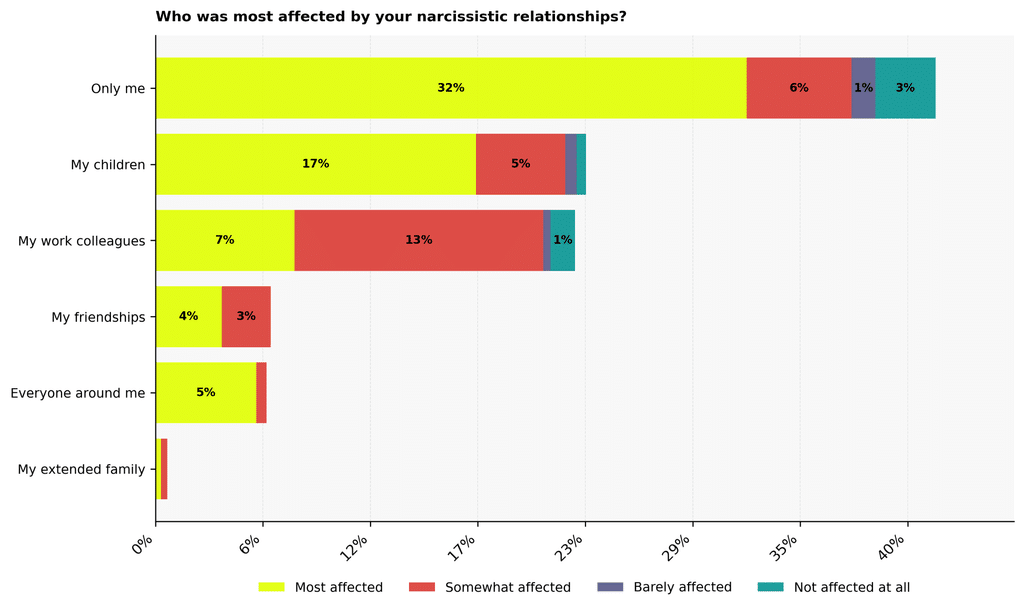
Narcissism can have a ripple effect, and this is evident in who is most affected by people experiencing narcissistic relationships. 32% were most affected by their narcissistic relationship, and the effects only impacted them, with 6% being somewhat affected, 1% barely affected, and 3% not affected at all.
For 17%, their children were most affected by their narcissistic relationship, and a further 5% were somewhat impacted.
Outside of the family circle, 7% of people experiencing narcissism’s work colleagues were most affected by the relationships, and 13% were somewhat affected, with just 1% not affected at all. 4% saw their friendships most affected, and 3% agreed they were somewhat affected, and for 5%, everyone around them was most affected. Combined, these relationships impacted 32% of non-family members, showing just how far-reaching the effects can be.
No opinions were recorded regarding the impact of a narcissistic relationship on extended family, pointing to a lack of interaction or limited awareness of how the relationship affected them.
How long did survivors stay in narcissistic relationships?
27% of people experiencing narcissism were in a narcissistic relationship for more than 10 years, 28% for between 5 and 10 years; 14% for 1 to 3 years, and 13% for 3 to 5 years, while 11% stayed in a narcissistic relationship for 6 months to 1 year, and just 6% were in a relationship for less than 6 months
Longer relationships are more common:
While anecdotal evidence suggests that the average length of a narcissistic relationship is around six months, there is no set time frame, and the duration will also differ depending on whether the relationship is familial, romantic, or in the workplace.
For people experiencing narcissism, longer relationships are the norm, with 28% having been in one for between 5 and 10 years, and 27% for more than a decade. 14% were in narcissistic relationships for 1 to 3 years, and 13% between 3 and 5 years, while 11% stayed in a relationship with a narcissist for 6 months to a year. This means that overall, 93% had longer relationships than the anecdotal average, with only 7% leaving the relationship in less than 6 months.
According to survivors, which tactic was most common in narcissistic relationships?
28% of people experiencing narcissism found that gaslighting was somewhat common in their narcissistic relationship, but this tactic wasn’t very common for 15%; 21% were often subjected to love bombing, but 6% didn’t experience this very often; 10% were regularly given the silent treatment, but 2% didn’t experience this much; triangulation was somewhat common for 11%, and financial control was also somewhat common for 4%, but less so for 3%
Five tactics were relatively common:
Narcissists’ behavior is a characteristic of the condition they live with rather than a rational choice, and they are often driven by the urge to maintain control at all costs. To do so, they use a variety of tactics or game-playing, with some being more common than others.
For people experiencing narcissism, 28% agree that gaslighting was somewhat common in their narcissistic relationship, but 15% didn’t find it that common. Gaslighting is a very common tactic for narcissists as they try to create a dependency.
Love bombing is also somewhat common for 21% but less so for 6%, and this tactic ties in with the hunting for attention and dependency.
10% were subjected to silent treatment quite often, but not very often for 2%, and 11% found triangulation to be a somewhat common tactic. Triangulation involves bringing a third person into a relationship or conflict to create jealousy, provoke insecurity, gain support, or manipulate how others perceive the situation.
Financial control was the least common tactic overall, and this correlates with the low number of people experiencing narcissism we saw who were financially impacted by their relationship. Only 4% found financial control to be a somewhat common tactic, and 3% said it was less common.
What was the first signal to survivors they were in narcissistic relationships?
For 1% of people experiencing narcissism, gaslighting and denial of reality were a clear sign of being in a narcissistic relationship and were somewhat noticeable for 8%, but for 36%, they were not really a sign; 16% found controlling or jealous behavior to be somewhat noticeable but was not really a sign for 15%; another 12% didn’t really notice love bombing followed by withdrawal, but 5% did see signs of this somewhat, while a lack of empathy was not really a sign for 4%, and neither was a friend or therapist pointing the narcissist relationship out for 2%
Some signs are stronger than others:
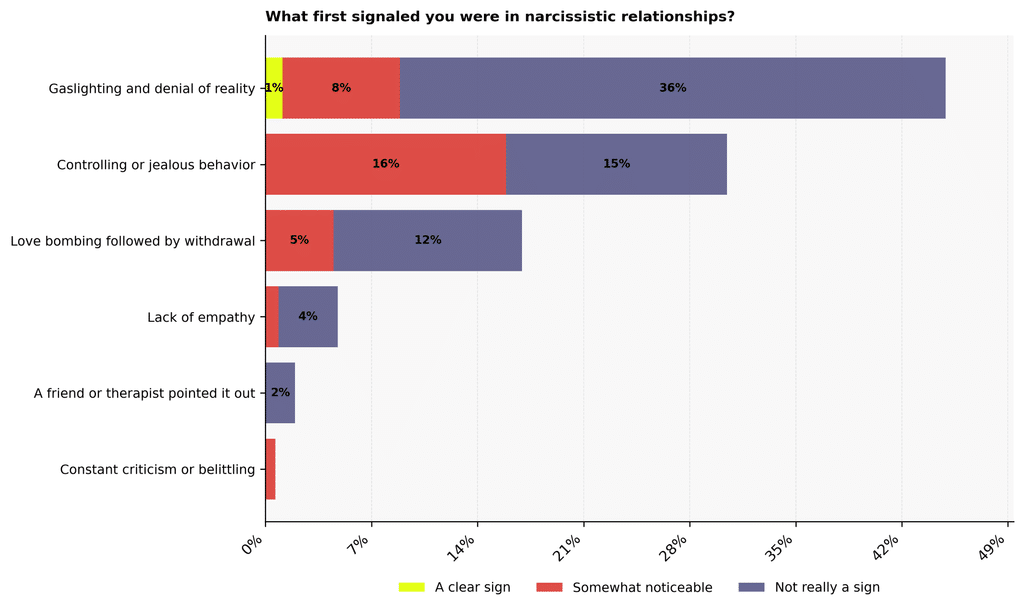
Narcissistic behavior tends to follow a similar pattern, and as we saw above, gaslighting and love bombing are two of the most common tactics used. For 1% of people experiencing narcissism, gaslighting and a denial of reality were a clear sign they were in a narcissistic relationship, and 8% found these to be somewhat noticeable. However, 36% didn’t really see these as a sign, despite their commonality. According to Dr. Anthony Mazzella, dismissing another person’s experience or insisting that one’s own perspective is the only valid one can create distance rather than foster mutual understanding.
Controlling or jealous behavior was more prevalent, with 16% finding it somewhat noticeable, but almost as many (15%) didn’t see it as a sign.
Love bombing followed by withdrawal was a somewhat noticeable signal of a narcissistic relationship for 5%, but not for 12%, while a lack of empathy wasn’t really a sign for 4%, and 2% didn’t think a friend or therapist pointing the relationship behavior out was a sign. Fewer than 1% mentioned constant criticism or belittling as a sign that they were in a narcissistic relationship, putting the focus more firmly on the common traits mentioned in the graph above.
How long did it take survivors to recognize narcissistic relationships?
38% of people experiencing narcissism are still unsure how long it took to recognize a narcissistic relationship, but for 32%, they noticed within 1 to 3 years, and 27% noticed within 6 months to a year; 2% only realized they were in a narcissistic relationship once it ended, and another 2% noticed within the first few months
Recognition takes time:
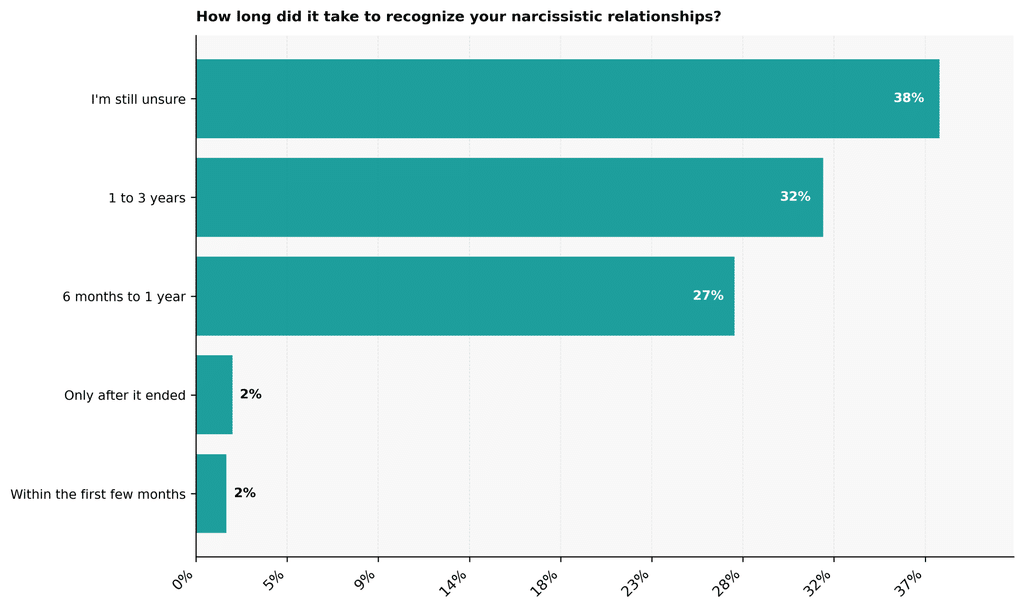
Recognizing a narcissistic relationship isn’t always easy. For many, the emotional and psychological dynamics are not evident immediately, or even after a long period of time. For people experiencing narcissism, 38% are still unsure how long it took for them to notice this behavior, or whether the behavior they recognized was in fact narcissistic. 32% were more definite, as it took them between 1 and 3 years to recognize their narcissistic relationship, and 27% took between 6 months and a year.
In contrast, 2% only recognized they had been in a narcissistic relationship after it ended, and another 2% noticed within the first few months, once again showing the disparity in timing.
What kept survivors in narcissistic relationships the longest?
Love and emotional attachment were the main reason 16% of people experiencing narcissism stayed in the relationship for a long time, with this also being a significant factor for 50%, and a minor factor for 3%, but not a factor for 6%; low self-worth was the main reason 5% stayed, and a significant factor keeping 9% in the relationship; 9% stayed due to financial dependence, and 2% remained in the relationship mostly due to children or family ties
Reasons for staying are led by emotion:
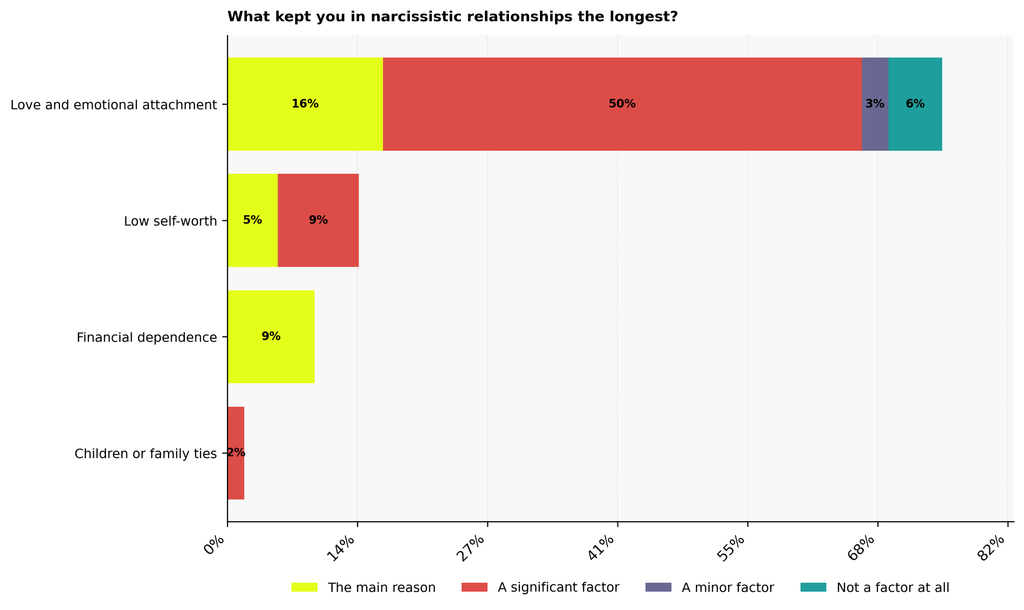
It’s often hard to end a relationship with a narcissist, and most people stay because they have an overriding hope that the person will change. For people experiencing narcissism, love and emotional attachment were cited as the main reason for staying in a narcissistic relationship the longest, with it being the main reason for 18%, a significant factor for 50%, and a minor factor for 3%. Only 6% did not agree that this was a factor at all. This aligns with the hope many feel as they love the person and don’t want to give up their emotional link.
As Dr. Anthony Mazzella frequently notes, this hope can be tied to the idea of a “magical reunion,” in which individuals hold on to the belief that the relationship will eventually meet their needs for validation, recognition, and love despite the ongoing abuse.
5% cite their main reason for staying the longest is due to low self-worth, which may have been exacerbated by the narcissistic behavior, and a further 9% say this was a significant factor in them staying. 2% mentioned children or family ties playing a significant role in staying in the relationship, likely as leaving would cause upset and upheaval.
Interestingly, despite financial impact cited as minimal in the graph further down, 9% of our audience agree that the main reason they stayed in a narcissistic relationship the longest was due to financial dependence, pointing to money holding some weight in the power dynamics.
What was the hardest part of leaving narcissistic relationships for survivors?
Financial concerns are a significant difficulty for 37% of people experiencing narcissism when leaving a relationship, and a minor issue for 8%; emotional attachment is the biggest challenge for 3%, a significant difficulty for 17%, and a minor issue for 1%, while 18% fear for their safety, making it hard to leave, 3% struggle with co-parenting or custody issues the most, and this makes it very difficult for 6%, 3% struggle with losing shared friends, and 2% find hoovering attempts a significant difficulty when trying to leave
Leaving is hindered by different challenges:
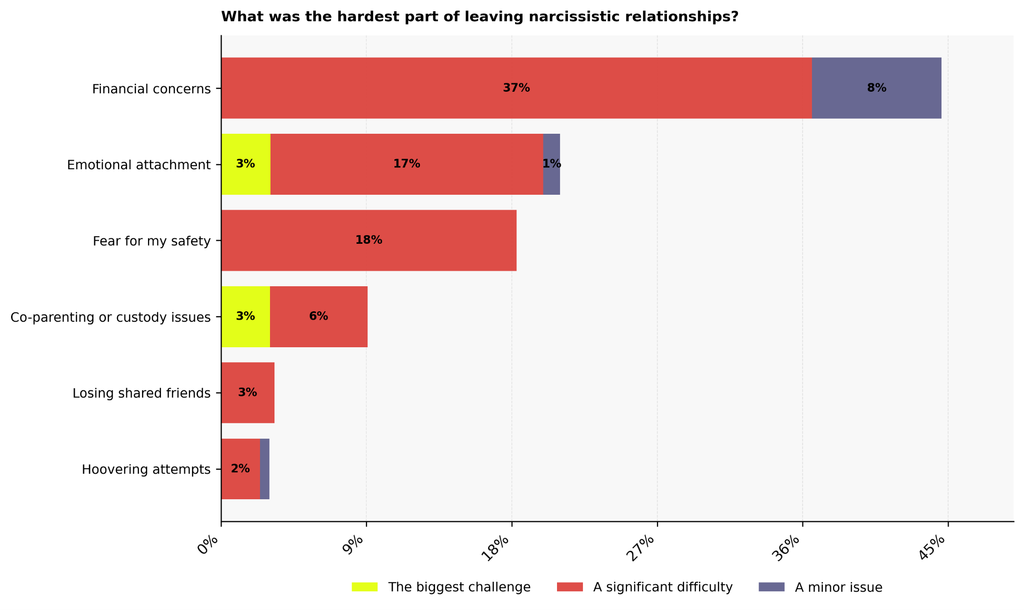
Once again, finances are mentioned, and this time they take center stage. For 37% of people experiencing narcissism, the hardest part of leaving a relationship is financial concerns, as this poses a significant difficulty. It’s also a minor issue for 8%. With 45% of our audience naming finances as a concern, there is a clear pattern of dependency that needs to be broken before they can move on. Co-parenting or custody issues are also the biggest challenge for 3% and a significant difficulty for 6%, which may also link to finances.
18% fear for their safety, making leaving a significant challenge. This is an alarming number and suggests many would need external assistance to leave the situation.
Emotional attachment is the biggest challenge for 3%; 17% agree it’s a significant difficulty, and it’s a minor issue for 1%; and losing shared friends is a significant difficulty for 3%. These challenges are more based on feelings than lifestyle impact, but are still tough to conquer.
2% also find hoovering attempts a significant difficulty, as they are hard to ignore. Hoovering draws a former partner or another person back into the relationship after a separation, often through apologies, promises to change, affection, guilt-tripping, or sudden declarations of love.
How did survivors finally leave narcissistic relationships?
39% of people experiencing narcissism ended the relationship themselves, but 38% had the relationship ended by the narcissist, and 4% ended the relationship with help from family and friends; however, 18% haven’t left yet and are still in a relationship with a narcissist
Leaving is prompted in different ways:
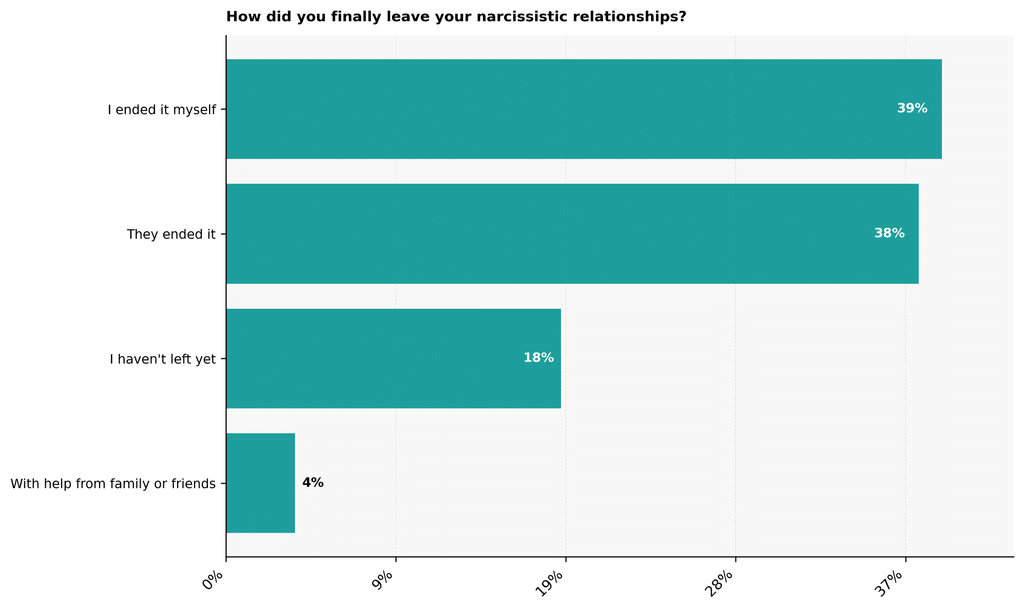
Whether with a family member, romantic partner, friend, boss, or other party, leaving a narcissistic relationship isn’t always easy, as these relationships pose unique challenges. For people experiencing narcissism, 39% ended the relationship themselves; however, for almost as many (38%), the narcissist ended the relationship.
This shows that leaving a narcissistic relationship is not always a decision the person experiencing the narcissism makes, with many having the relationship ended for them rather than choosing to walk away themselves. Another 4% left the relationship with help from family and friends, underscoring how important this support can be.
The remaining 18% of our audience are still in a relationship with a narcissist and have not left yet, indicating that they may well do so in the future.
How have narcissistic relationships affected people’s mental health?
33% of people experiencing narcissism suffered from self-doubt and confusion, 21% had low self-esteem after a narcissistic relationship, 17% suffered PTSD or C-PTSD symptoms, 14% had anxiety, 13% suffered from depression, and 2% experienced trouble sleeping
Mental health impact is widespread:
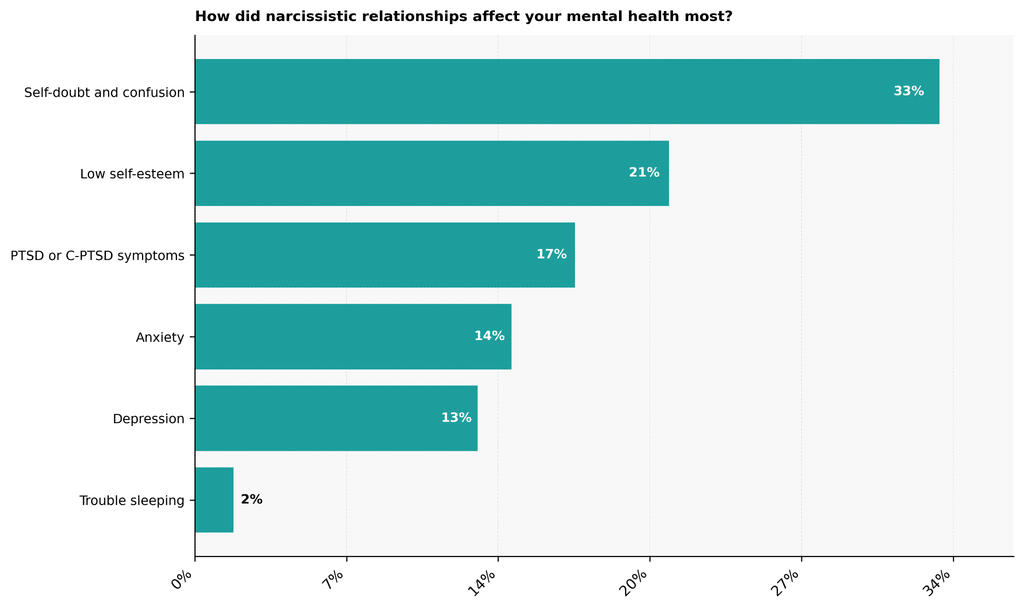
The behavior exhibited by a narcissist can affect people experiencing narcissism’s self-esteem, which in turn can impact their mental health. This is true for 21%, who found that their narcissistic relationship left them with low self-esteem, while 33% suffered from self-doubt and confusion.
17% were left with PTSD or complex PTSD symptoms that developed over time from long-term trauma; 14% suffered from anxiety, 13% from depression, and 2% had trouble sleeping.
These mental health struggles show how the effects of narcissistic relationships can extend beyond the relationship itself, influencing survivors’ confidence, emotional well-being, and ability to trust their own judgement. For some, the impact also includes longer-term psychological symptoms that can make recovery more difficult.
How did narcissistic relationships affect survivors’ physical health?
59% of people experiencing narcissism suffered no noticeable physical effects from a narcissistic relationship; however, 17% experienced weight changes, 16% suffered from chronic fatigue, and 7% had digestive issues, all of which can be triggered or exacerbated by stress
Physical health impacts were obvious:
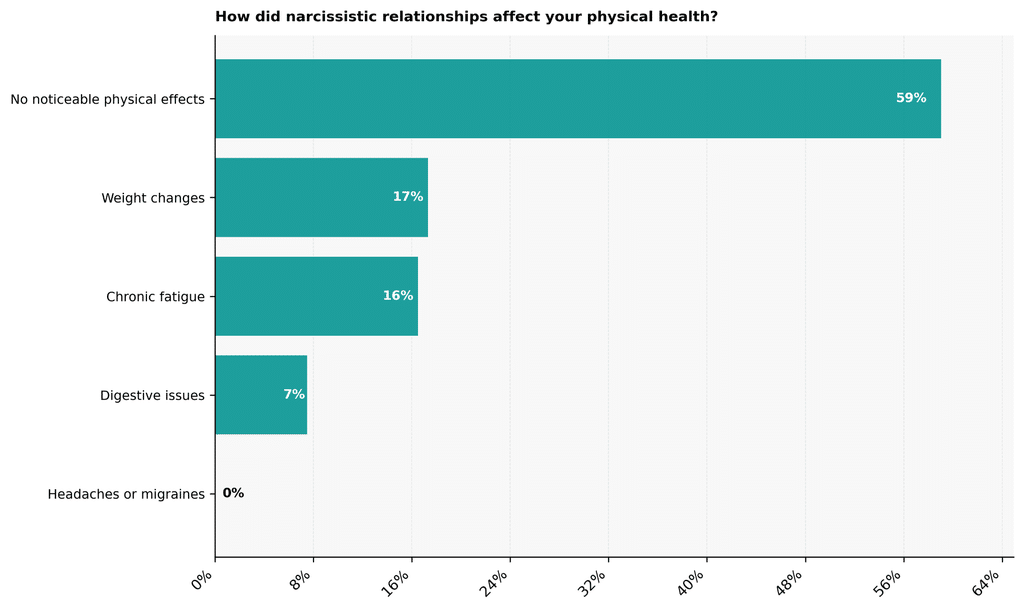
The impact on people experiencing narcissism’s mental health is far greater than the physical effects of these relationships. 59% did not notice any physical effects, despite negative relationships causing stress and strain on the body that may increase the risk of cardiovascular events and chronic disease.
However, the remaining 49% of our audience did suffer from physiological effects, with 17% experiencing weight changes, 16% developing chronic fatigue, and 7% suffering from digestive issues. All of these ailments have close links to stress, which is a major factor in narcissistic relationships.
Interestingly, no one mentioned suffering from headaches or migraines, both of which can be triggered by stress.
How did narcissistic relationships affect survivors’ finances?
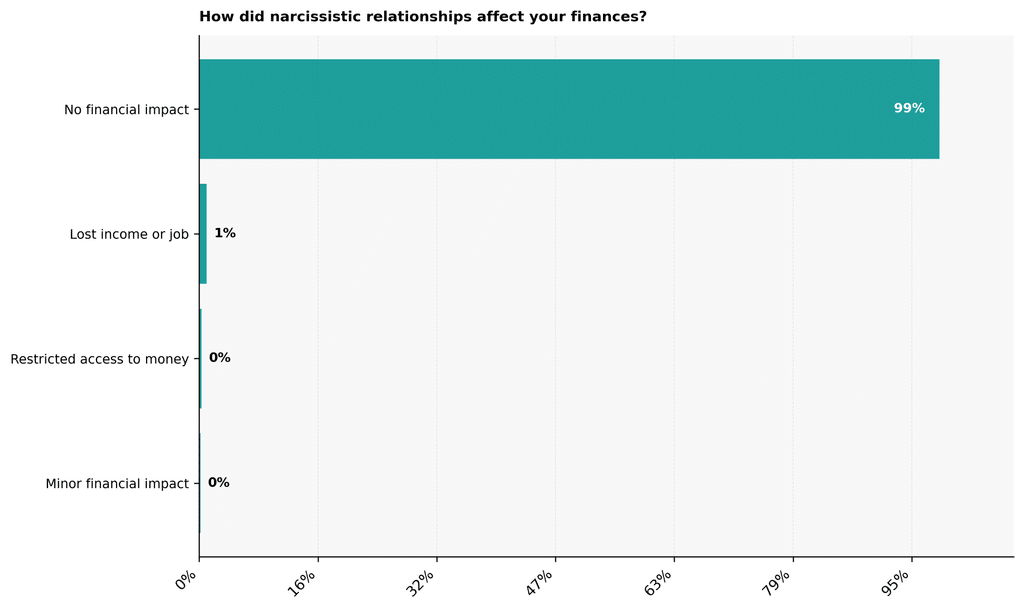
99% of people experiencing narcissism did not see any financial impact from being in a relationship with a narcissist, but 1% lost their income or job, indicating that this condition still has some financial effect
Finances are largely left out of the equation:
A US News and World Report found that more than two in ten people in a relationship have suffered from financial abuse, almost 14% are currently in a financially abusive situation, and 66.5% have left a relationship due to this type of abuse.
However, despite what we saw earlier, in this case, for people experiencing narcissism, this type of abuse is minimal. 99% reported no financial impact after a narcissistic relationship, and only 1% lost their income or job. While every loss is still a concern, the low number is encouraging.
None of those who experienced narcissism discussed having restricted access to money or suffering any minor financial impact, which is also a positive sign.
How did narcissistic relationships affect survivors’ careers?
41% of people experiencing narcissism saw no impact on their career, but 22% changed careers due to a narcissistic relationship, 21% lost their job, and 16% took extended time off work
Narcissistic relationships impact working lives:
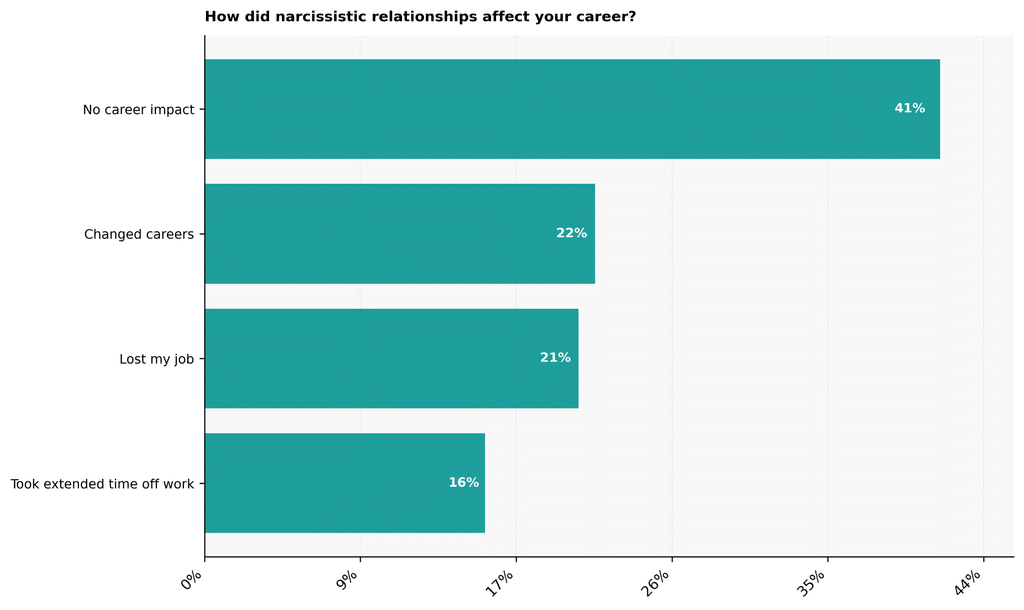
While there was minimal financial impact for those experiencing narcissism, a greater number of those in a relationship with a narcissist felt an impact on their career.
22% changed careers due to a narcissistic relationship, indicating that a boss or co-worker may have been involved. 21% lost their job, which may have been due to a narcissist in the workplace, or the impact of an external relationship with one that caused mental or physical health challenges. 16% took extended time off work, likely for the same reasons.
The remaining 41% of people experiencing narcissism did not suffer any career impact, suggesting that while narcissistic relationships can disrupt working lives in significant ways, their effects on career progression and employment vary between individuals.
What contact do survivors keep after narcissistic relationships end?
3% of people experiencing narcissism agree that co-parenting contact only is a reasonable choice after narcissistic relationships end, but this isn’t a preference for 7%, and 28% would avoid this contact if they could; 4% think that a gray rock only approach is the absolute best approach, it’s a reasonable approach for 3%, but it’s not a preference for 23%; 17% are still in the relationship despite this not being their preference and 5% wish they could avoid this, while low contact is a reasonable choice after a narcissistic relationship ends for 6% but not preferred by 3%, and 3% would avoid regular contact
Post-relationship contact is minimal:
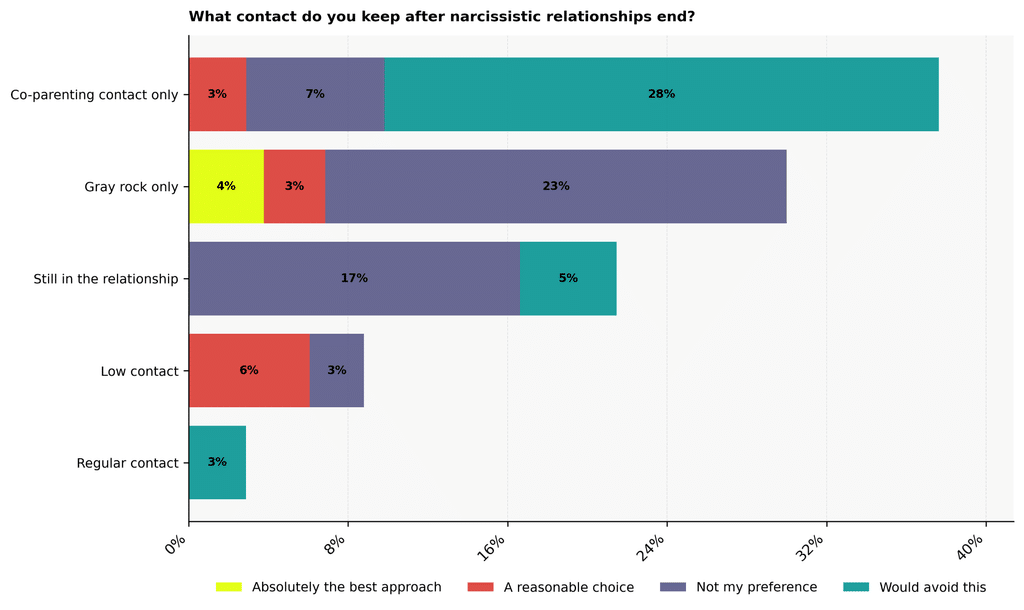
Co-parenting was mentioned as one of the challenges of leaving a narcissistic relationship, as it can be difficult to remain in contact without letting emotions overwhelm interactions. For people experiencing narcissism, 3% are only in co-parenting contact after their narcissistic relationship ended and they feel this is a reasonable choice, 7% are still in contact for this reason, but it is not their preference, and 28% would avoid this contact if it were possible.
4% agree that using only the gray rock method is absolutely the best approach to post-relationship contact; 3% think it’s a reasonable choice, but it’s not a preference for 23%. 8% opt for low contact as a reasonable choice, but it’s not a preference for 3%, and 3% would avoid regular contact.
However, 17% of our audience are still in the relationship, despite this not being their preference, and 5% are in the relationship but would avoid being so if possible. Their contact would only be determined after they leave, depending on the circumstances.
Where did survivors first seek help for narcissistic relationships?
89% of people experiencing narcissism first sought help for narcissistic relationships from books or podcasts, and 1% sought help first from a therapist or counselor, and the remaining 9% have not yet sought help
Initial help comes from 3 main sources:
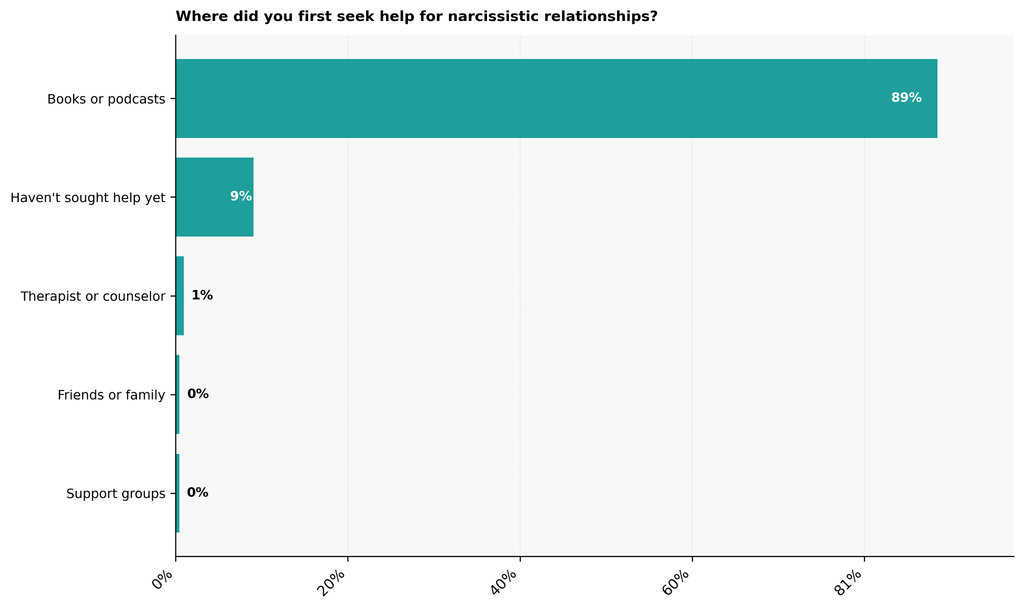
First seeking help for a narcissistic relationship is a brave step, and most people experiencing narcissism turn to books or podcasts for help initially. The subject is clearly a popular one, as there are over 70 podcasts on the topic and numerous books. The accessibility of books or podcasts also makes it easy for those experiencing narcissism to learn more at their own pace and to do so anonymously if preferred.
In contrast, 1% first sought help via a therapist or a counselor, and no one mentioned turning to friends or family or support groups. A further 9% have not sought help yet, indicating that they are not ready to take the first step.
How did survivors learn about narcissistic relationships?
85% of people experiencing narcissism learned about narcissistic relationships from social media, 8% from online articles or blogs, 6% from podcasts or YouTube, and 1% learned about these relationships from a therapist or counselor
Knowledge mostly comes from online resources:
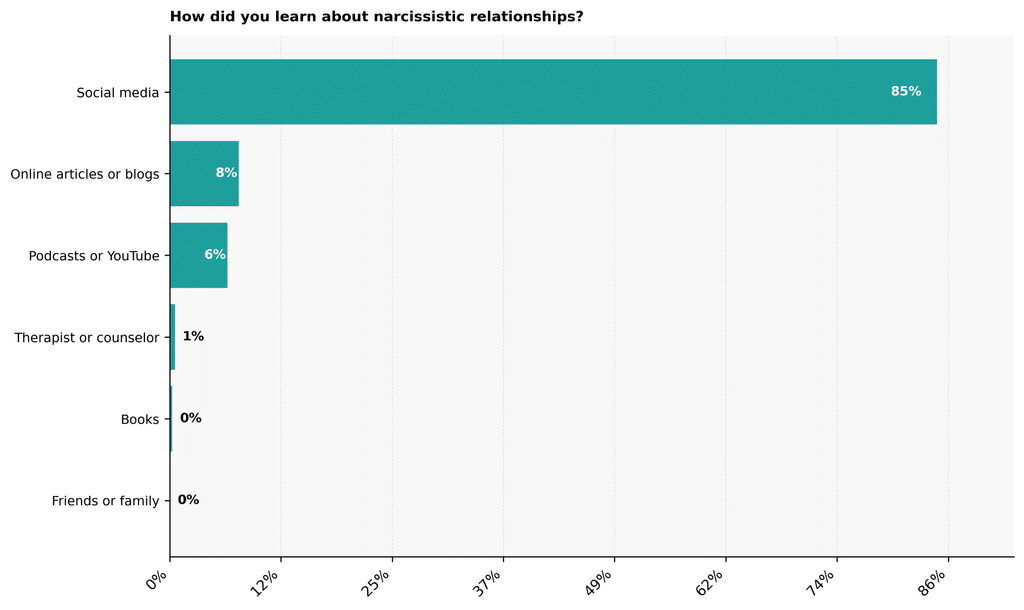
Seeking medical advice on social media is not always advisable, but research shows that these platforms make it easier to access and share information, especially on topics surrounding health. 85% of people experiencing narcissism feel the same, as they all learned about narcissism on social media.
But it’s not just social media that provides information; the internet is a valuable source in many forms, with 8% learning about narcissistic relationships via blogs or online articles, and 6% doing so from podcasts or YouTube.
Just 1% learned about narcissistic relationships from a therapist or a counselor, and no one mentions books or friends and family, pointing to a clear preference for online informational sources.
What do people misunderstand most about narcissistic relationships according to survivors?
16% of people experiencing narcissism agree that there is a major misunderstanding about how subtle the abuse is in a narcissistic relationship, and 50% find this to be somewhat misunderstood; 7% agree that the lasting trauma is majorly misunderstood, and 8% think it’s somewhat misunderstood; 4% find that there is a major misunderstanding about how hard leaving a narcissistic relationship is, and 8% find this to be somewhat misunderstood, while 2% agree that why victims stay is majorly misunderstood and 4% find it to be somewhat misunderstood
There are 5 major misunderstandings:
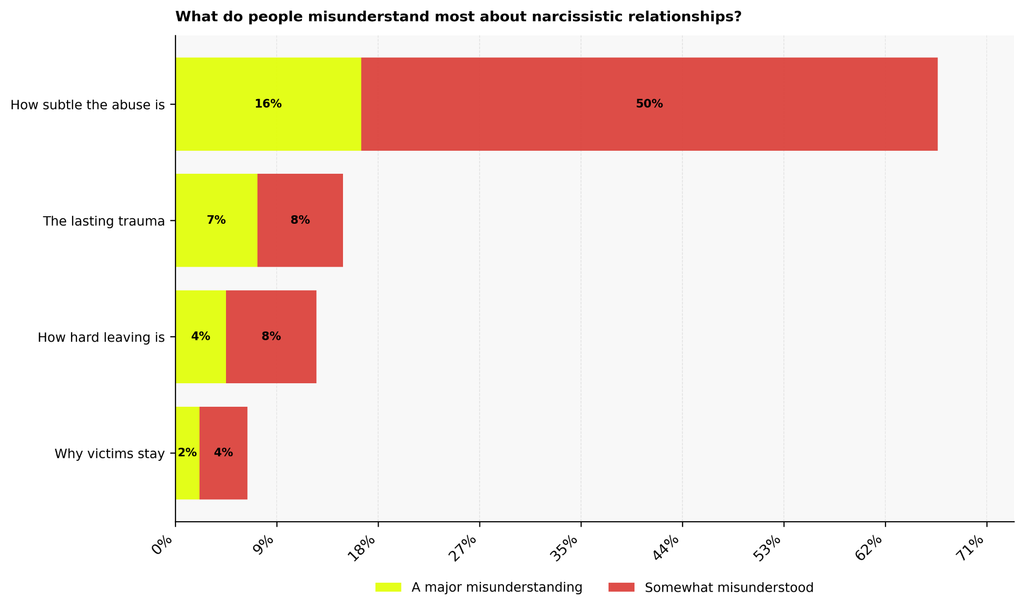
Narcissistic behavior often takes place behind closed doors to protect a carefully curated public image. This impacts the majority of our audience, as 16% of people experiencing narcissism agree that there is a major misunderstanding regarding how subtle the abuse is, and 50% agree it’s somewhat misunderstood.
The lasting trauma is a major misunderstanding for 7%, and 8% find this to be somewhat misunderstood. This can cause complications for survivors if they have PTSD or similar effects, as not everyone will understand why or where they come from.
4% find how hard leaving is to be majorly misunderstood, and 8% agree this is somewhat misunderstood, while 2% wish there was more understanding about why victims stay, as this is majorly misunderstood, and it’s somewhat misunderstood by 4%.
How have survivors used AI to understand narcissistic relationships?
While 39% of people experiencing narcissism have used AI to draft messages or boundaries and 3% have used it to find therapists or resources, 59% have not yet used AI to understand narcissistic relationships
AI adoption is still limited:
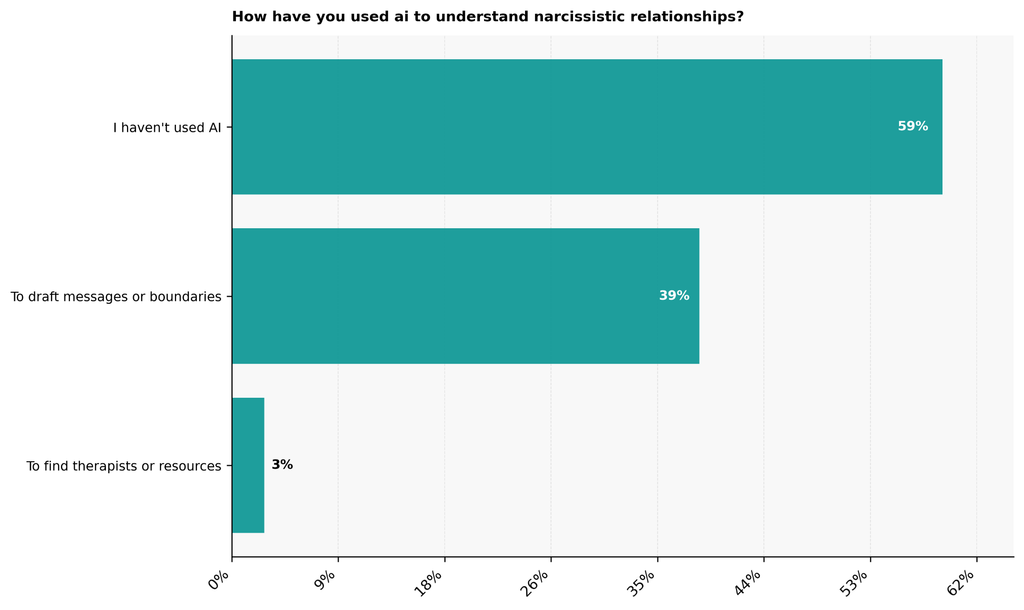
With the internet being a popular resource for learning about narcissistic relationships, it is surprising that 59% of people experiencing narcissism have not used AI to understand their relationships. Research from the American Psychological Association reports that more than a third of psychologists’ patients are turning to AI as an additional mental health professional. But evidently more than half of our audience is not at this stage yet.
39% are, however, using AI to draft messages or boundaries, relying on this technology to help them communicate clearly and with intent. The remaining 3% of our audience use AI to find therapists or resources, and as AI becomes more commonly used as a search engine, these numbers will likely grow/
Which therapy helped survivors most with narcissistic relationships?
EMDR has been the most effective therapy for 3% of people experiencing narcissism, it’s been helpful for 37%, and somewhat helpful for 16%, but not helpful for 3%; 11% agree that cognitive behavioral therapy has been helpful for coping with a narcissistic relationship, and it’s somewhat helped 6%, but not 1%; 3% have found talk therapy helpful, and 1% found trauma-focused therapy helpful too, while 7% haven’t tried therapy but think it will be somewhat helpful, and another 7% haven’t tried it and don’t think it would help them
Different types of therapy help in various ways:
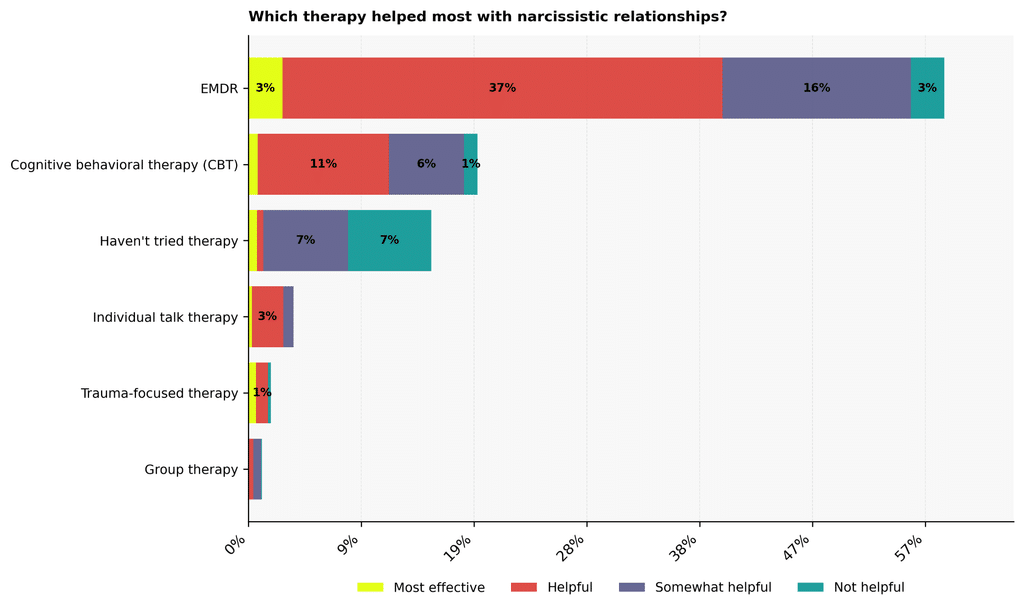
PTSD and C-PTSD are among the mental health issues people experiencing narcissism suffer from as a result, and Eye Movement Desensitization and Reprocessing (EMDR) therapy has proven to result in an 84% remission of PTSD diagnosis. For our audience, 3% find EMDR the most effective therapy, 37% find it helpful, and 16% somewhat so, with just 3% not finding EMDR helpful for their treatment.
Cognitive behavior therapy (CBT) was helpful for 11% of people experiencing narcissistic relationships, and somewhat so for 6%, but 1% didn’t find it helpful, while 3% found individual talk therapy helpful, and 1% cited trauma-focused therapy as offering some help too.
No one mentioned whether group therapy was helpful, and 7% have not yet tried therapy, although they think it could be somewhat helpful, compared to the 7% who haven’t tried it and don’t think it will help.
What helped survivors heal most after narcissistic relationships?
Education about the topic helped 14% of people experiencing narcissism to heal the most after a narcissistic relationship; it was helpful in the healing process for 32%, and somewhat helpful for 30%; 5% benefitted the most from professional therapy, 6% found this helpful, and 2% somewhat so; 1% found setting boundaries most helpful when healing after a narcissistic relationship,4% agree this was helpful, and for 2%, it was somewhat helpful, while no one mentioned support groups, support from loved ones, or journaling or mindfulness as helping their recovery
Healing is helped along with certain tools:
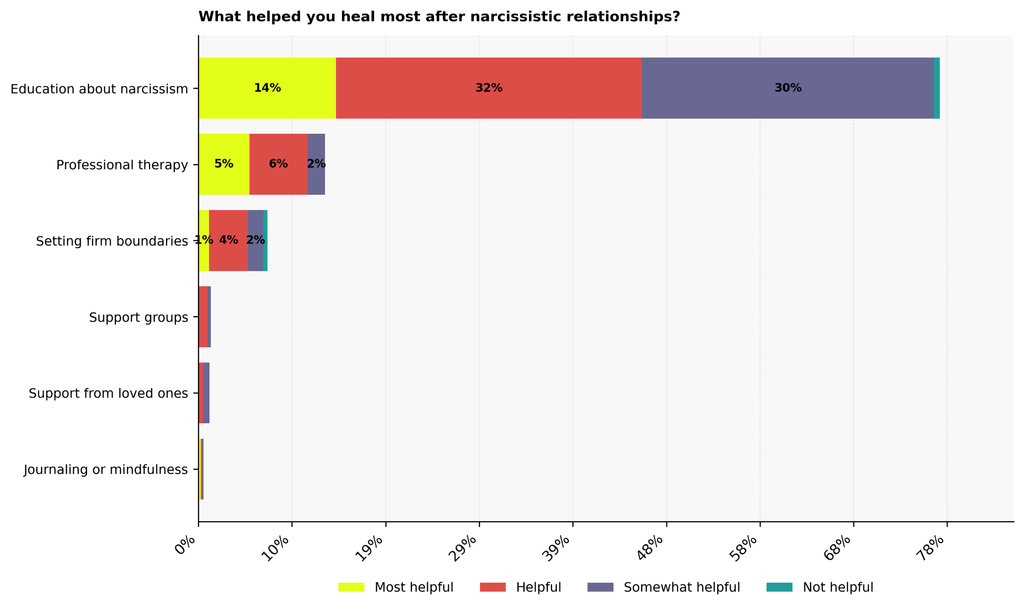
Knowledge is power, and for 14% of people experiencing narcissism, education is the best tool for healing after being in a narcissistic relationship. 32% agree education is helpful, and 30% say it’s somewhat helpful. By learning about narcissism, the behavior, and its impact, survivors can gain a greater understanding of what they went through and how the condition impacts them and the person they were in a relationship with.
Professional therapy has been most helpful for 5%, helpful for 6%, and 2% agree it was somewhat helpful. The insights and guidance from a professional are invaluable and can help survivors process their experiences, rebuild their self-esteem, and develop healthier coping strategies as they recover from the effects of a narcissistic relationship.
Setting firm boundaries has helped 1% of people heal the most after a narcissistic relationship; it’s been helpful for 4%, and for 2% it is somewhat helpful. By putting firm boundaries in place, it ensures that the narcissist cannot use hoovering tactics and creates distance between them.
No one mentioned support groups, support from loved ones, journaling, or mindfulness as ways to help them heal, keeping the focus firmly on education, professional input, and limiting expectations.
How long has recovery from narcissistic relationships taken for survivors?
75% of people experiencing narcissism took between 6 months and a year to recover from a narcissistic relationship; 11% took less than 6 months to recover, 7% took more than 5 years, and 4% took between 1 and 2 years, with 3% still recovering from a narcissistic relationship
Recovery times vary greatly:
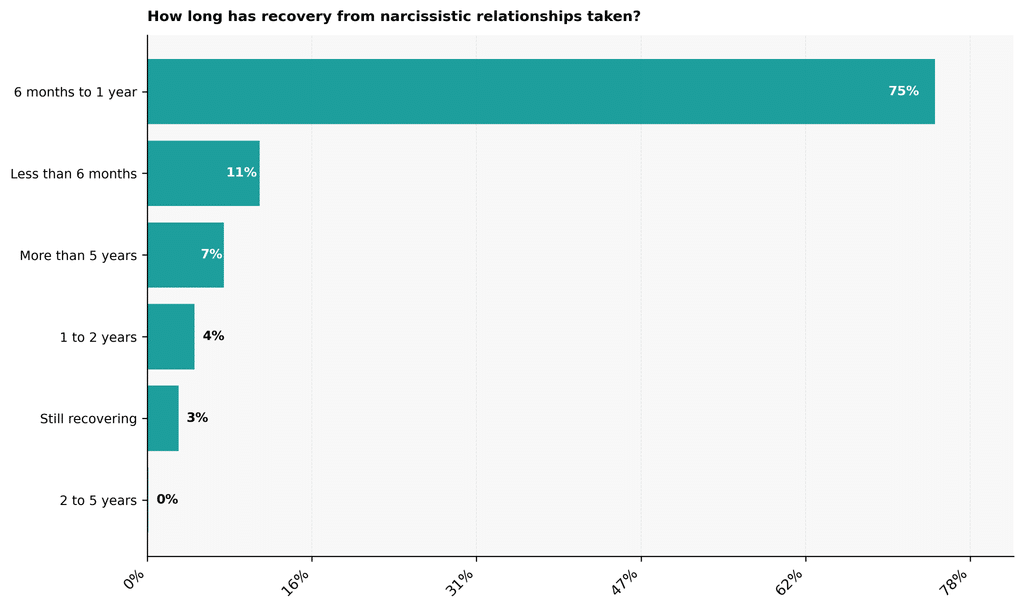
Recovery from a narcissistic relationship can take time, as the condition is complex and can have far-reaching impacts on a person’s life. There is no pre-defined recovery time, and each situation is unique. For 75% of people experiencing narcissism, recovery has taken between 6 months and a year, but for 11%, it has taken less than 6 months.
On the other end of the scale, 7% have taken more than 5 years to recover from a narcissistic relationship, and 4% have taken between 1 and 2 years. 3% are still recovering. These timelines point to the varied and often lengthy process of healing from narcissistic relationships, with recovery depending on the nature of the relationship and the lasting effects of the experience.
How has trust changed for survivors since narcissistic relationships?
For 99% of people experiencing narcissism, trust has been fully restored after ending a narcissistic relationship, while only 1% now avoid new relationships due to trust issues, and the same number remain cautious but open
Trust is not permanently damaged for most:
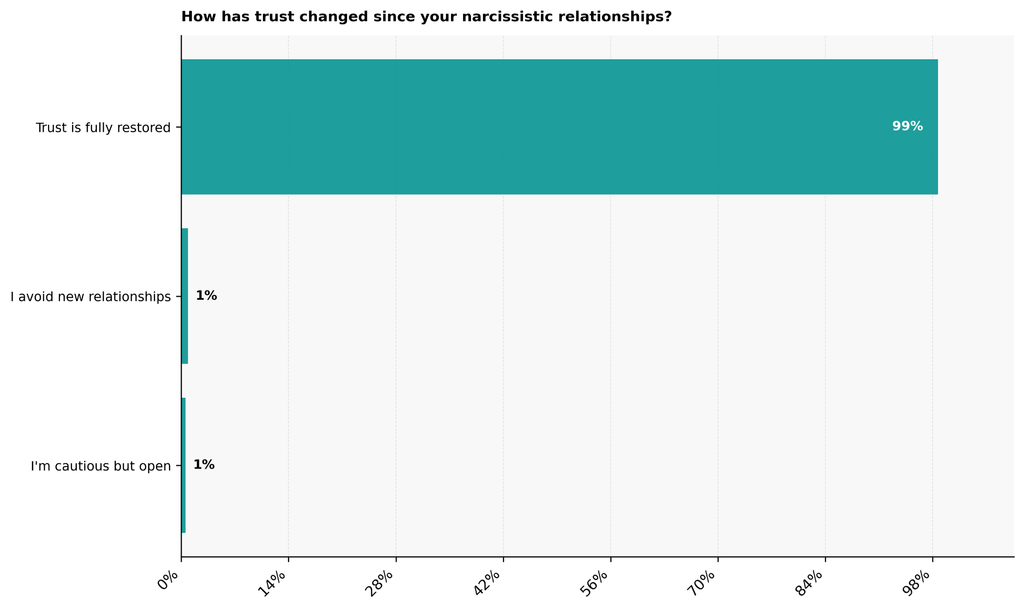
Recovery may not be linear, and it is not always quick, but on a positive note, the majority of people experiencing narcissism have suffered long-term issues with trust.
99% agree that their trust is fully restored since their relationship ended. This emphasizes that while trust was broken, it has healed and they are now open to trusting again. Another 1% are cautious but open, which is also positive.
Yet 1% still avoid new relationships due to trust issues, pointing to a small but significant number who have been impacted long-term.
What resource is most needed for narcissistic relationships according to survivors?
For 5% of people experiencing narcissism, support groups are absolutely essential, and another 49% find these groups very helpful after surviving a narcissistic relationship; 5% agree legal support is absolutely essential, and it’s very helpful for 29% and somewhat useful for 3%, while crisis hotlines are considered very helpful for 10%
Three resources stand out:
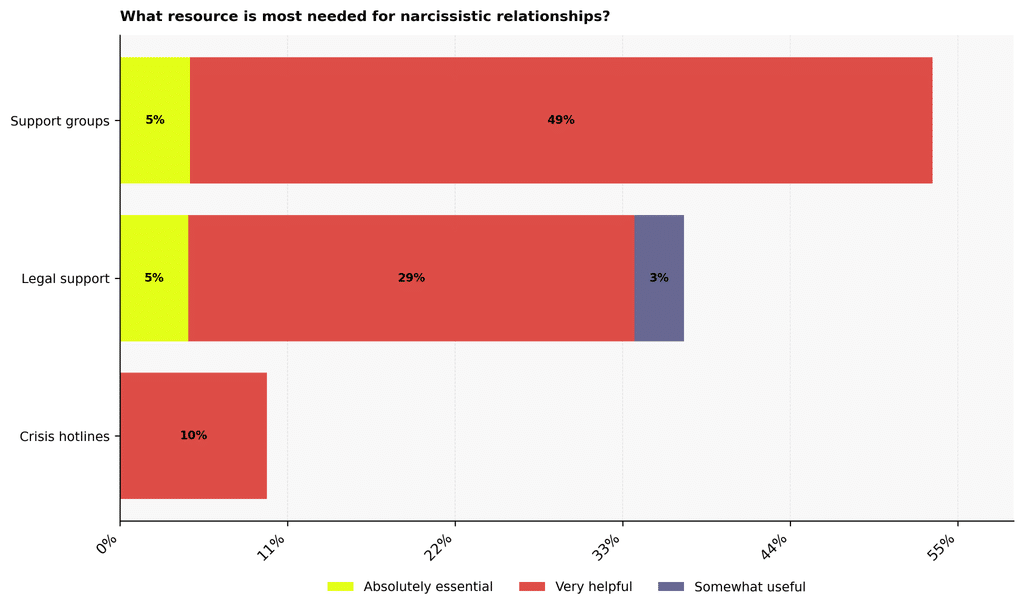
While no one mentioned support groups as a type of therapy that helped them heal after a narcissistic relationship, the reason now may be clear. 5% agree these groups would be an absolutely essential resource for narcissistic relationship survivors, and 49% would find them very helpful. Studies suggest that group sessions not only offer support, but they also help participants develop hope and establish social networks that can make coping easier.
Legal support is an absolutely essential resource for 5%; 29% would find it very helpful, and 3% somewhat useful. This likely ties in with those who need financial or co-parenting support.
Lastly, 10% of people experiencing narcissism would find crisis hotlines very helpful. This would give them someone to talk to anonymously when they need it.
What advice would survivors give others in narcissistic relationships?
50% of people experiencing narcissism would tell others in a narcissistic relationship to absolutely seek professional help early on, and this is seen as a helpful suggestion by 19%; 17% agree that essential advice is to go no contact if possible, and this is a helpful suggestion for 3%; 5% would advise others to learn about narcissism as this is essential advice, and 1% think it’s a helpful suggestion too, while 2% would tell people to absolutely trust their instincts, and this is considered a helpful suggestion by a further 2%
Advice for others is clear:
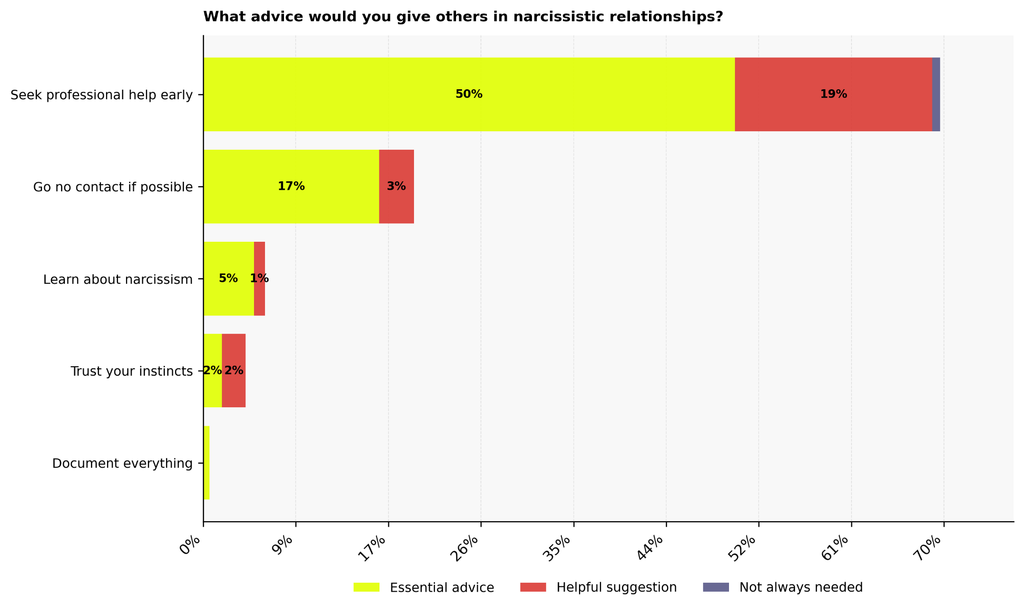
People who have experienced something firsthand are often in an excellent position to give advice, and our audience does exactly that. 50% would advise others in narcissistic relationships to seek professional help early on, as this is essential advice, while a further 19% agree this is a helpful suggestion. By seeking professional help early on, coping with narcissistic behavior and limiting its impact becomes far more manageable.
17% would advise others to go no contact if possible, and 3% agree this would be a helpful position. This removes the narcissist from their lives and reduces the impact they have on the survivor and anyone else who is impacted.
Education is also mentioned here, with 5% saying that they think others in narcissistic relationships should learn about the condition, and this is also considered helpful by 1%. The remaining 4% agree that telling someone in a narcissistic relationship to trust their instinct is essential advice (2%), and a helpful suggestion (2%). In doing so, they remind others not to be gaslit and to maintain their self-esteem.
Fewer than 1% also mention documenting everything, which can be important if the relationship causes self-doubt or poses a safety risk.
Supporting recovery after narcissistic relationships
Overall, our findings show that narcissistic relationships can affect many areas of life, from mental health and self-esteem to family connections, employment and trust. Recognizing these dynamics can take time, particularly when emotional attachment, hope for change, and practical concerns make leaving difficult. While some people experiencing narcissism manage to end these relationships themselves, others need external support or remain in contact with the person involved.
Education emerged as an important part of recovery, alongside professional guidance and firmer personal limits. The findings also emphasize the need for accessible support, greater public understanding, and advice that helps survivors recognize harmful behavior and make informed decisions about their well-being.

