
Vulnerable narcissism often hides behind sensitivity rather than confidence, showing up as self-doubt, withdrawal, and a deep fear of criticism or rejection. Unlike its more outwardly grandiose counterpart, this subtype tends to be quieter, harder to spot, and often mistaken for anxiety or low self-esteem. Dr. Anthony Mazzella frequently describes vulnerable narcissism as a pattern in which the “strong,” competent, self-sufficient self is undermined by feelings of insecurity, shame, passivity, and hypersensitivity to criticism. For anyone recognizing these patterns in themselves or someone they love, understanding vulnerable narcissism is often the first step toward meaningful change.
To find out what 1,063,802 opinions of people experiencing narcissism in the USA were about vulnerable narcissism, we utilized AI-driven audience profiling to synthesize insights from online discussions over 12 months, ending on August 14th, 2026, to a high statistical confidence level. The findings show how these traits surface day to day, what triggers them off, and where the effects tend to show up first.
Index
- Methodology and data
- 22% of people experiencing narcissism almost always notice vulnerable narcissism traits in themselves, 21% notice these traits sometimes, and 20% see them often, but another 20% only see vulnerable narcissistic traits in themselves rarely, and 16% are not sure how often they see them
- 37% of people experiencing narcissism are not very aware of their own vulnerable narcissism patterns, 31% are just becoming aware, 11% are somewhat aware, and 9% are very aware, compared to the 12% who are not aware of their vulnerable narcissism patterns at all
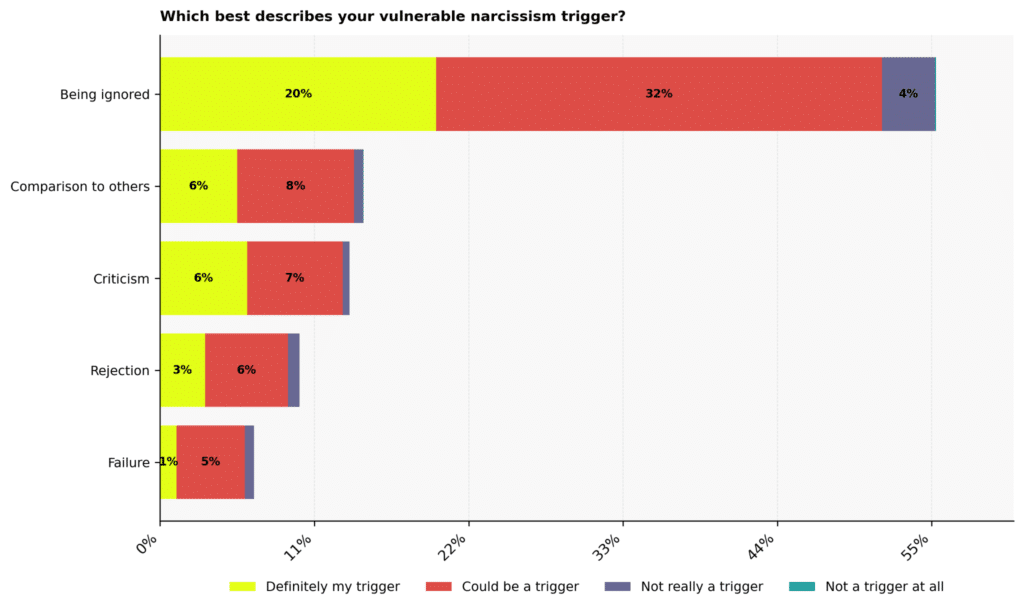
- Being ignored is definitely a vulnerable narcissism trigger for 20% of people experiencing narcissism, it could be a trigger for 32%, and it’s not really a trigger for 4%, while comparison to others definitely triggers 6%, and could trigger 8%, 6% are definitely triggered by criticism, and 7% could be, 3% are triggered by rejection and this could be a trigger for 6%, and failure definitely triggers vulnerable narcissism for 1%, and could do for 5%
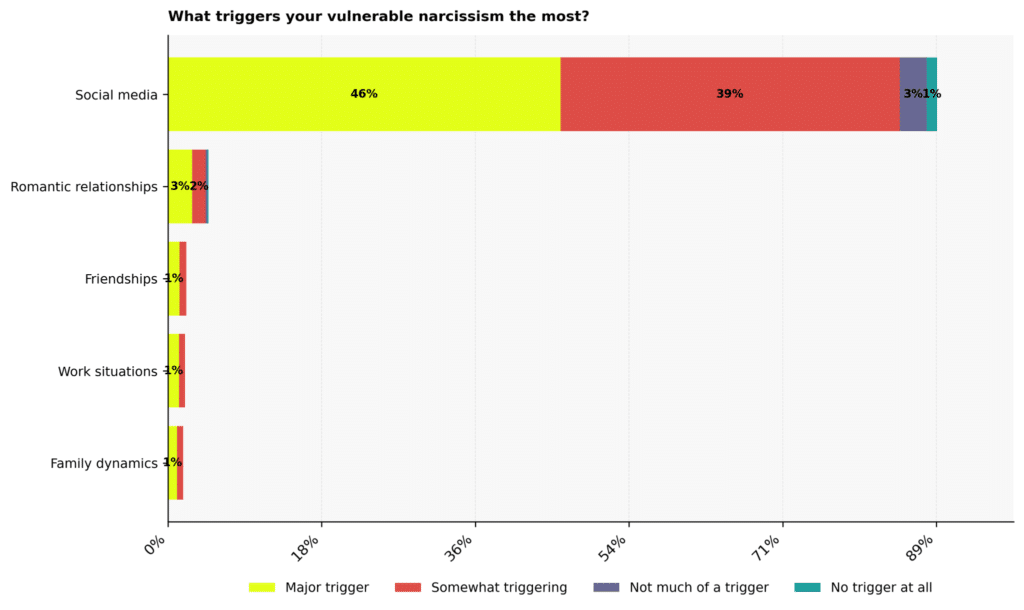
- 46% of people experiencing narcissism find social media a major trigger for vulnerable narcissism, 39% find social media somewhat triggering; however, 3% don’t find it much of a trigger, and it’s not a trigger at all for 1%, while 3% are majorly triggered by romantic relationships, and 2% find these relationships somewhat triggering, friendships, work situations, and family dynamics are a major vulnerable narcissism trigger for just 1% each
- Anger completely dominates 6% of people experiencing vulnerable narcissism episodes, it somewhat dominates 17%, and it’s barely noticeable for 4%, envy completely dominates for 8%, 5% agree it somewhat dominates, and it’s barely noticeable for 4%, anxiety dominates for a further 13%, but it not noticeable for 9%, sadness is prevalent for 6% but not really an emotion for 15%, and only 3%’s emotions are somewhat dominated by emptiness
- 34% of people experiencing narcissism always avoid criticism because of vulnerable narcissism, 16% avoid it often, 16% sometimes, and 18% rarely, while another 18% never avoid criticism due to vulnerable narcissism
- 73% of people experiencing narcissism constantly compare themselves to others, 6% do so often, and 5% sometimes; on the other hand, 10% never compare themselves to others, and 6% do so rarely
- While 24% of people experiencing narcissism never find that envy relates to their vulnerable narcissism, and 17% find that it rarely relates, 24% say that envy sometimes relates to their vulnerable narcissism, 18% find that it relates very often, and 17% say they often feel this emotion in relation
- 60% of people experiencing narcissism occasionally seek reassurance from others, and 9% never do, but 30% seek reassurance constantly
- After a vulnerable narcissism episode, 67% of people experiencing narcissism feel exhausted, 17% feel ashamed, 13% feel angry, and 3% feel numb
- For 37% of people experiencing narcissism, vulnerable narcissism slightly lowers their self-esteem, and 28% find that it lowers their self-esteem significantly, but it barely affects 27% of people, and 8% of those who experience narcissism’s self-esteem is not affected at all
- Vulnerable narcissism has a very significant impact on 12% of people experiencing narcissism’s sleep, and 57% agree it has some impact, yet it has little to no impact for 25%, and 2% find it has no significant impact at all
- 31% of people experiencing narcissism are unsure how vulnerable narcissism has affected their relationships, and it has had no major impact for 26%; however, it has made 15% distant in their relationships, 15% are clingy, and 13% find that vulnerable narcissism has caused frequent conflict
- For 24% of people experiencing narcissism, vulnerable narcissism impacts their work life by reducing productivity; for 23%, it makes them avoid feedback; it causes conflict with co-workers for 20%; and it fuels overachievement for 17%, but 15% don’t really see any impact on their work life
- 71% of people experiencing narcissism usually cope with vulnerable narcissist feelings by avoiding the triggers entirely, 2% withdraw or isolate, and 1% seek reassurance, while 27% don’t have a coping method for avoiding triggers
- 36% of people experiencing narcissism are very confident discussing vulnerable narcissism, 21% are neutral, and 3% are somewhat confident; conversely, 35% are uncomfortable discussing vulnerable narcissism, and 5% are very uncomfortable
- 33% of people experiencing narcissism are very likely to seek help for vulnerable narcissism, 33% are likely to do so, and 31% are unsure, compared to just 2% who are unlikely to seek help for vulnerable narcissism, and 1% who are very unlikely to do so
- Taking the path toward greater self-understanding
Methodology and data
Sourced using Artios from an independent sample of 1,063,802 opinions of people experiencing narcissism in the USA across X, Quora, Reddit, Bluesky, TikTok, and Threads. Responses are collected within a 95% confidence interval and 5% margin of error. Results are derived from what people describe online, from opinions expressed, and not actual questions answered by people in the sample.
How often do people experiencing narcissism notice vulnerable narcissism traits in themselves?
22% of people experiencing narcissism almost always notice vulnerable narcissism traits in themselves, 21% notice these traits sometimes, and 20% see them often, but another 20% only see vulnerable narcissistic traits in themselves rarely, and 16% are not sure how often they see them
Self-reflection shows up consistently:
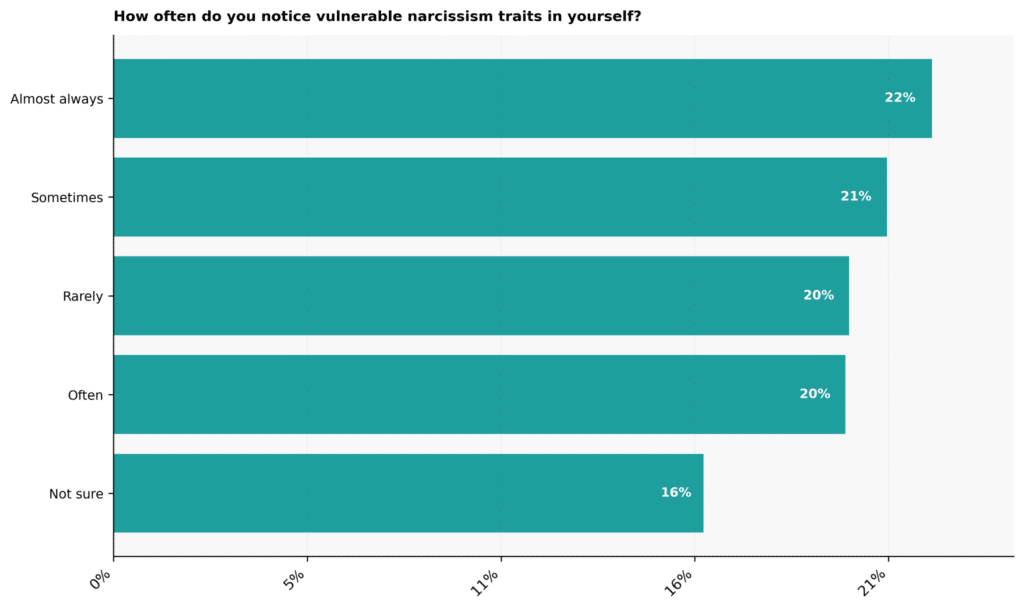
Self-reflection is relatively common among people experiencing vulnerable narcissism, although the frequency varies considerably amongst our audience. 22% of people experiencing vulnerable narcissism in our audience notice the traits that define this condition in themselves almost always, 21% notice these traits in themselves often, and a further 20% see them sometimes. Comparatively, 20% rarely identify these traits in themselves, and a further 16% are unsure.
This variation may indicate the difficulty that some people experience in recognizing their own emotional patterns. Verywell Mind notes that vulnerable narcissism can involve an unclear sense of self and difficulty identifying emotions and needs, which could make self-recognition less consistent. This type of narcissism can also be difficult to recognize because its traits may be hidden beneath insecurity, hypersensitivity, defensiveness, and withdrawal.
How aware are people experiencing narcissism of their own vulnerable narcissism patterns?
37% of people experiencing narcissism are not very aware of their own vulnerable narcissism patterns, 31% are just becoming aware, 11% are somewhat aware, and 9% are very aware, compared to the 12% who are not aware of their vulnerable narcissism patterns at all
Patterns are not always obvious:
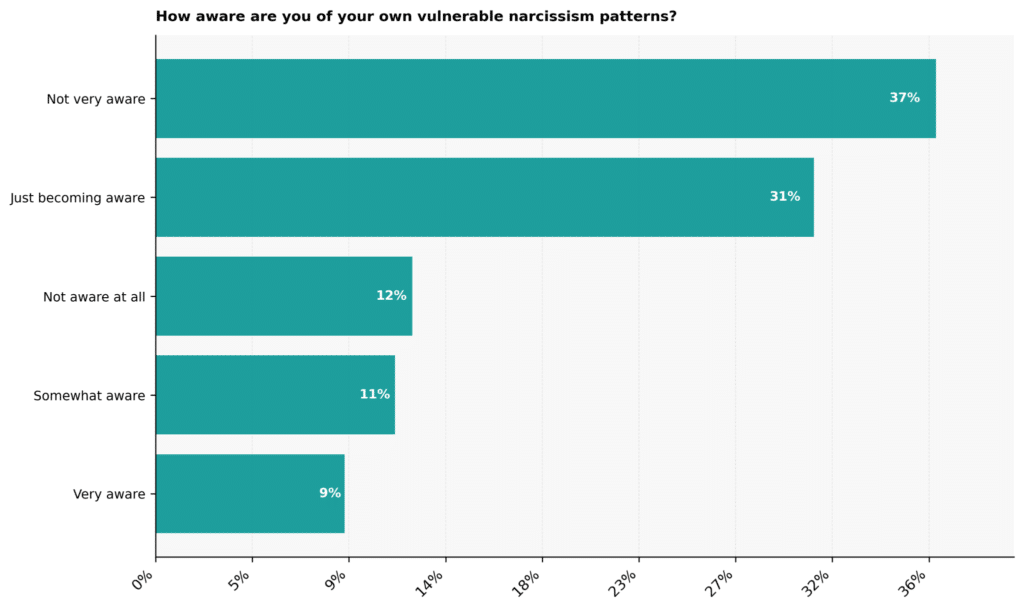
While a large number of people experiencing narcissism notice vulnerable narcissism traits in themselves, awareness of vulnerable narcissism patterns remains limited for much of our audience. 37% describe themselves as not very aware, making this the largest group, while 31% are just becoming aware. Another 12% are not aware at all. By comparison, just 11% feel somewhat aware, and 9% are very aware.
The distribution creates a clear divide between those still developing an understanding of their experiences and those with greater insight. The fact that nearly a third are only just becoming aware suggests that recognizing these patterns may be a relatively new process for many. This may mean they are beginning to identify behaviors, emotional responses, or relationship patterns that they had not previously connected with vulnerable narcissism.
With only 20% describing themselves as very or somewhat aware, most appear to be at an earlier stage of recognizing these patterns. For those who are still developing this understanding, recognizing recurring behaviors or emotional responses can be an important starting point for exploring how vulnerable narcissism may influence relationships, reactions to criticism, and perceptions of rejection.
What is the vulnerable narcissism trigger for people experiencing narcissism?
Being ignored is definitely a vulnerable narcissism trigger for 20% of people experiencing narcissism, it could be a trigger for 32%, and it’s not really a trigger for 4%, while comparison to others definitely triggers 6%, and could trigger 8%, 6% are definitely triggered by criticism, and 7% could be, 3% are triggered by rejection and this could be a trigger for 6%, and failure definitely triggers vulnerable narcissism for 1%, and could do for 5%
Typical triggers evoke a strong response:
Particular situations may activate feelings connected to unresolved pain or past trauma for people experiencing vulnerable narcissism, causing their brains and bodies to respond as though the original threat is happening once more.
Being ignored was the biggest reaction, with 20% and 32% of people experiencing narcissism admitting that this issue was definitely their trigger and that this could be a trigger, respectively. Just 4% believe that being ignored is not really a trigger.
Comparison to others was next on the list, with 6% expressing the clear view that this was definitely their trigger and another 8% saying it could be. Less than 1% did not feel that this was really a trigger. With criticism so closely linked to damaged self-esteem for people experiencing this type of narcissism, it’s interesting that 6% state that this is definitely their trigger and 7% agree that it could be. Once again, fewer than 1% did not feel that this is really their trigger.
3% of our audience cite rejection as definitely a trigger, and 6% view it as something that could be a trigger. Less than 1% don’t see rejection as a trigger. Lastly, 1% said failure was definitely a trigger, 5% said it could be a trigger, and 1% said it’s not really a trigger.
Triggers can be highly specific, with some situations provoking a response while others have little effect. The range of percentages across these categories shows that this form of vulnerability does not center on one universal trigger
What triggers vulnerable narcissism the most for people experiencing it?
46% of people experiencing narcissism find social media a major trigger for vulnerable narcissism, 39% find social media somewhat triggering; however, 3% don’t find it much of a trigger, and it’s not a trigger at all for 1%, while 3% are majorly triggered by romantic relationships, and 2% find these relationships somewhat triggering, friendships, work situations, and family dynamics are a major vulnerable narcissism trigger for just 1% each
Social media tops the trigger list:
In a 2021 study by Fegan and Bland, researchers found that the oversensitivity of people experiencing vulnerable narcissism was significantly associated with all six of the social media measures they examined. This list included time spent on social media, posting frequency, concern about likes and comments, sensitivity to negative remarks, jealousy, and differences between online and real-life self-presentation.
The study provides useful context for the strong connection between vulnerable narcissism and social media in our audience.
46% of people experiencing narcissism identify social media as a major trigger, while 39% describe it as somewhat triggering. At the other end, it’s not much of a trigger for 3%, and it’s no trigger at all for 1%.
Also on the lower side were the 3% who said romantic relationships are a major trigger and 2% who said they’re somewhat triggering, with less than 1% describing them as not much of a trigger. Friendships are a major trigger for 1% and somewhat triggering for less than 1%, while work relationships and family dynamics have identical percentages in the same categories. This puts social media firmly at the top and illustrates how powerful a role it can play in mental and emotional stability.
Which emotion dominates vulnerable narcissism episodes for people experiencing them?
Anger completely dominates 6% of people experiencing narcissism’s vulnerable narcissism episodes, it somewhat dominates 17%, and it’s barely noticeable for 4%, envy completely dominates for 8%, 5% agree it somewhat dominates, and it’s barely noticeable for 4%, anxiety dominates for a further 13%, but it not noticeable for 9%, sadness is prevalent for 6% but not really an emotion for 15%, and only 3%’s emotions are somewhat dominated by emptiness
A myriad of emotions are experienced:
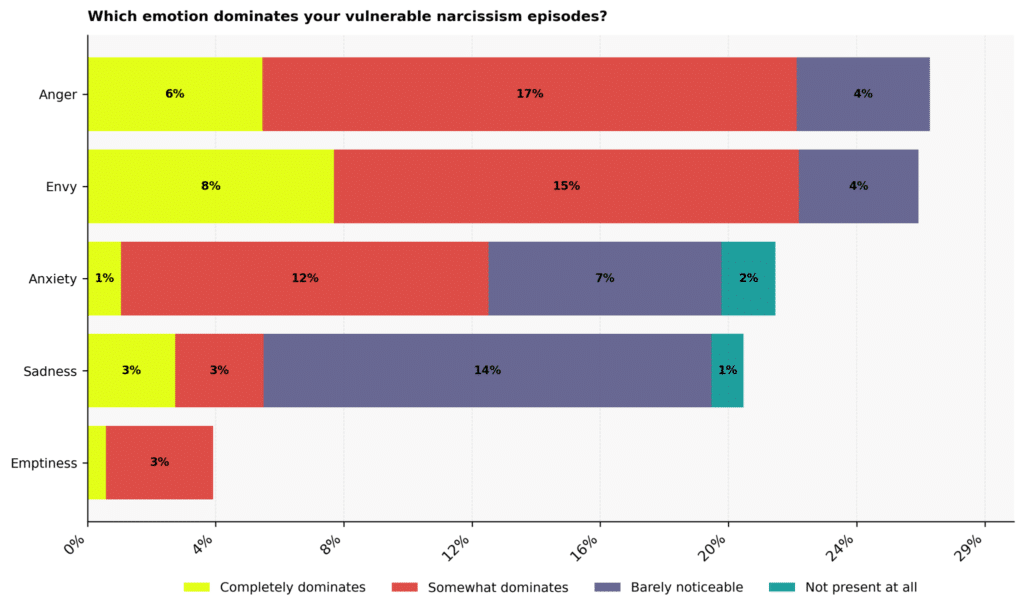
A vulnerable narcissism episode can involve an intense emotional reaction to perceived rejection, criticism, or slight, often accompanied by defensiveness, distress, self-pity, or hostility. These reactions can vary in intensity and emotional character, with anger and envy emerging as the most prominent emotions.
For 6% of people experiencing narcissism, anger completely dominates, and another 17% agree that it somewhat does, yet 4% say that it’s barely noticeable. Envy is up next, with 8% revealing that this emotion completely dominates, 15% indicating that it somewhat dominates, and another 4% confirming that it’s barely noticeable.
Anxiety completely dominates the experience of a vulnerable narcissism episode for 1% and somewhat dominates for 12%. It’s barely noticeable or not present at all for 7% and 2%, respectively. Sadness completely dominates for 3%, somewhat dominates for another 3%, but is barely noticeable for 14%. 1% state that it’s not present at all.
A feeling of emptiness completely dominates for less than 1% but somewhat dominates for 3%.
It seems that outward hostility overrides internal grief for most people experiencing vulnerable narcissism. Aggressive, externalized feelings like anger and envy strongly outrank internalized, sorrowful states like sadness and emptiness during episodes.
How often do people experiencing narcissism avoid criticism because of vulnerable narcissism?
34% of people experiencing narcissism always avoid criticism because of vulnerable narcissism, 16% avoid it often, 16% sometimes, and 18% rarely, while another 18% never avoid criticism due to vulnerable narcissism
Criticism is best kept at bay:
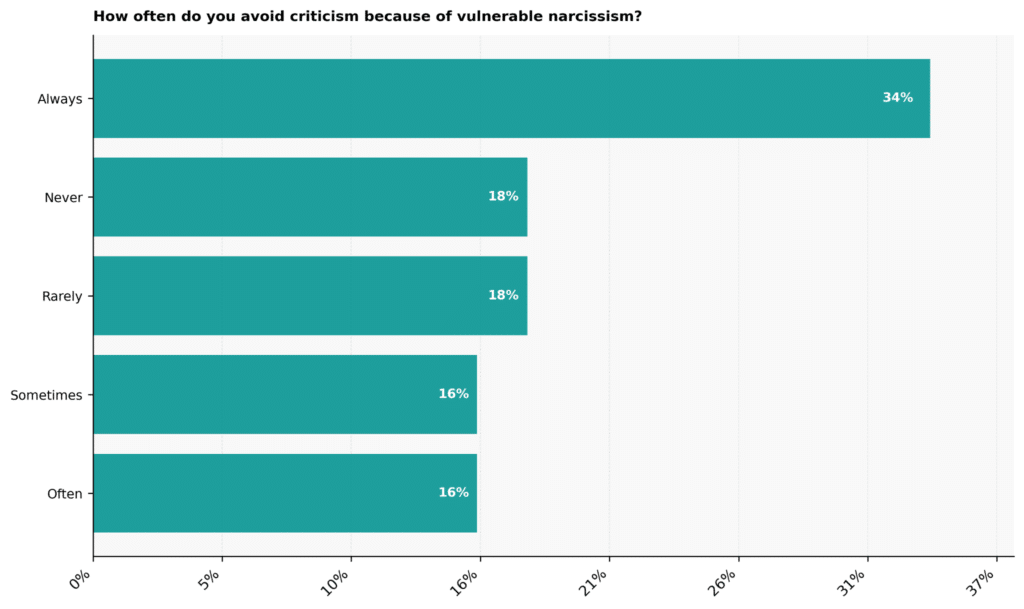
Criticism appears to be something that many people experiencing vulnerable narcissism try to avoid, with 34% saying they always do so. A further 16% avoid it often, while the same proportion do so sometimes. At the other end, 18% rarely avoid criticism, and another 18% never do.
This pattern aligns with research by Poless and colleagues, which found a positive association between vulnerable narcissism and shame withdrawal. The researchers describe shame withdrawal as retreating or concealing behavior when a transgression becomes publicly exposed. They say that this relationship may link vulnerable narcissism’s sensitivity to criticism and other people’s evaluations, alongside lower self-esteem.
This may help explain why criticism can become something people experiencing vulnerable narcissism seek to avoid, particularly when it threatens how they see themselves.
How often do people experiencing narcissism compare themselves to others?
73% of people experiencing narcissism constantly compare themselves to others, 6% do so often, and 5% sometimes; on the other hand, 10% never compare themselves to others, and 6% do so rarely
Constant comparison is commonplace:
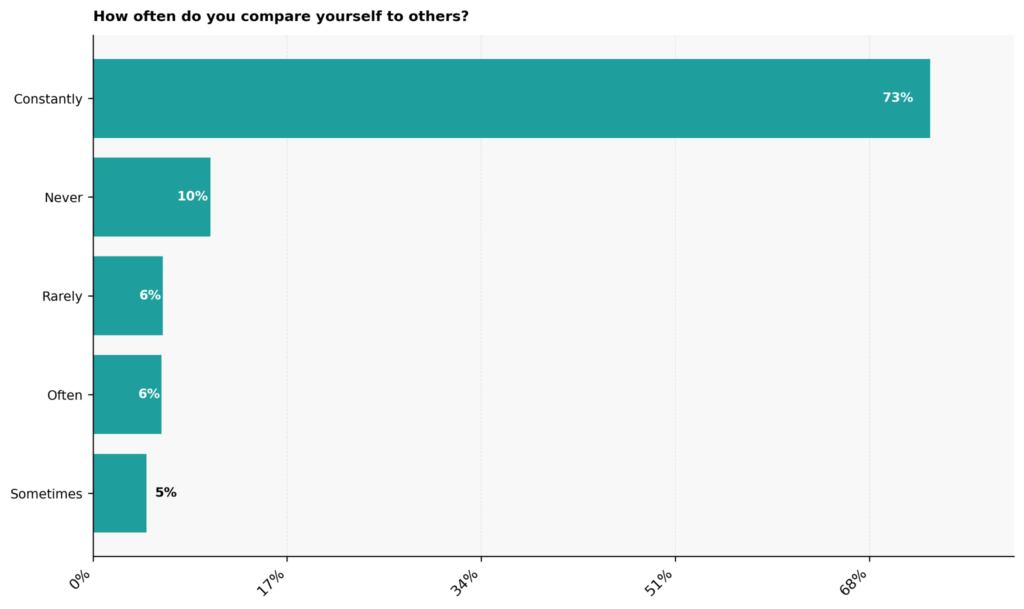
For people with vulnerable narcissistic traits, others can become an important reference point for judging their own worth and success. Social comparison can play a significant role in how they see themselves.
The majority (73%) of our audience constantly compare themselves with others, while a further 6% do so often. Combined, this makes for 79% that compare themselves with others frequently. In contrast, just 5% do so sometimes, 6% rarely, and 10% never.
A 2021 NYU article explains that social comparison is a way of judging our own abilities, achievements, and position by looking at other people. For people experiencing vulnerable narcissism, the high rate of frequent comparison may therefore show a greater reliance on other people as reference points for assessing their own worth and success.
How often does envy relate to vulnerable narcissism for people experiencing it?
Dr. Anthony Mazzella, who has written extensively about narcissism and envy, links envy to unresolved feelings of inferiority. Narcissistic individuals may carry a profound sense of inadequacy, often stemming from early life experiences where they felt overshadowed by others or were constantly compared to an idealized other.
While 24% of people experiencing narcissism never find that envy relates to their vulnerable narcissism, and 17% find that it rarely relates, 24% say that envy sometimes relates to their vulnerable narcissism, 18% find that it relates very often, and 17% say they often feel this emotion in relationships.
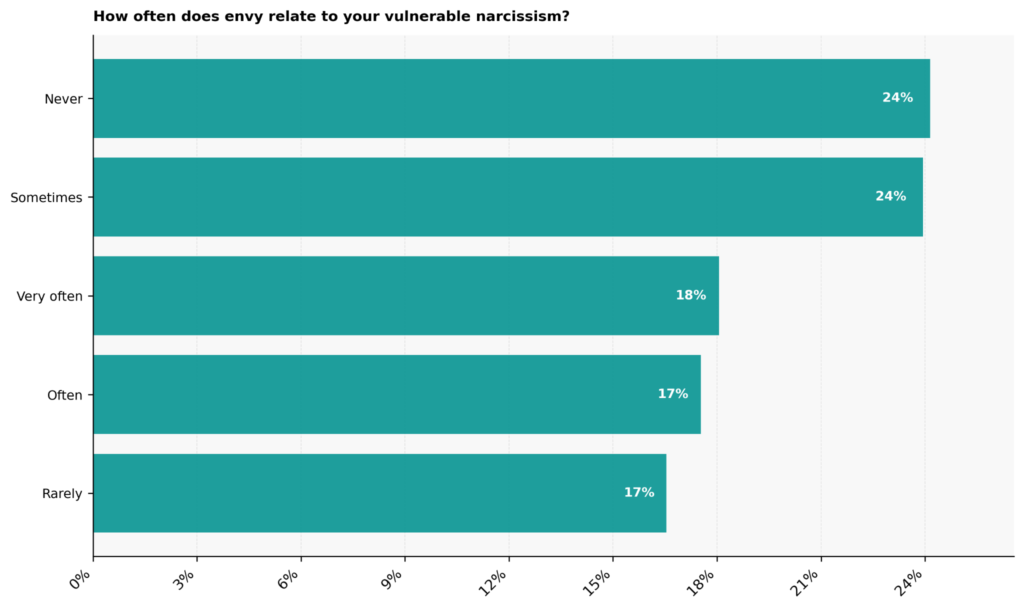
Frequent comparison can also contribute to feelings of envy among people with vulnerable narcissistic traits. When self-esteem is fragile, seeing someone else receive recognition, achieve success, or appear more accomplished can intensify feelings of inadequacy. This may lead to resentment towards people perceived as having advantages, recognition, or success that those experiencing vulnerable narcissism feel they deserve.
Among our audience, 18% agree that envy is very often related to their narcissism, while a further 17% concur that such behavior happens often. At the other end of the scale, 24% feel that envy is never or only sometimes related to their narcissism, while another 17% experience this connection rarely.
This reveals that envy can be a prominent emotional response for a substantial proportion of people experiencing vulnerable narcissism, particularly when another person’s achievements highlight feelings of inadequacy or unmet expectations.
How often do people experiencing narcissism seek reassurance from others?
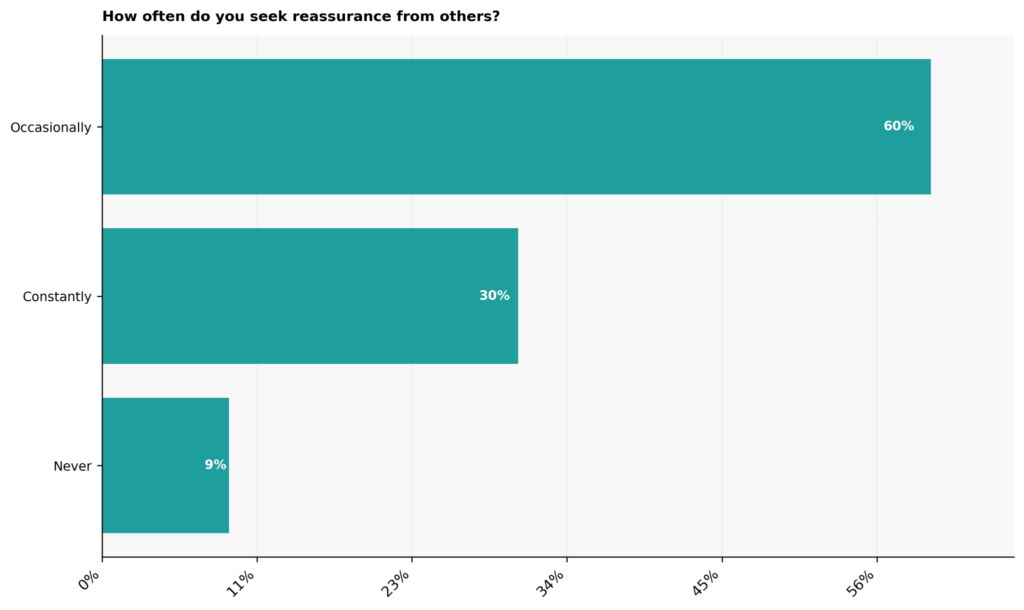
60% of people experiencing narcissism occasionally seek reassurance from others, and 9% never do, but 30% seek reassurance constantly
Reassurance is required but not essential for all:
The insecurity associated with vulnerable narcissism can also extend into a need for reassurance from other people. Seeking comfort, guidance, or validation is a common response to uncertainty, difficult decisions, unfamiliar situations, and self-doubt, but this need may be more pronounced among people experiencing narcissism.
For people experiencing narcissism, 30% constantly seek reassurance from those around them, while a further 60% do so occasionally. Only 9% never do so, making reassurance seeking a common thread.
This difference in frequency provides a useful basis for distinguishing ordinary reassurance from compulsive validation seeking. ReachLink links compulsive validation seeking with frequency, intensity, and dependency. Frequent reassurance seeking involves repeated requests for confirmation rather than occasional support during uncertain moments, while greater intensity involves significant anxiety when approval is absent.
Dependency goes further, with external confirmation becoming too closely tied to self-worth and emotional stability. In this pattern, reassurance may provide temporary relief for someone experiencing vulnerable narcissism, but the need for further validation can return once that relief fades.
How do people experiencing narcissism feel after a vulnerable narcissism episode?
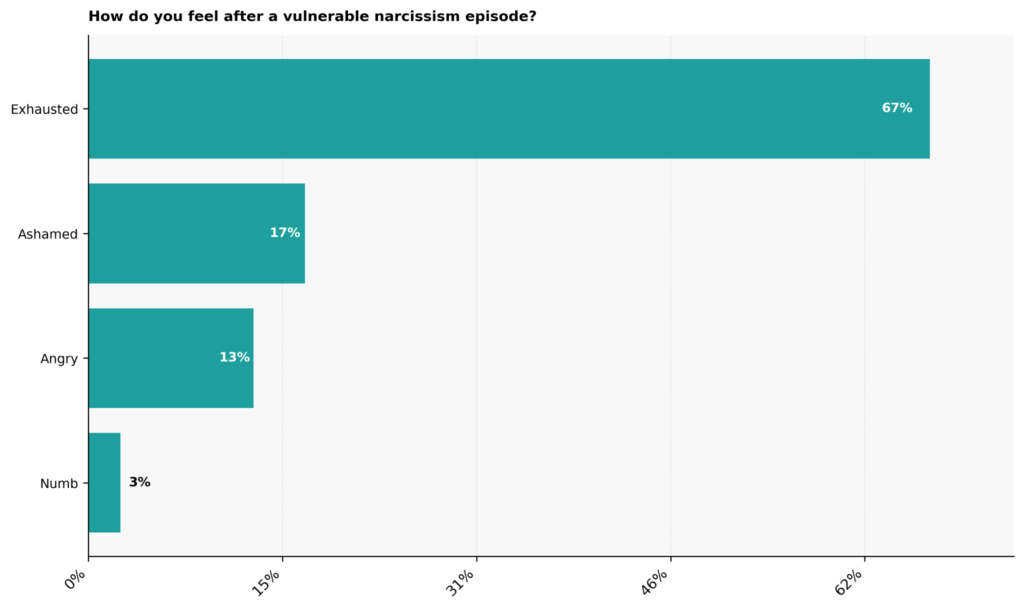
After a vulnerable narcissism episode, 67% of people experiencing narcissism feel exhausted, 17% feel ashamed, 13% feel angry, and 3% feel numb
Episodes can take their toll:
Psych Central links narcissistic behavior to fragile self-esteem, with some narcissists attempting to maintain superiority by making the people around them feel inferior. The tactics used to do so include gaslighting, blame, projection, attacks, entitlement, taking credit, and victimhood. The article presents these behaviors as ways that narcissists protect an insecure sense of self.
These defensive responses can carry an emotional cost, especially when the underlying insecurity remains unresolved, and that strain is seen in our audience. 67% are exhausted after a vulnerable narcissism episode, and another 17% feel ashamed. 13% are angry, and 3% are numb. These percentages point to a predominantly inward emotional response following an episode.
This pattern fits with Psych Central’s discussion of fragile self-esteem, where defensive behavior serves to protect an insecure sense of self. The aftermath reported by people experiencing narcissism tells us that the effects of an episode can persist internally, with difficult emotions remaining after the defensive response has passed.
How does vulnerable narcissism affect the self-esteem of people experiencing it?
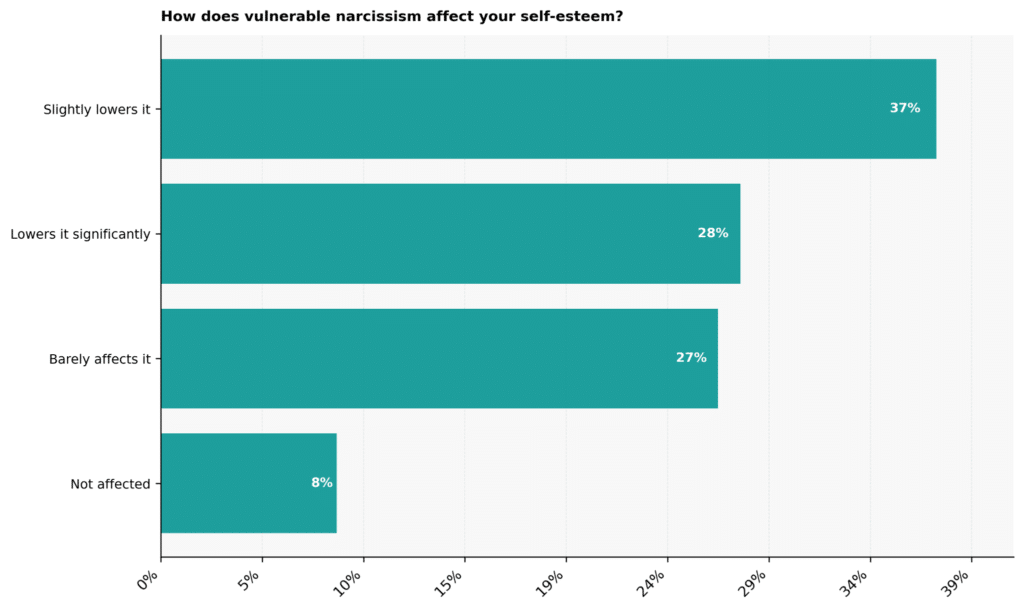
For 37% of people experiencing narcissism, vulnerable narcissism slightly lowers their self-esteem, and 28% find that it lowers their self-esteem significantly, but it barely affects 27% of people, and 8% of those who experience narcissism’s self-esteem is not affected at all
Poor self-esteem is interlinked:
Vulnerable narcissism is associated with fragile, unstable self-esteem. In contrast to their grandiose counterparts, vulnerable narcissists mask their intense feelings of inadequacy, shame, and low self-worth behind anxiety, a chronic sense of victimhood, and self-doubt.
For our audience, these traits are clearly evident, as only 8%’s self-esteem is not affected by their condition, while another 27% are barely affected. On the other hand, 37% agree that it slightly lowers their self-esteem, and 28% find that it lowers their self-esteem significantly.
Healthline’s discussion shows the other side of these relationships, where narcissistic manipulation can undermine the confidence and self-esteem of the person they’re interacting with. Alongside our audience data, a striking contrast becomes evident. While the vulnerable narcissist may already be struggling with an unstable sense of self-worth, their behavior can in turn leave those around them questioning their own worth and judgment.
Does vulnerable narcissism affect your sleep or mood?
Vulnerable narcissism has a very significant impact on 12% of people experiencing narcissism’s sleep, and 57% agree it has some impact, yet it has little to no impact for 25%, and 2% find it has no significant impact at all
Sleep impact is a potential side effect of narcissism:
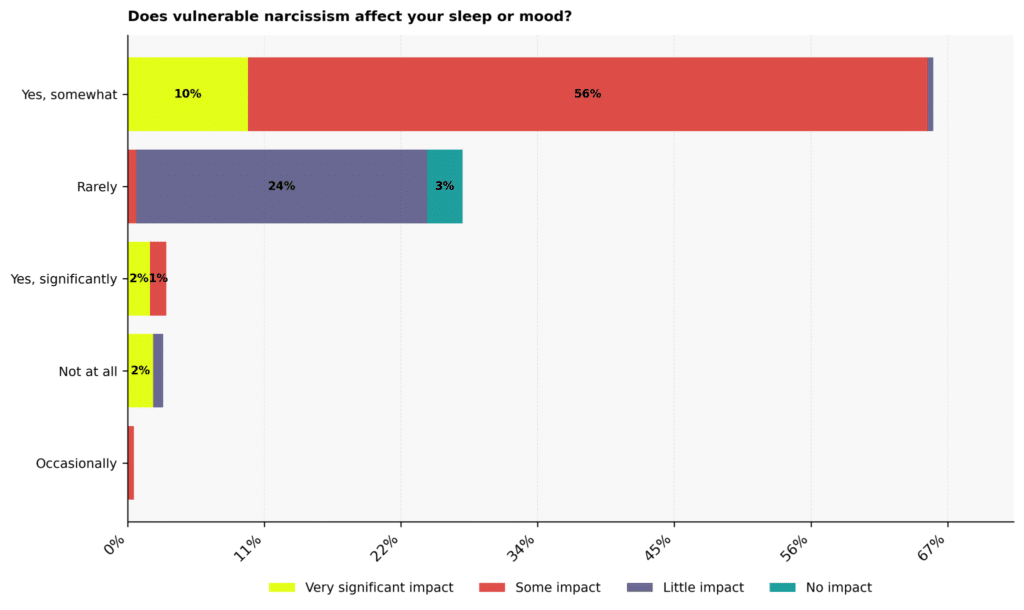
There’s a close relationship between sleep and mood, and according to the Centers for Disease Control and Prevention, more than one in three adults don’t get enough shut-eye. While many factors can impact sleep, vulnerable narcissism is certainly one of them. For people experiencing narcissism, 10% find that it has a very significant impact on their sleep, and 55% agree that it has some impact. For a further 2%, this condition has significantly affected their sleep, and 1% have seen some impact in this regard.
For those less impacted, 24%’s sleep is rarely affected, and 3% say vulnerable narcissism has no impact on their sleep, while fewer than 1% discussed an occasional impact.
Based on these numbers, sleep may be an important area for some to consider when looking at the wider effects of vulnerable narcissism and the factors that may support better emotional well-being.
How has vulnerable narcissism affected the relationships of people experiencing it?
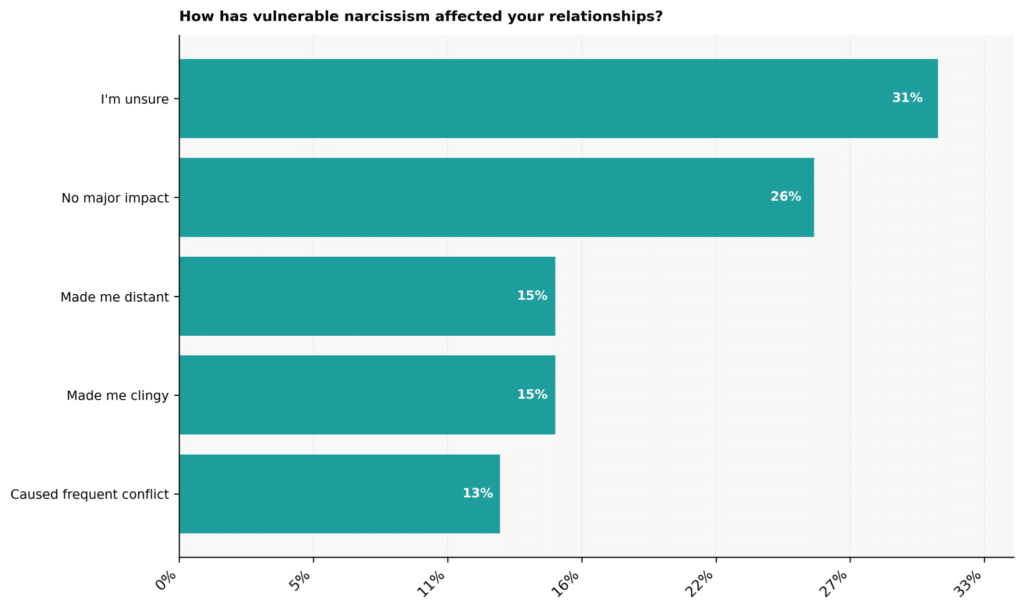
31% of people experiencing narcissism are unsure how vulnerable narcissism has affected their relationships, and it has had no major impact for 26%; however, it has made 15% distant in their relationships, 15% are clingy, and 13% find that vulnerable narcissism has caused frequent conflict
Relationships don’t always suffer:
The effects of vulnerable narcissism can extend beyond sleep and mood into romantic relationships, where the difficulties associated with it may also affect relationship satisfaction.
Research has found that vulnerable narcissism is linked with lower relationship satisfaction, with people experiencing it having more difficulty accepting differences between themselves and their partners and using positive conflict resolution strategies less often.
Although 31% of our audience is unsure about how their vulnerable narcissism has affected their relationships and 26% feel that it has had no major impact, 43% have seen a negative effect. Additionally, it made 15% distant, another 15% say it made them clingy, and 13% indicate it has caused frequent conflict. The split between distancing and clinginess emphasizes how vulnerable narcissism can pull relationships in opposite directions, with some people creating more space while others seek greater proximity and reassurance.
How does vulnerable narcissism impact the work life of people experiencing it?
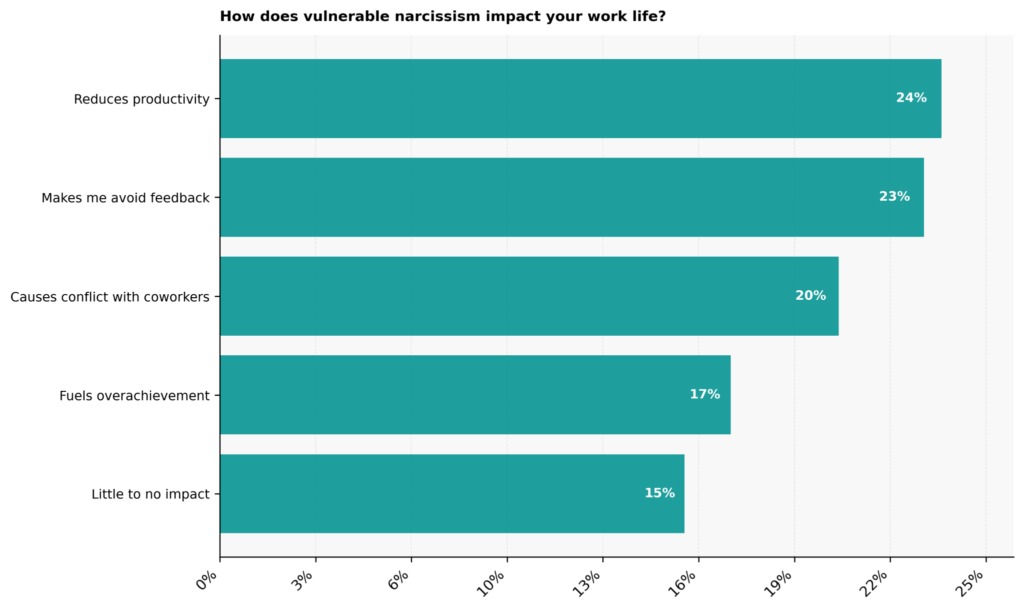
For 24% of people experiencing narcissism, vulnerable narcissism impacts their work life by reducing productivity; for 23%, it makes them avoid feedback; it causes conflict with co-workers for 20%; and it fuels overachievement for 17%, but 15% don’t really see any impact on their work life
The impact on work can be far-reaching:
For someone experiencing vulnerable narcissism, the workplace can feel threatening, with criticism, lack of recognition, or the possibility of humiliation intensifying their existing insecurity. Such factors can affect how the vulnerable narcissist responds to feedback, their overall productivity, and their relationships with their coworkers.
For 24% of people experiencing narcissism, vulnerable narcissism reduces productivity in the workplace. For 23%, avoiding feedback has a major impact in their work life, and this, in turn, can also impact productivity. 20% find that this condition causes conflict with coworkers, which is upsetting for everyone involved and can create an unpleasant workplace environment if not addressed in a sensitive manner.
For 17%, it fuels overachievement, which may seem positive but can quickly lead to burnout. Only 15% of people experiencing narcissism feel little to no impact from their condition on their work life.
Contrastingly, SHRM’s discussion focuses on the consequences narcissistic behavior can have for other people at work, including reduced collaboration, difficulty accepting feedback, and damage to team performance.
When combined, the two perspectives show how narcissism can affect both sides of workplace relationships. People experiencing vulnerable narcissism may struggle with their own productivity, feedback, and interactions, and their behavior can create other difficulties for the colleagues working alongside them.
How do people experiencing narcissism usually cope with vulnerable narcissism feelings?
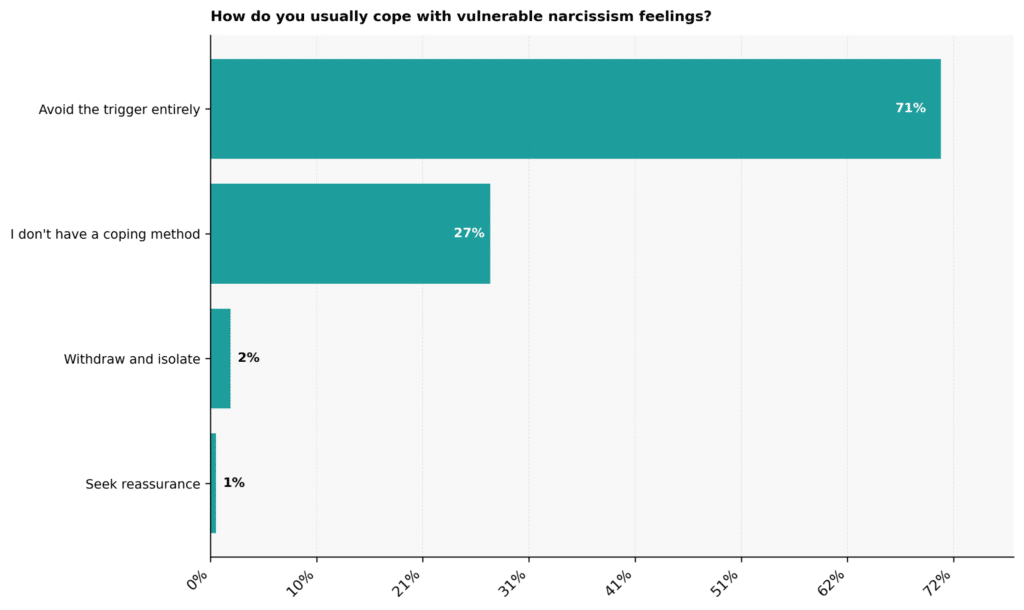
71% of people experiencing narcissism usually cope with vulnerable narcissistic feelings by avoiding the triggers entirely, 2% withdraw or isolate, and 1% seek reassurance, while 27% don’t have a coping method for avoiding triggers
Coping mechanisms focus on avoidance:
Vulnerable narcissism can involve intense feelings of insecurity, shame, and sensitivity to criticism, which may make situations that trigger these feelings difficult to manage. When these emotions become uncomfortable, people may respond by trying to remove themselves from the situation rather than confronting the underlying feelings.
We see this in the 71% of our audience who avoid the trigger entirely, making avoidance by far the most common response. A further 27% do not have a coping method, suggesting that many people may struggle to identify a constructive way of responding when these emotions arise. Only 2% withdraw and isolate, while just 1% seek reassurance from others.
The small proportion seeking reassurance contrasts sharply with the much larger reliance on avoidance. This suggests that most people in the audience don’t turn to others for support when confronted with a trigger, instead choosing to remove themselves from the situation or reporting that they have no established coping strategy. These findings also point to a potential gap between recognizing an emotional trigger and knowing how to respond to it in a way that feels manageable.
How confident are people experiencing narcissism discussing vulnerable narcissism?
36% of people experiencing narcissism are very confident discussing vulnerable narcissism, 21% are neutral, and 3% are somewhat confident; conversely, 35% are uncomfortable discussing vulnerable narcissism, and 5% are very uncomfortable
Talking it over isn’t uncommon:
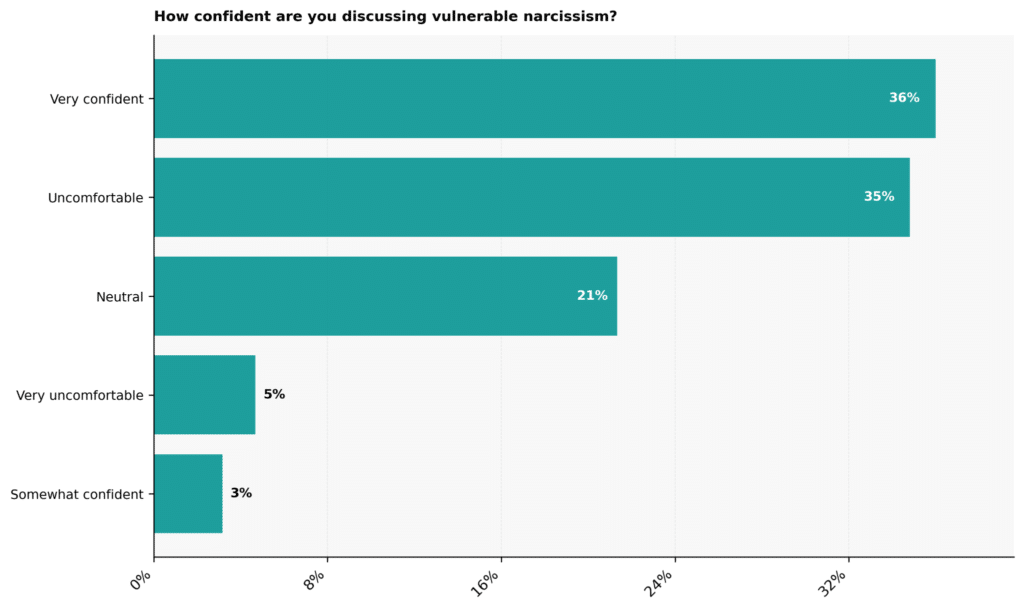
Talking about vulnerable narcissism can involve discussing insecurity, shame, criticism, relationships, and behaviors that people may find difficult to acknowledge. Yet, 36% of people experiencing narcissism are very confident in discussing the condition, and another 3% are somewhat confident about talking about it. However, 21% are neutral about engaging in discussion, indicating that while they don’t have strong feelings either way, they certainly don’t invite discussion.
But almost as many of those who are very confident in discussing vulnerable narcissism are uncomfortable in doing so (35%), and 5% are very uncomfortable. This near-even split illustrates how divided people can be when it comes to discussing vulnerable narcissism, with some feeling able to speak openly while an almost equal proportion may find the subject difficult or uncomfortable.
How likely are people experiencing narcissism to seek help for vulnerable narcissism?
33% of people experiencing narcissism are very likely to seek help for vulnerable narcissism, 33% are likely to do so, and 31% are unsure, compared to just 2% who are unlikely to seek help for vulnerable narcissism, and 1% who are very unlikely to do so
Seeking help is largely likely:
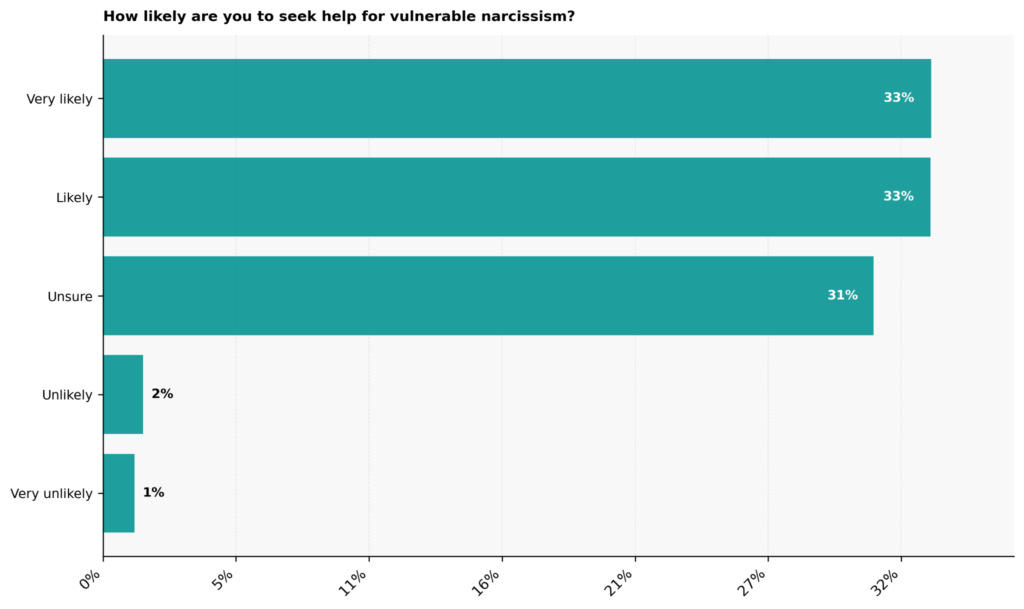
Contrary to the popular belief that narcissism naturally prevents help-seeking behaviors, people experiencing the vulnerable subtype in our audience demonstrate a surprisingly high willingness to pursue support when experiencing distress.
33% are very likely to seek help for their vulnerable narcissism, and another 33% are likely to do so. 31% are unsure, but this does not mean they will not seek help at some stage, just that currently, they’re not planning to do so. Just 3% say it is unlikely or very unlikely that they’ll seek help for vulnerable narcissism, with these percentages at 2% and 1%, respectively.
This strong willingness to seek support is encouraging, showing that vulnerable narcissism does not necessarily prevent people from recognizing when they are struggling or considering help.
Taking the path toward greater self-understanding
Across this data, we see a common thread. It’s obvious that vulnerable narcissism rarely stays contained, and it often touches everything from relationships to work, mood, and sleep. Comparison and sensitivity to criticism tend to trigger the hardest moments, and avoidance is often the first response.
Yet alongside this struggle sits real openness. Many people show genuine willingness to reflect, talk about what they’re experiencing, and seek support when it’s needed.
Dr. Anthony Mazzella is a psychoanalyst and psychodynamic psychotherapist specializing in narcissism, personality disorders, and relational dynamics.
Continue The Journey
If you or your loved one is in need of support, contact us today and take the first step toward understanding, growth, and emotional balance.
For further insights and support, explore:
The Narcissism Decoder Podcast: get a deeper understanding through expert discussions and real-life stories.
These resources can provide additional guidance as you navigate your journey toward healing and personal growth.

